第28章無脊椎動物
Water Vascular and Hemal Systems水管系と血管系
Echinoderms have a unique ambulacral (water vascular) system, derived from part of the coelom, or “body cavity.” The water vascular system consists of a central ring canal and radial canals that extend along each arm. Each radial canal is connected to a double row of tube feet, which project through holes in the endoskeleton, and function as tactile and ambulatory structures. These tube feet can extend or retract based on the volume of water present in the system of that arm, allowing the animal to move and also allowing it to capture prey with their suckerlike action. Individual tube feet are controlled by bulblike ampullae. Seawater enters the system through an aboral madreporite (opposite the oral area where the mouth is located) and passes to the ring canal through a short stone canal. Water circulating through these structures facilitates gaseous exchange and provides a hydrostatic source for locomotion and prey manipulation. A hemal system, consisting of oral, gastric, and aboral rings, as well as other vessels running roughly parallel to the water vascular system, circulates nutrients. Transport of nutrients and gases is shared by the water vascular and hemal systems in addition to the visceral body cavity that surrounds the major organs.
英語のヒント
棘皮動物は、体腔の一部に由来する独特な歩帯系、すなわち水管系をもつ。水管系は中央の環状管と、各腕に沿って伸びる放射管からなる。各放射管は2列の管足につながり、管足は内骨格の孔から突き出して、触覚と歩行の構造として働く。管足は、その腕の水管系にある水の量に応じて伸縮し、移動を可能にするとともに、吸盤のような働きで獲物の捕獲も可能にする。個々の管足は球状の瓶嚢によって制御される。海水は、口がある口側と反対の反口側にある多孔板から入り、短い石管を通って環状管へ進む。これらの構造を循環する水は、ガス交換を助け、移動や獲物の操作のための静水圧源となる。口側環、胃環、反口側環と、水管系にほぼ平行に走るほかの血管からなる血管系は、栄養を循環させる。栄養とガスの運搬は、水管系と血管系、さらに主要な器官を囲む内臓体腔が分担する。
Nervous System神経系
The nervous system in these animals is a relatively simple, comprising a circumoral nerve ring at the center and five radial nerves extending outward along the arms. In addition, several networks of nerves are located in different parts of the body. However, structures analogous to a brain or large ganglia are not present in these animals. Depending on the group, echinoderms may have well-developed sensory organs for touch and chemoreception (e.g., within the tube feet and on tentacles at the tips of the arms), as well as photoreceptors and statocysts.
英語のヒント
棘皮動物の神経系は比較的単純で、中央の口を囲む神経環と、腕に沿って外へ伸びる5本の放射神経からなる。さらに、体のさまざまな部分に複数の神経網がある。しかし、脳や大きな神経節に相当する構造はない。群によっては、管足の中や腕の先端の触手などに、触覚や化学受容のための発達した感覚器官があり、光受容器や平衡胞もある。
Digestive and Excretory Systems消化系と排泄系
A mouth, located on the oral (ventral) side, opens through a short esophagus to a large, baglike stomach. The so-called “cardiac” stomach can be everted through the mouth during feeding (for example, when a starfish everts its stomach into a bivalve prey item to digest the animal—alive—within its own shell!) There are masses of digestive glands (pyloric caeca) in each arm, running dorsally along the arms and overlying the reproductive glands below them. After passing through the pyloric caeca in each arm, the digested food is channeled to a small anus, if one exists.
英語のヒント
口側(腹側)の口は、短い食道を通って、大きな袋状の胃に開く。いわゆる「噴門胃」は、摂食時に口から反転して出すことができる。例えばヒトデは、二枚貝の獲物の中へ胃を反転させて入れ、その貝を生きたまま、貝自身の殻の中で消化する。各腕には消化腺の塊(幽門盲嚢)があり、腕の背側に沿って走り、その下の生殖腺を覆う。消化された食物は、各腕の幽門盲嚢を通った後、小さな肛門がある場合にはそこへ送られる。
Podocytes—cells specialized for ultrafiltration of bodily fluids—are present near the center of the echinoderm disc, at the junction of the water vascular and hemal systems. These podocytes are connected by an internal system of canals to the madreporite, where water enters the stone canal. The adult echinoderm typically has a spacious and fluid-filled coelom. Cilia aid in circulating the fluid within the body cavity, and lead to the fluid-filled papulae, where the exchange of oxygen and carbon dioxide takes place, as well as the secretion of nitrogenous waste such as ammonia, by diffusion.
英語のヒント
体液の限外ろ過に特殊化した細胞である足細胞は、棘皮動物の体盤の中心付近、水管系と血管系の接合部にある。足細胞は内部の管系で多孔板につながり、多孔板から水が石管へ入る。成体の棘皮動物は通常、液体で満たされた広い体腔をもつ。繊毛は体腔内の液体の循環を助け、液体に満たされた皮鰓へ導く。皮鰓では拡散により、酸素と二酸化炭素の交換や、アンモニアなどの窒素性老廃物の分泌が起こる。
Reproduction生殖
Echinoderms are dioecious, but males and females are indistinguishable apart from their gametes. Males and females release their gametes into water at the same time and fertilization is external. The early larval stages of all echinoderms (e.g., the bipinnaria of asteroid echinoderms such as sea stars) have bilateral symmetry, although each class of echinoderms has its own larval form. The radially symmetrical adult forms from a cluster of cells in the larva. Sea stars, brittle stars, and sea cucumbers may also reproduce asexually by fragmentation, as well as regenerate body parts lost in trauma, even when over 75 percent of their body mass is lost!
英語のヒント
棘皮動物は雌雄異体だが、配偶子以外では雄と雌を見分けられない。雄と雌は同時に水中へ配偶子を放出し、体外受精する。すべての棘皮動物の初期幼生は左右相称である。例として、ヒトデなどのヒトデ綱のビピンナリア幼生があるが、各綱はそれぞれ独自の幼生型をもつ。放射相称の成体は、幼生内の細胞の集まりから形成される。ヒトデ、クモヒトデ、ナマコは、分裂による無性生殖も可能で、外傷で失った体の部分を再生することもできる。体重の75%以上が失われた場合でさえ、再生することがある。
Classes of Echinoderms棘皮動物の各綱
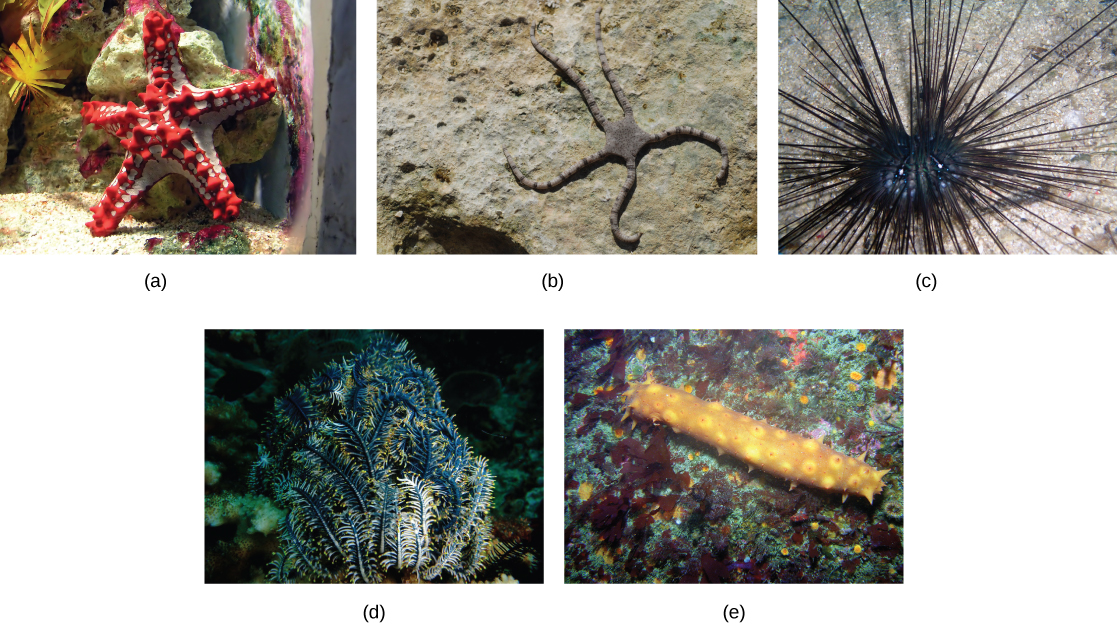
This phylum is divided into five extant classes: Asteroidea (sea stars), Ophiuroidea (brittle stars), Echinoidea (sea urchins and sand dollars), Crinoidea (sea lilies or feather stars), and Holothuroidea (sea cucumbers) (Figure 28.48).
この門は、ヒトデ綱(ヒトデ)、クモヒトデ綱(クモヒトデ)、ウニ綱(ウニとタコノマクラ類)、ウミユリ綱(ウミユリやウミシダ)、ナマコ綱(ナマコ)という五つの現生の綱に分かれる(図28.48)。
The most well-known echinoderms are members of class Asteroidea, or sea stars. They come in a large variety of shapes, colors, and sizes, with more than 1,800 species known so far. The key characteristic of sea stars that distinguishes them from other echinoderm classes includes thick arms that extend from a central disk from which various body organs branch into the arms. At the end of each arm are simple eye spots and tentacles that serve as touch receptors. Sea stars use their rows of tube feet not only for gripping surfaces but also for grasping prey. Most sea stars are carnivores and their major prey are in the phylum Mollusca. By manipulating its tube feet, a sea star can open molluscan shells. Sea stars have two stomachs, one of which can protrude through their mouths and secrete digestive juices into or onto prey, even before ingestion. A sea star eating a clam can partially open the shell, and then evert its stomach into the shell, introducing digestive enzymes into the interior of the mollusk. This process can both weaken the strong adductor (closing) muscles of a bivalve and begin the process of digestion.
英語のヒント
最もよく知られた棘皮動物は、ヒトデ綱に属するヒトデである。形、色、大きさは多様で、これまでに1,800種以上が知られている。ほかの綱と区別する重要な特徴は、中央の体盤から伸びる太い腕であり、体盤からさまざまな器官が腕へ枝分かれする。各腕の先端には、単純な眼点と、触覚受容器として働く触手がある。ヒトデは列をなす管足を、表面につかまるためだけでなく、獲物をつかむためにも使う。多くは肉食性で、主要な獲物は軟体動物である。管足を操作して、軟体動物の殻を開けることができる。ヒトデには二つの胃があり、その一つは口から突き出し、取り込む前の獲物の内部や表面に消化液を分泌できる。二枚貝を食べるヒトデは、殻を少し開けて胃を反転させて入れ、貝の内部に消化酵素を送り込む。この過程は、二枚貝の強い閉殻筋を弱らせるとともに、消化を開始させる。
Brittle stars belong to the class Ophiuroidea ("snake-tails"). Unlike sea stars, which have plump arms, brittle stars have long, thin, flexible arms that are sharply demarcated from the central disk. Brittle stars move by lashing out their arms or wrapping them around objects and pulling themselves forward. Their arms are also used for grasping prey. The water vascular system in ophiuroids is not used for locomotion.
英語のヒント
クモヒトデはクモヒトデ綱(「ヘビの尾」の意)に属する。太い腕をもつヒトデとは異なり、中央の体盤から明瞭に区切られた、長く細い柔軟な腕をもつ。腕を振り出したり、物に巻き付けて体を前へ引いたりして移動する。腕は獲物をつかむためにも使われる。クモヒトデの水管系は移動には使われない。
Sea urchins and sand dollars are examples of Echinoidea ("prickly"). These echinoderms do not have arms, but are hemispherical or flattened with five rows of tube feet that extend through five rows of pores in a continuous internal shell called a test. Their tube feet are used to keep the body surface clean. Skeletal plates around the mouth are organized into a complex multipart feeding structure called "Aristotle's lantern." Most echinoids graze on algae, but some are suspension feeders, and others may feed on small animals or organic detritus—the fragmentary remains of plants or animals.
英語のヒント
ウニとタコノマクラ類は、ウニ綱(「とげのある」の意)の例である。腕はなく、半球形または扁平な体をもつ。テストと呼ばれる連続した内側の殻にある5列の孔から、5列の管足が伸びる。管足は体表を清潔に保つために使われる。口の周囲の骨格板は、「アリストテレスの提灯」と呼ばれる、複数の部分からなる複雑な摂食構造を形成する。多くのウニ類は藻類を食べるが、懸濁物食者もおり、小動物や有機デトリタス、すなわち植物・動物の断片的な遺骸を食べるものもある。
Sea lilies and feather stars are examples of Crinoidea. Sea lilies are sessile, with the body attached to a stalk, but the feather stars can actively move about using leglike cirri that emerge from the aboral surface. Both types of crinoid are suspension feeders, collecting small food organisms along the ambulacral grooves of their feather-like arms. The "feathers" consisted of branched arms lined with tube feet. The tube feet are used to move captured food toward the mouth. There are only about 600 extant species of crinoids, but they were far more numerous and abundant in ancient oceans. Many crinoids are deep-water species, but feather stars typically inhabit shallow areas, especially in subtropical and tropical waters.
英語のヒント
ウミユリとウミシダはウミユリ綱の例である。ウミユリは固着性で、体が柄に付着している。一方、ウミシダは反口側の表面から生える脚状の巻枝を使い、能動的に動き回れる。どちらも懸濁物食者で、羽毛状の腕の歩帯溝に沿って小さな食用生物を集める。この「羽毛」は、管足が並ぶ枝分かれした腕からなる。管足は、捕らえた食物を口へ運ぶために使われる。現生のウミユリ類は約600種にすぎないが、古代の海では、はるかに種数も個体数も多かった。深海種が多い一方、ウミシダは通常、特に亜熱帯・熱帯の浅海に生息する。
Sea cucumbers of class Holothuroidea exhibit an extended oral-aboral axis. These are the only echinoderms that demonstrate “functional” bilateral symmetry as adults, because the extended oral-aboral axis compels the animal to lie horizontally rather than stand vertically. The tube feet are reduced or absent, except on the side on which the animal lies. They have a single gonad and the digestive tract is more typical of a bilaterally symmetrical animal. A pair of gill-like structures called respiratory trees branch from the posterior gut; muscles around the cloaca pump water in and out of these trees. There are clusters of tentacles around the mouth. Some sea cucumbers feed on detritus, while others are suspension feeders, sifting out small organisms with their oral tentacles. Some species of sea cucumbers are unique among the echinoderms in that cells containing hemoglobin circulate in the coelomic fluid, the water vascular system and/or the hemal system.
英語のヒント
ナマコ綱のナマコは、口側から反口側への軸が長く伸びている。成体で「機能上の」左右相称を示す唯一の棘皮動物である。この軸の伸長によって、体を垂直に立てるのではなく、横に寝かせる必要があるためだ。管足は、体を接地させる側を除いて、縮小するか消失している。生殖腺は一つで、消化管は左右相称動物により典型的な形である。後腸からは、呼吸樹という一対の鰓状構造が枝分かれする。総排泄腔の周囲の筋肉が、呼吸樹へ水を出し入れする。口の周囲には触手の集まりがある。デトリタスを食べるものもいれば、口の触手で小さな生物をふるい取る懸濁物食者もいる。一部のナマコでは、ヘモグロビンを含む細胞が、体腔液、水管系、血管系のいずれか、または複数を循環する。この点は棘皮動物の中で独特である。
OpenStax, Rice University; Biology 2e. (credit a: modification of work by Adrian Pingstone; credit b: modification of work by Joshua Ganderson; credit c: modification of work by Samuel Chow; credit d: modification of work by Sarah Depper; credit e: modification of work by Ed Bierman) · CC BY 4.0 · Source出典

Figure 28.48図 28.48
Classes of echinoderms. Different members of Echinodermata include the (a) sea star of class Asteroidea, (b) the brittle star of class Ophiuroidea, (c) the sea urchins of class Echinoidea, (d) the sea lilies belonging to class Crinoidea, and (e) sea cucumbers, representing class Holothuroidea. (credit a: modification of work by Adrian Pingstone; credit b: modification of work by Joshua Ganderson; credit c: modification of work by Samuel Chow; credit d: modification of work by Sarah Depper; credit e: modification of work by Ed Bierman)
棘皮動物の各綱。棘皮動物には、(a)ヒトデ綱のヒトデ、(b)クモヒトデ綱のクモヒトデ、(c)ウニ綱のウニ、(d)ウミユリ綱のウミユリ、(e)ナマコ綱のナマコなどが含まれる。(a:Adrian Pingstone、b:Joshua Ganderson、c:Samuel Chow、d:Sarah Depper、e:Ed Biermanの各作品を改変)