第28章無脊椎動物
28.5 Superphylum Ecdysozoa: Nematodes and Tardigrades28.5 脱皮動物上門:線形動物と緩歩動物
Learning Objectives学習目標
By the end of this section, you will be able to do the following:
この節を学ぶと、次のことができるようになる。
- Describe the structural organization of nematodes線形動物の体の構成を説明する。
- Describe the importance of Caenorhabditis elegans in research研究における Caenorhabditis elegans の重要性を説明する。
- Describe the features of Tardigrades緩歩動物の特徴を説明する。
Superphylum Ecdysozoa脱皮動物上門
The superphylum Ecdysozoa contains an incredibly large number of species. This is because it contains two of the most diverse animal groups: phylum Nematoda (the roundworms) and phylum Arthropoda (the arthropods). The most prominent distinguishing feature of ecdysozoans is the cuticle—a tough, but flexible exoskeleton that protects these animals from water loss, predators, and other dangers of the external environment. One small phylum within the Ecdysozoa, with exceptional resistance to desiccation and other environmental hazards, is the Tardigrada. The nematodes, tardigrades, and arthropods all belong to the superphylum Ecdysozoa, which is believed to be monophyletic—a clade consisting of all evolutionary descendants from one common ancestor. All members of this superphylum periodically go through a molting process that culminates in ecdysis—the actual shedding of the old exoskeleton. (The term “ecdysis” translates roughly as “take off” or “strip.”) During the molting process, old cuticle is replaced by a new cuticle, which is secreted beneath it, and which will last until the next growth period.
英語のヒント
脱皮動物上門には、驚くほど多数の種が含まれる。これは、最も多様な動物群のうち二つ、線形動物門(線虫)と節足動物門が含まれるためである。最も際立つ特徴はクチクラである。これは丈夫でありながら柔軟な外骨格で、水分の喪失、捕食者、その他の外部環境の危険から体を守る。脱皮動物の中の小さな門である緩歩動物門は、乾燥などの環境上の危険に対して並外れた抵抗性をもつ。線形動物、緩歩動物、節足動物はすべて脱皮動物上門に属する。この上門は、一つの共通祖先から進化したすべての子孫からなる、単系統のクレードと考えられている。この上門のすべての動物は、定期的に脱皮過程を経る。その最終段階が、古い外骨格を実際に脱ぎ捨てる脱皮である。「ecdysis」という語は、おおよそ「脱ぐ」「剥ぎ取る」を意味する。脱皮過程では、古いクチクラの下に新しいクチクラが分泌されて置き換わり、新しいものは次の成長期まで保たれる。
Phylum Nematoda線形動物門
The Nematoda, like other members of the superphylum Ecdysozoa, are triploblastic and possess an embryonic mesoderm that is sandwiched between the ectoderm and endoderm. They are also bilaterally symmetrical, meaning that a longitudinal section will divide them into right and left sides that are superficially symmetrical. In contrast with flatworms, nematodes are pseudocoelomates and show a tubular morphology and circular cross-section. Nematodes include both free-living and parasitic forms.
英語のヒント
線形動物は、脱皮動物上門のほかの動物と同様に三胚葉性であり、胚には外胚葉と内胚葉の間に挟まれた中胚葉がある。また左右相称で、縦断面によって、外見上対称な右側と左側に分けられる。扁形動物とは異なり、線形動物は偽体腔動物で、管状の形態と円形の横断面を示す。自由生活性と寄生性の両方が含まれる。
In 1914, N.A. Cobb said, “In short, if all the matter in the universe except the nematodes were swept away, our world would still be dimly recognizable, and if, as disembodied spirits, we could then investigate it, we should find its mountains, hills, vales, rivers, lakes and oceans represented by a thin film of nematodes...” To paraphrase Cobb, nematodes are so abundant that if all the non-nematode matter of the biosphere were removed, there would still remain a shadow of the former world outlined by nematodes! Stoll, N. R., “This wormy world. 1947,” Journal of Parasitology 85(3) (1999): 392-396. The phylum Nematoda includes more than 28,000 species with an estimated 16,000 being parasitic in nature. However, nematologists believe there may be over one million unclassified species.
英語のヒント
1914年、N. A. Cobb はこう述べた。「要するに、宇宙のあらゆる物質が線虫を除いて一掃されたとしても、私たちの世界はなお、おぼろげに見分けられるだろう。そして、肉体のない霊となってそれを調べられるなら、山、丘、谷、川、湖、海が、線虫の薄い膜によって表されているのを見るはずだ……」。Cobb の言葉を言い換えれば、線虫はそれほど豊富に存在し、生物圏から線虫以外のすべての物質を取り除いても、線虫が輪郭を描く、以前の世界の影が残るということである。Stoll, N. R., “This wormy world. 1947,” Journal of Parasitology 85(3)(1999):392–396。線形動物門には2万8,000種を超える種が含まれ、推定1万6,000種が寄生性である。しかし線虫学者は、未分類の種が100万種以上いる可能性があると考えている。
The name Nematoda is derived from the Greek word “Nemos,” which means “thread,” and includes all true roundworms. Nematodes are present in all habitats, typically with each species occurring in great abundance. The free-living nematode, Caenorhabditis elegans, has been extensively used as a model system for many different avenues of biological inquiry in laboratories all over the world.
英語のヒント
Nematoda という名前は「糸」を意味するギリシャ語 Nemos に由来し、すべての真の線虫を含む。線虫はあらゆる生息地に存在し、通常、それぞれの種が非常に豊富に見られる。自由生活性の線虫 Caenorhabditis elegans は、世界中の研究室で、生物学の多様な研究分野のモデル系として広く用いられてきた。
Morphology形態
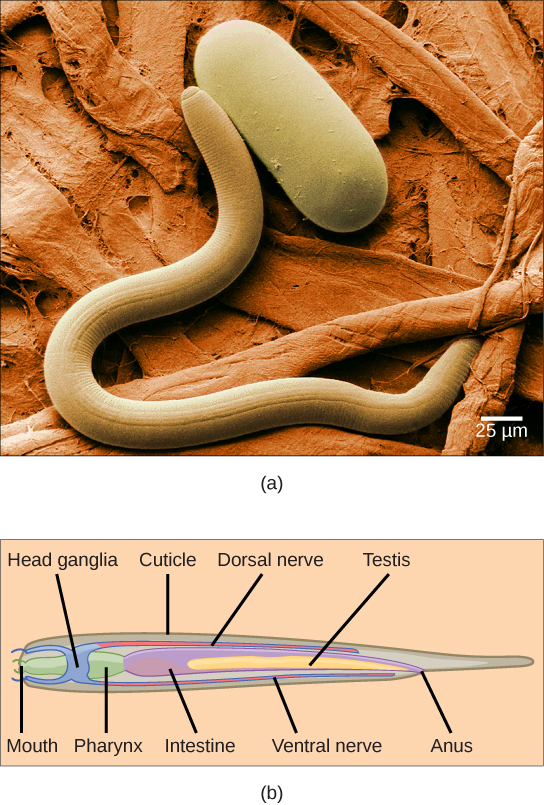
The cylindrical body form of the nematodes is seen in Figure 28.32. These animals have a complete digestive system with a distinct mouth and anus, whereas only one opening is present in the digestive tract of flatworms. The mouth opens into a muscular pharynx and intestine, which leads to a rectum and anal opening at the posterior end. The epidermis can be either a single layer of cells or a syncytium—a multinucleated tissue that in this case is formed by the fusion of many single cells. The cuticle of nematodes is rich in collagen and a polymer called chitin, which forms a protective armor outside the epidermis. The cuticle extends into both ends of the digestive tract, the pharynx, and rectum. In the head, an anterior mouth opening is composed of three (or six) “lips” as well as teeth derived from the cuticle (in some species). Some nematodes may present other modifications of the cuticle such as rings, head shields, or warts. These external rings, however, do not reflect true internal body segmentation, which as we have seen is a hallmark of phylum Annelida. The attachment of the muscles of nematodes differs from that of most animals: they have a longitudinal layer only, and their direct attachment to the dorsal and ventral nerve cords creates a strong muscular contraction that results in a whiplike, almost spastic, body movement.
英語のヒント
図28.32に、線形動物の円筒形の体を示す。線形動物は、明確に分かれた口と肛門をもつ完全な消化系を備える。一方、扁形動物の消化管には開口部が一つしかない。口は筋肉質の咽頭と腸へ通じ、腸は後端の直腸と肛門へ続く。表皮は一層の細胞の場合もあれば、合胞体の場合もある。ここでいう合胞体は、多数の単一細胞の融合で生じた多核組織である。線形動物のクチクラにはコラーゲンとキチンという高分子が豊富に含まれ、表皮の外側に保護用の装甲を形成する。クチクラは消化管の両端、すなわち咽頭と直腸の内部にも伸びる。頭部前端の口は、三つまたは六つの「唇」と、一部の種ではクチクラ由来の歯で構成される。クチクラが環、頭部の盾、いぼなどに変化しているものもある。しかし、これら外側の環は、すでに見た環形動物門の特徴である真の内部体節を反映するものではない。線形動物の筋肉の付着は、多くの動物とは異なる。筋肉は縦走する層だけからなり、背側・腹側の神経索に直接つながることで、強い収縮が生じる。その結果、鞭のような、ほとんど痙攣的な体の動きが生まれる。
OpenStax, Rice University; Biology 2e. (credit a: modification of work by USDA ARS; scale-bar data from Matt Russell) · CC BY 4.0 · Source出典

Figure 28.32図 28.32
Nematode morphology. Scanning electron micrograph shows (a) the soybean cyst nematode (Heterodera glycines) and a nematode egg. (b) A schematic representation shows the anatomy of a typical nematode. (credit a: modification of work by USDA ARS; scale-bar data from Matt Russell)
線形動物の形態。(a)ダイズシストセンチュウ(Heterodera glycines)と線虫卵の走査型電子顕微鏡写真。(b)典型的な線虫の体の構造を示す模式図。(a:USDA ARSの作品を改変。スケールバーのデータ:Matt Russell)