第28章無脊椎動物
Morphology形態
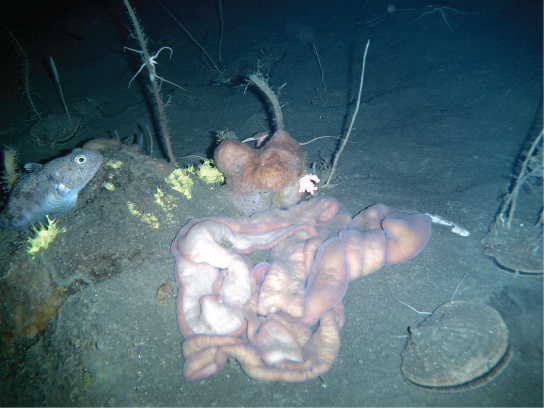
Nemerteans vary in size from 1 cm to several meters. They show bilateral symmetry and remarkable contractile properties. Because of their contractility, they can change their morphological presentation in response to environmental cues. Animals in phylum Nemertea are soft and unsegmented animals, with a morphology like a flattened tube. (Figure 28.19).
英語のヒント
紐形動物の大きさは、1 cmから数mまでさまざまである。左右相称を示し、著しい収縮性をもつ。この収縮性によって、環境からの手掛かりに応じて外形を変えられる。紐形動物門の動物は柔らかく、体節がなく、平たくした管のような形をしている(図28.19)。
OpenStax, Rice University; Biology 2e. (credit: Henry Kaiser, National Science Foundation) · CC BY 4.0 · Source出典
Figure 28.19図 28.19
A proboscis worm. The proboscis worm (Parborlasia corrugatus) is a scavenger that combs the sea floor for food. The species is a member of the phylum Nemertea. The specimen shown here was photographed in the Ross Sea, Antarctica. (credit: Henry Kaiser, National Science Foundation)
吻をもつ紐形動物。Parborlasia corrugatus は、海底をくまなく探して食物を得る腐肉食者で、紐形動物門に属する。写真の個体は、南極のロス海で撮影された。(提供:Henry Kaiser、National Science Foundation)
A unique characteristic of this phylum is the presence of an eversible proboscis enclosed in a pocket called a rhynchocoel (not part of the animal's actual coelom). The proboscis is located dorsal to the gut and serves as a harpoon or tentacle for food capture. In some species it is ornamented with barbs. The rhynchocoel is a fluid-filled cavity that extends from the head to nearly two-thirds of the length of the gut in these animals (Figure 28.20). The proboscis may be extended by hydrostatic pressure generated by contraction of muscle of the rhynchocoel and retracted by a retractor muscle attached to the rear wall of the rhynchocoel.
英語のヒント
この門に固有の特徴は、吻腔と呼ばれる袋に収められた、反転して突出できる吻があることである。吻腔は動物の実際の体腔の一部ではない。吻は腸の背側にあり、食物を捕らえる銛や触手として働く。一部の種では逆棘が付いている。吻腔は液体に満たされた空洞で、頭部から腸の長さのほぼ3分の2まで伸びる(図28.20)。吻腔の筋肉の収縮が生む静水圧によって吻が伸び、吻腔の後壁に付着する牽引筋によって引き戻される。
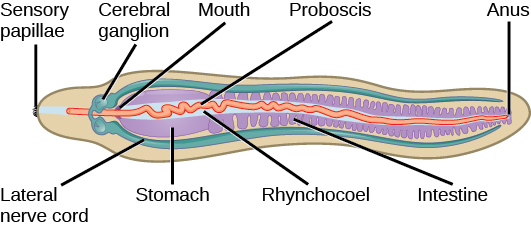


Figure 28.20図 28.20
The anatomy of a Nemertean is shown.
紐形動物の体の構造を示す。
Digestive System消化系
The nemerteans, which are primarily predators of annelids and crustaceans, have a well-developed digestive system. A mouth opening that is ventral to the rhynchocoel leads into the foregut, followed by the intestine. The intestine is present in the form of diverticular pouches and ends in a rectum that opens via an anus. Gonads are interspersed with the intestinal diverticular pouches and open outward via genital pores.
英語のヒント
主に環形動物や甲殻類を捕食する紐形動物は、よく発達した消化系をもつ。吻腔の腹側にある口は前腸に通じ、その後に腸が続く。腸には憩室状の袋があり、末端は肛門から外へ開く直腸となる。生殖腺は腸の憩室の間に散在し、生殖孔から体外へ開く。
Nemerteans are sometimes classified as acoels, but because their closed circulatory system is derived from the coelomic cavity of the embryo, they may be regarded as coelomic. Their circulatory system consists of a closed loop formed by a connected pair of lateral blood vessels. Some species may also have a dorsal vessel or cross-connecting vessels in addition to lateral ones. Although the circulatory fluid contains cells, it is often colorless. However, the blood cells of some species bear hemoglobin as well as other yellow or green pigments. The blood vessels are contractile, although there is usually no regular circulatory pathway, and movement of blood is also facilitated by the contraction of muscles in the body wall. The circulation of fluids in the rhynchocoel is more or less independent of the blood circulation, although blind branches from the blood vessels into the rhynchocoel wall can mediate exchange of materials between them. A pair of protonephridia, or excretory tubules, is present in these animals to facilitate osmoregulation. Gaseous exchange occurs through the skin.
英語のヒント
紐形動物は無体腔動物に分類されることもあるが、閉鎖血管系が胚の体腔に由来するため、体腔をもつ動物とみなせる。循環系は、一対の側方血管がつながってできた閉じた環からなる。一部の種には、側方血管に加え、背側血管や横につなぐ血管もある。循環液には細胞が含まれるが、しばしば無色である。ただし、一部の種の血球には、ヘモグロビンや、ほかの黄色・緑色の色素がある。通常は一定の循環経路がないものの、血管には収縮性があり、体壁の筋肉の収縮も血液の移動を助ける。吻腔内の液の循環は、血液循環とはおおむね独立している。ただし、血管から吻腔の壁へ伸びる盲端の枝によって、両者の物質交換が仲介されることがある。これらの動物には、一対の原腎管、すなわち排泄細管があり、浸透圧調節を助ける。ガス交換は皮膚を通じて行われる。
Nervous System神経系
Nemerteans have a "brain" composed of four ganglia situated at the anterior end, around the rhynchocoel. Paired longitudinal nerve cords emerge from the brain ganglia and extend to the posterior end. Additional nerve cords are found in some species. Interestingly, the brain can contain hemoglobin, which acts as an oxygen reserve. Ocelli or eyespots are present in pairs, in multiples of two in the anterior portion of the body. It is speculated that the eyespots originate from neural tissue and not from the epidermis.
英語のヒント
紐形動物の前端、吻腔の周囲には、四つの神経節からなる「脳」がある。脳神経節からは一対の縦走神経索が出て、後端へ伸びる。一部の種では、さらに神経索がある。興味深いことに、脳にヘモグロビンが含まれ、酸素の貯蔵庫として働くことがある。体の前部には、単眼、すなわち眼点が、対になって偶数個存在する。眼点は表皮ではなく神経組織に由来すると推測されている。
Reproduction生殖
Nemerteans, like flatworms, have excellent powers of regeneration, and asexual reproduction by fragmentation is seen in some species. Most animals in phylum Nemertea are dioecious, although freshwater species may be hermaphroditic. Stem cells that become gametes aggregate within gonads placed along the digestive tract. Eggs and sperm are released into the water, and fertilization occurs externally. Like most lophotrochozoan protostomes, cleavage is spiral, and development is usually direct, although some species have a trochophore-like larva, in which a young worm is constructed from a series of imaginal discs that begin as invaginations from the body surface of the larva.
英語のヒント
紐形動物は扁形動物と同様に優れた再生能力をもち、一部の種では分裂による無性生殖が見られる。大部分は雌雄異体だが、淡水種には雌雄同体のものもある。配偶子になる幹細胞は、消化管に沿って配置された生殖腺の中へ集まる。卵と精子は水中へ放出され、受精は体外で起こる。多くの冠輪動物に属する前口動物と同様、らせん卵割を行い、通常は直接発生する。ただし、一部の種にはトロコフォアに似た幼生がある。この場合、幼生の体表の陥入から始まる一連の成虫原基盤から、若い虫がつくられる。
Section Summary節のまとめ
This section describes three phyla of relatively simple invertebrates: one acoelomate, one pseudocoelomate, and one eucoelomate. Flatworms are acoelomate, triploblastic animals. They lack circulatory and respiratory systems, and have a rudimentary excretory system. This digestive system is incomplete in most species, and absent in tapeworms. There are four traditional groups of flatworms, the largely free-living turbellarians, which include polycladid marine worms and tricladid freshwater species, the ectoparasitic monogeneans, and the endoparasitic trematodes and cestodes. Trematodes have complex life cycles involving a molluscan secondary host and a primary host in which sexual reproduction takes place. Cestodes, or tapeworms, infect the digestive systems of their primary vertebrate hosts.
この節では、比較的単純な無脊椎動物の三つの門を取り上げた。一つは無体腔、一つは偽体腔、もう一つは真体腔である。扁形動物は、無体腔で三胚葉性の動物である。循環系と呼吸系がなく、初歩的な排泄系をもつ。消化系は多くの種で不完全であり、条虫類にはない。扁形動物は伝統的に四つの群に分けられる。多岐腸類の海産種と三岐腸類の淡水種を含み、大部分が自由生活性である渦虫類、外部寄生性の単生類、内部寄生性の吸虫類と条虫類である。吸虫類は、軟体動物の中間宿主と、有性生殖を行う終宿主を含む複雑な生活環をもつ。条虫類は、脊椎動物の終宿主の消化系に感染する。
Rotifers are microscopic, multicellular, mostly aquatic organisms that are currently under taxonomic revision. The group is characterized by the ciliated, wheel-like corona, located on their head. Food collected by the corona is passed to another structure unique to this group of organisms—the mastax or jawed pharynx.
ワムシは微小な多細胞生物で、大部分が水生であり、現在、分類の見直しが行われている。頭部にある、繊毛を備えた車輪のような輪器が特徴である。輪器で集めた食物は、この群に固有のもう一つの構造、咀嚼器、すなわち顎をもつ咽頭へ送られる。
The nemerteans are probably simple eucoelomates. These ribbon-shaped animals also bear a specialized proboscis enclosed within a rhynchocoel. The development of a closed circulatory system derived from the coelom is a significant difference seen in this species compared to other phyla described here. Alimentary, nervous, and excretory systems are more developed in the nemerteans than in the flatworms or rotifers. Embryonic development of nemertean worms proceeds via a planuliform or trochophore-like larval stage.
紐形動物は、おそらく単純な真体腔動物である。このリボン状の動物は、吻腔内に収められた特殊な吻も備える。ここで述べたほかの門との重要な違いは、体腔に由来する閉鎖血管系が発達していることである。消化系、神経系、排泄系は、扁形動物やワムシより発達している。胚発生は、プラヌラ型またはトロコフォアに似た幼生期を経て進む。