第28章無脊椎動物
Parasitic Nematodes寄生性線虫
A number of common parasitic nematodes serve as prime examples of parasitism (endoparasitism). These economically and medically important animals exhibit complex life cycles that often involve multiple hosts, and they can have significant medical and veterinary impacts. Here is a partial list of nasty nematodes: Humans may become infected by Dracunculus medinensis, known as guinea worms, when they drink unfiltered water containing copepods (Figure 28.34), an intermediate crustacean host. Hookworms, such as Ancylostoma and Necator, infest the intestines and feed on the blood of mammals, especially of dogs, cats, and humans. Trichina worms (Trichinella) are the causal organism of trichinosis in humans, often resulting from the consumption of undercooked pork; Trichinella can infect other mammalian hosts as well. Ascaris, a large intestinal roundworm, steals nutrition from its human host and may create physical blockage of the intestines. The filarial worms, such as Dirofilaria and Wuchereria, are commonly vectored by mosquitoes, which pass the infective agents among mammals through their blood-sucking activity. One species, Wuchereria bancrofti, infects the lymph nodes of over 120 million people worldwide, usually producing a non-lethal but deforming condition called elephantiasis. In this disease, parts of the body often swell to gigantic proportions due to obstruction of lymphatic drainage, inflammation of lymphatic tissues, and resulting edema. Dirofilaria immitis, a blood-infective parasite, is the notorious dog heartworm species.
英語のヒント
よく見られる寄生性線虫のいくつかは、寄生、特に内部寄生の代表例である。経済的・医学的に重要なこれらの動物は、しばしば複数の宿主を含む複雑な生活環をもち、医療や獣医療に大きな影響を与える。以下は、厄介な線虫の一部である。人は、中間宿主である甲殻類のカイアシ類(図28.34)を含む未ろ過の水を飲むと、ギニア虫として知られるメジナ虫 Dracunculus medinensis に感染することがある。Ancylostoma や Necator などの鉤虫は腸に寄生し、特にイヌ、ネコ、人などの哺乳類の血液を食べる。旋毛虫 Trichinella は人の旋毛虫症の原因であり、加熱不十分の豚肉を食べて感染することが多い。旋毛虫はほかの哺乳類にも感染できる。大型の腸内線虫である回虫 Ascaris は、人の宿主から栄養を奪い、腸を物理的にふさぐこともある。Dirofilaria や Wuchereria などのフィラリアは、一般に蚊が媒介し、吸血によって哺乳類間へ感染体を運ぶ。一種のバンクロフト糸状虫 Wuchereria bancrofti は、世界で1億2,000万人を超える人々のリンパ節に感染し、通常は致死的ではないが体を変形させる象皮病を起こす。この病気では、リンパ排出の閉塞、リンパ組織の炎症、それに伴う浮腫によって、体の一部が巨大に腫れることがある。血液に感染する寄生虫 Dirofilaria immitis は、悪名高い犬糸状虫である。
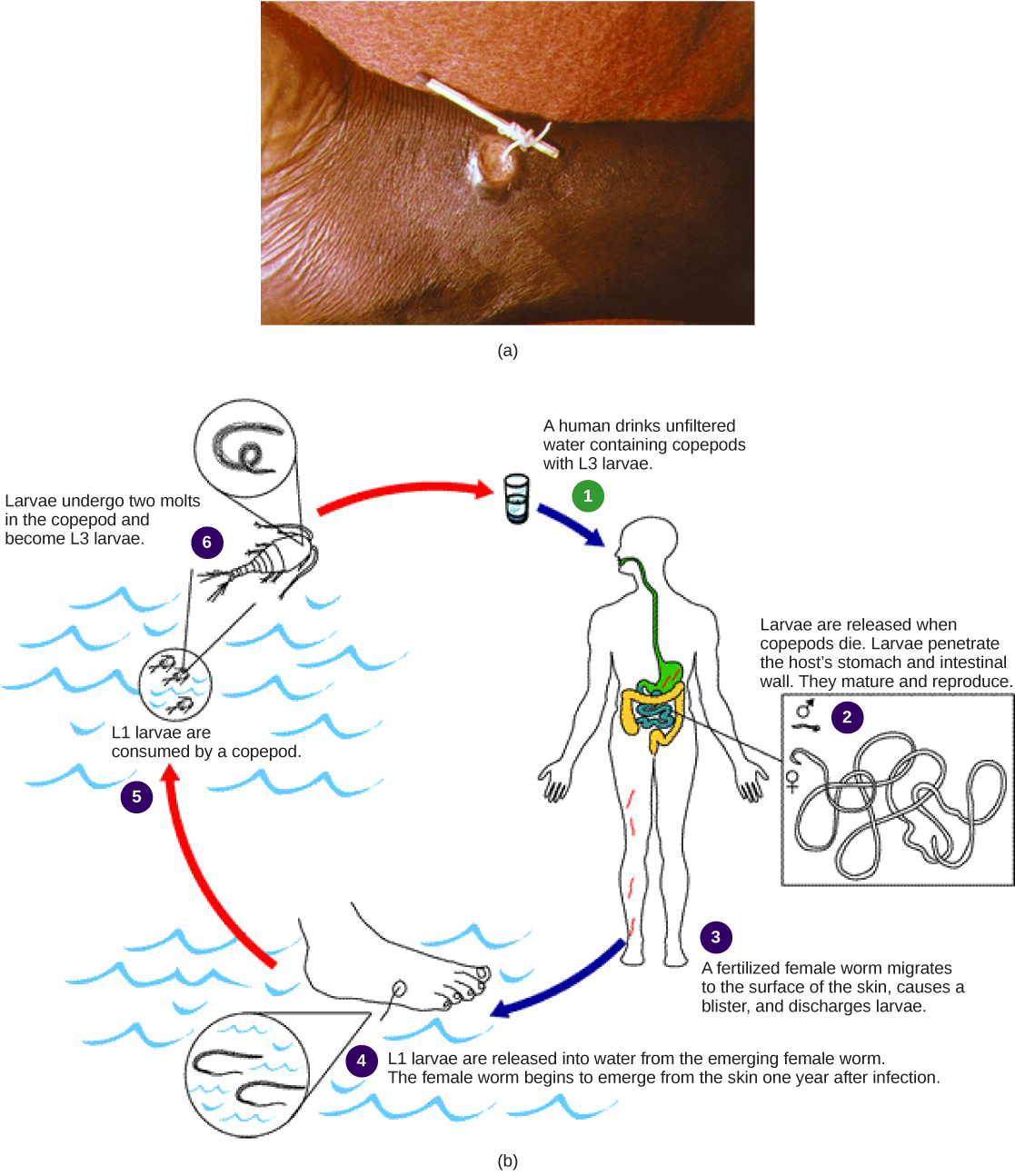

Figure 28.34図 28.34
Life cycle of the guinea worm. The guinea worm Dracunculus medinensis infects about 3.5 million people annually, mostly in Africa. (a) Here, the worm is wrapped around a stick so it can be slowly extracted. (b) Infection occurs when people consume water contaminated by infected copepods, but this can easily be prevented by simple filtration systems. (credit: modification of work by CDC)
メジナ虫の生活環。メジナ虫 Dracunculus medinensis は、主にアフリカで、毎年約350万人に感染する。(a)ここでは、ゆっくり引き出せるよう、虫を棒に巻き付けている。(b)感染したカイアシ類で汚染された水を飲むと感染するが、単純なろ過装置で容易に防げる。(提供:CDCの作品を改変)
Phylum Tardigrada緩歩動物門
The tardigrades ("slow-steppers") comprise a phylum of inconspicuous little animals living in marine, freshwater, or damp terrestrial environments throughout the world. They are commonly called "water bears" because of their plump bodies and the large claws on their stubby legs. There are over 1,000 species, most of which are less than 1 mm in length. A chitinous cuticle covers the body surface and may be divided into plates (Figure 28.35). Tardigrades are known for their ability to enter a state called cryptobiosis, which provides them with resistance to multiple environmental challenges, including desiccation, very low temperatures, vacuum, high pressure, and radiation. They can suspend their metabolic activity for years, and survive the loss of up to 99% of their water content. Their remarkable resistance has recently been attributed to unique proteins that replace water in their cells and protect their internal cell structure and their DNA from damage.
英語のヒント
緩歩動物(「ゆっくり歩くもの」の意)は、世界中の海、淡水、湿った陸上環境に暮らす、目立たない小動物の門である。ふっくらした体と、短い脚の大きな爪から、一般に「水のクマ」、すなわちクマムシと呼ばれる。1,000種以上あり、多くは体長1 mm未満である。体表はキチン質のクチクラに覆われ、板状に分かれる場合もある(図28.35)。クマムシはクリプトビオシスという状態に入れることで知られる。この状態では、乾燥、極低温、真空、高圧、放射線など、多様な環境ストレスに耐えられる。代謝活動を何年も停止し、水分の最大99%を失っても生存できる。近年、この並外れた抵抗性は、細胞内の水に代わり、細胞の内部構造やDNAを損傷から守る特殊なタンパク質によるものとされている。
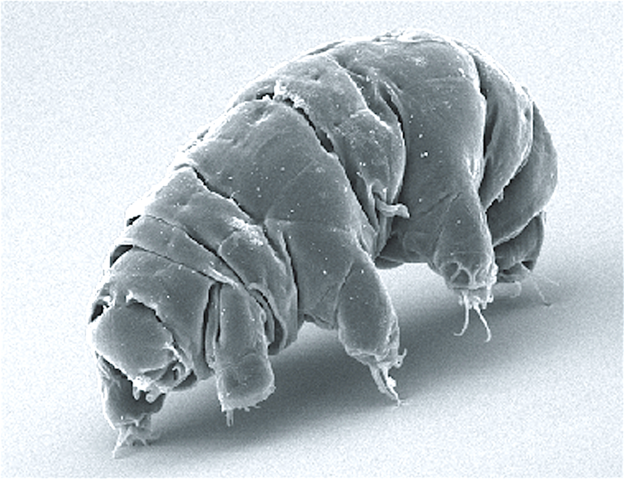
Schokraie E, Warnken U, Hotz-Wagenblatt A, Grohme MA, Hengherr S, et al. (2012); SEM image of Milnesium tardigradum, PLOS ONE figure 1. OpenStax, Biology 2e adaptation. · CC BY 2.5 · Source出典
Figure 28.35図 28.35
Scanning electronmicrograph of Milnesium tardigradum. (credit: Schokraie E, Warnken U, Hotz-Wagenblatt A, Grohme MA, Hengherr S, et al. (2012) -https://commons.wikimedia.org/w/index.php?curid=22716809)
Milnesium tardigradum の走査型電子顕微鏡写真。(提供:Schokraie E、Warnken U、Hotz-Wagenblatt A、Grohme MA、Hengherr S ほか(2012)。https://commons.wikimedia.org/w/index.php?curid=22716809)
Morphology and Physiology形態と生理
Tardigrades have cylindrical bodies, with four pairs of legs terminating in a number of claws. The cuticle is periodically shed, including the cuticular covering of the claws. The first three pairs of legs are used for walking, and the posterior pair for clinging to the substrate. A circular mouth leads to a muscular pharynx and salivary glands. Tardigrades feed on plants, algae, or small animals. Plant cells are pierced with a chitinous stylet and the cellular contents are then sucked into the gut by the muscular pharynx. Bands of single muscle cells are attached to the various points of the epidermis and extend into the legs to provide ambulatory movement. The major body cavity is a hemocoel, but there are no specialized circulatory structures for moving the blood, nor are there specialized respiratory structures. Malpighian tubules in the hemocoel remove metabolic wastes and transport them to the gut. A dorsal brain is connected to a ventral nerve cord with segmental ganglia associated with the appendages. Sensory structures are greatly reduced, but there is a pair of simple eyespots on the head, and sensory cilia or bristles concentrated toward the head end of the animal.
英語のヒント
クマムシは円筒形の体に四対の脚をもち、各脚の先に複数の爪がある。爪を覆う部分も含め、クチクラは定期的に脱ぎ捨てられる。前の三対の脚は歩行に、後ろの一対は基質につかまるために使われる。円形の口は、筋肉質の咽頭と唾液腺へ通じる。植物、藻類、小動物を食べる。植物細胞にはキチン質の口針を突き刺し、筋肉質の咽頭で内容物を腸内へ吸い込む。単一の筋細胞からなる帯が表皮の各所に付着し、脚へ伸びて歩行運動を生み出す。主要な体内の空洞は血体腔だが、血液を動かす特殊な循環構造も、特殊な呼吸構造もない。血体腔内のマルピーギ管が代謝老廃物を除き、腸へ運ぶ。背側の脳は腹側神経索につながり、神経索には付属肢に対応した体節ごとの神経節がある。感覚構造は大幅に縮小しているが、頭部に一対の単純な眼点があり、感覚繊毛や感覚毛は頭側の端に集中する。