第28章無脊椎動物
Phylum Annelida環形動物門
Phylum Annelida comprises the true, segmented worms. These animals are found in marine, terrestrial, and freshwater habitats, but the presence of water or humidity is a critical factor for their survival in terrestrial habitats. The annelids are often called “segmented worms” due to their key characteristic of metamerism, or true segmentation. Approximately 22,000 species have been described in phylum Annelida, which includes polychaete worms (marine annelids with multiple appendages), and oligochaetes (earthworms and leeches). Some animals in this phylum show parasitic and commensal symbioses with other species in their habitat.
英語のヒント
環形動物門は、真の体節をもつ虫状の動物からなる。海、陸上、淡水に生息するが、陸上での生存には水や湿気の存在が決定的に重要である。同規的な体節制、すなわち真の分節という重要な特徴から、しばしば「体節のある虫」と呼ばれる。環形動物門では約2万2,000種が記載され、多数の付属肢をもつ海産環形動物である多毛類と、ミミズやヒルを含む貧毛類が属する。この門の一部の動物は、同じ生息地のほかの種と、寄生または片利共生の関係をもつ。
Morphology形態
Annelids display bilateral symmetry and are worm-like in overall morphology. The name of the phylum is derived from the Latin word annulus, which means a small ring, an apt description of the ring-like segmentation of the body. Annelids have a body plan with metameric segmentation, in which several internal and external morphological features are repeated in each body segment. Metamerism allows animals to become bigger by adding “compartments,” while making their movement more efficient. The overall body can be divided into head, body, and pygidium (or tail). During development, the segments behind the head arise sequentially from a growth region anterior to the pygidium, a pattern called teloblastic growth. In the Oligochaetes, the clitellum is a reproductive structure that generates mucus to aid sperm transfer and also produces a “cocoon,” within which fertilization occurs; it appears as a permanent, fused band located on the anterior third of the animal (Figure 28.29).
英語のヒント
環形動物は左右相称で、全体として虫状の形態を示す。門名は「小さな環」を意味するラテン語 annulus に由来し、体の環状の分節をよく表している。体制は同規的な体節制をもち、複数の内外の形態的特徴が各体節に繰り返される。体節制により、動物は「区画」を追加して大型化できるとともに、より効率よく動ける。体全体は頭部、胴部、尾節(尾)に分けられる。発生中、頭部の後ろの体節は、尾節の前方にある成長領域から順次生じる。この様式を端部成長と呼ぶ。貧毛類では、環帯が生殖のための構造となる。精子の受け渡しを助ける粘液をつくり、受精が起こる「繭」も形成する。環帯は、体の前方3分の1にある、恒常的に融合した帯として見える(図28.29)。
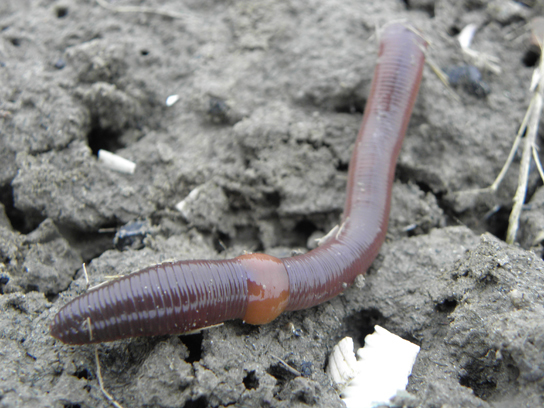
Figure 28.29図 28.29
The clitellum of an earthworm. The clitellum, seen here as a protruding segment with different coloration than the rest of the body, is a structure that aids in oligochaete reproduction. (credit: Rob Hille)
ミミズの環帯。ここで体のほかの部分と異なる色の、突き出した区画として見える環帯は、貧毛類の生殖を助ける構造である。(提供:Rob Hille)
Anatomy体の構造
The epidermis is protected by a collagenous, external cuticle, which is much thinner than the cuticle found in the ecdysozoans and does not require periodic shedding for growth. Circular as well as longitudinal muscles are located interior to the epidermis. Chitinous bristles called setae (or chaetae) are anchored in the epidermis, each with its own muscle. In the polychaetes, the setae are borne on paired appendages called parapodia.
英語のヒント
表皮は、コラーゲン性の外側のクチクラで保護される。このクチクラは脱皮動物のものよりはるかに薄く、成長のために定期的に脱ぎ捨てる必要がない。表皮の内側には、環状筋と縦走筋がある。剛毛と呼ばれるキチン質の毛が表皮に固定され、それぞれに独自の筋肉が付く。多毛類では、剛毛は疣足という対になった付属肢に生えている。
Most annelids have a well-developed and complete digestive system. Feeding mechanisms vary widely across the phylum. Some polychaetes are filter-feeders that use feather-like appendages to collect small organisms. Others have tentacles, jaws, or an eversible pharynx to capture prey. Earthworms collect small organisms from soil as they burrow through it, and most leeches are blood-feeders armed with teeth or a muscular proboscis. In earthworms, the digestive tract includes a mouth, muscular pharynx, esophagus, crop, and muscular gizzard. The gizzard leads to the intestine, which ends in an anal opening in the terminal segment. A cross-sectional view of a body segment of an earthworm is shown in Figure 28.30; each segment is limited by a membranous septum that divides the coelomic cavity into a series of compartments.
英語のヒント
多くの環形動物は、よく発達した完全な消化系をもつ。摂食の仕組みは門全体で大きく異なる。一部の多毛類は、羽毛状の付属肢で小さな生物を集めるろ過摂食者である。ほかには、触手、顎、反転して突出できる咽頭で獲物を捕らえるものもいる。ミミズは土を掘り進みながら土中の小さな生物を集め、多くのヒルは歯や筋肉質の吻を備えた吸血者である。ミミズの消化管には、口、筋肉質の咽頭、食道、嗉嚢、筋肉質の砂嚢が含まれる。砂嚢は腸に続き、腸は最後の体節にある肛門で終わる。図28.30にミミズの体節の断面を示す。各体節は膜状の隔壁で区切られ、体腔は一連の区画に分かれる。
Most annelids possess a closed circulatory system of dorsal and ventral blood vessels that run parallel to the alimentary canal as well as capillaries that service individual tissues. In addition, the dorsal and ventral vessels are connected by transverse loops in every segment. Some polychaetes and leeches have an open system in which the major blood vessels open into a hemocoel. In many species, the blood contains hemoglobin, but not contained in cells. Annelids lack a well-developed respiratory system, and gas exchange occurs across the moist body surface. In the polychaetes, the parapodia are highly vascular and serve as respiratory structures. Excretion is facilitated by a pair of metanephridia (a type of primitive “kidney” that consists of a convoluted tubule and an open, ciliated funnel) that is present in every segment toward the ventral side. Annelids show well-developed nervous systems with a ring of fused ganglia present around the pharynx. The nerve cord is ventral in position and bears enlarged nodes or ganglia in each segment.
英語のヒント
多くの環形動物は閉鎖血管系をもち、消化管と平行に走る背側血管と腹側血管、そして各組織に血液を送る毛細血管からなる。さらに、各体節で横方向の環状血管が背側血管と腹側血管をつなぐ。一部の多毛類とヒルには、主要血管が血体腔へ開く開放血管系がある。多くの種の血液にはヘモグロビンが含まれるが、細胞内には収まっていない。環形動物にはよく発達した呼吸系がなく、湿った体表でガス交換が起こる。多毛類の疣足には血管が豊富にあり、呼吸構造として働く。各体節の腹側寄りには、一対の後腎管があり、排泄を助ける。これは、曲がりくねった細管と、繊毛を備えた開口する漏斗からなる、原始的な「腎臓」の一種である。神経系はよく発達し、咽頭の周囲には、融合した神経節の環がある。神経索は腹側に位置し、各体節で膨らんだ節、すなわち神経節を備える。
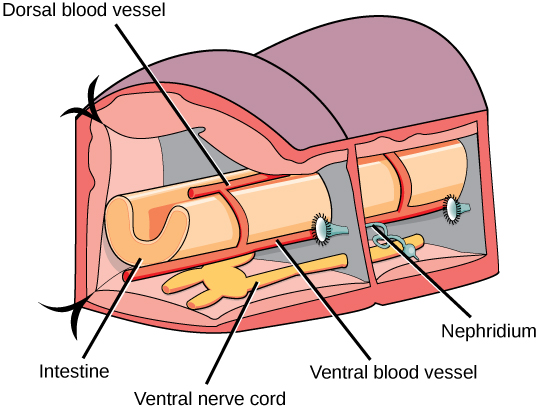


Figure 28.30図 28.30
Segmental anatomy of an earthworm. This schematic drawing shows the basic anatomy of annelids in a cross-sectional view.
ミミズの体節の構造。この模式図は、環形動物の基本的な体の構造を断面で示す。
Annelids may be either monoecious with permanent gonads (as in earthworms and leeches) or dioecious with temporary or seasonal gonads (as in polychaetes). However, cross-fertilization is preferred even in hermaphroditic animals. Earthworms may show simultaneous mutual fertilization when they are aligned for copulation. Some leeches change their sex over their reproductive lifetimes. In most polychaetes, fertilization is external and development includes a trochophore larva, which then metamorphizes to the adult form. In oligochaetes, fertilization is typically internal and the fertilized eggs develop in a cocoon produced by the clitellum; development is direct. Polychaetes are excellent regenerators and some even reproduce asexually by budding or fragmentation.
英語のヒント
環形動物には、ミミズやヒルのように恒常的な生殖腺をもつ雌雄同体のものと、多毛類のように一時的または季節的な生殖腺をもつ雌雄異体のものがある。ただし、雌雄同体でも他家受精が優先される。ミミズは交尾のために体をそろえると、同時に相互受精することがある。一部のヒルは、生殖可能な生涯の途中で性を変える。多くの多毛類では体外受精が行われ、トロコフォア幼生を経て成体へ変態する。貧毛類では受精は通常体内で起こり、受精卵は環帯がつくる繭の中で発生する。発生は直接的である。多毛類は優れた再生能力をもち、出芽や分裂によって無性的に繁殖するものもいる。