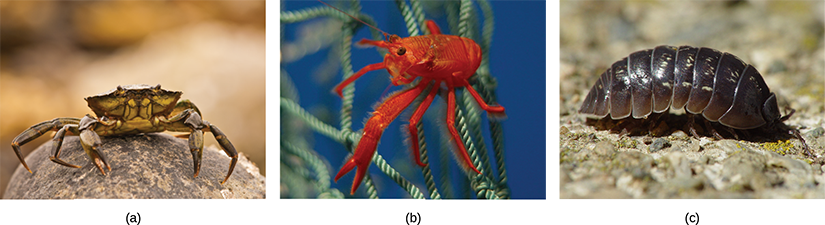
Crustaceans are the most dominant aquatic (both freshwater and marine) arthropods, with the total number of marine crustaceans standing at about 70,000 species. Krill, shrimp, lobsters, crabs, and crayfish are examples of crustaceans (Figure 28.41). However, there are also a number of terrestrial crustacean species as well: Terrestrial species like the wood lice (Armadillidium spp.), also called pill bugs, roly-polies, potato bugs, or isopods, are also crustaceans. Nonetheless, the number of terrestrial species in this subphylum is relatively low.
OpenStax, Rice University; Biology 2e. (credit a: modification of work by William Warby; credit b: modification of work by Jon Sullivan credit c: modification of work by Franco Folini. https://commons.wikimedia.org/w/index.php?curid=789616) Original Franco Folini; Armadillidium vulgare 001 (panel c) is available under CC BY 2.5: https://creativecommons.org/licenses/by/2.5/ (CC BY option selected). · CC BY 4.0 · Source出典
Figure 28.41図 28.41
Crustaceans. The (a) crab and (b) shrimp krill are both aquatic crustaceans. The pill bug Armadillidium is a terrestrial crustacean. (credit a: modification of work by William Warby; credit b: modification of work by Jon Sullivan credit c: modification of work by Franco Folini. https://commons.wikimedia.org/w/index.php?curid=789616)
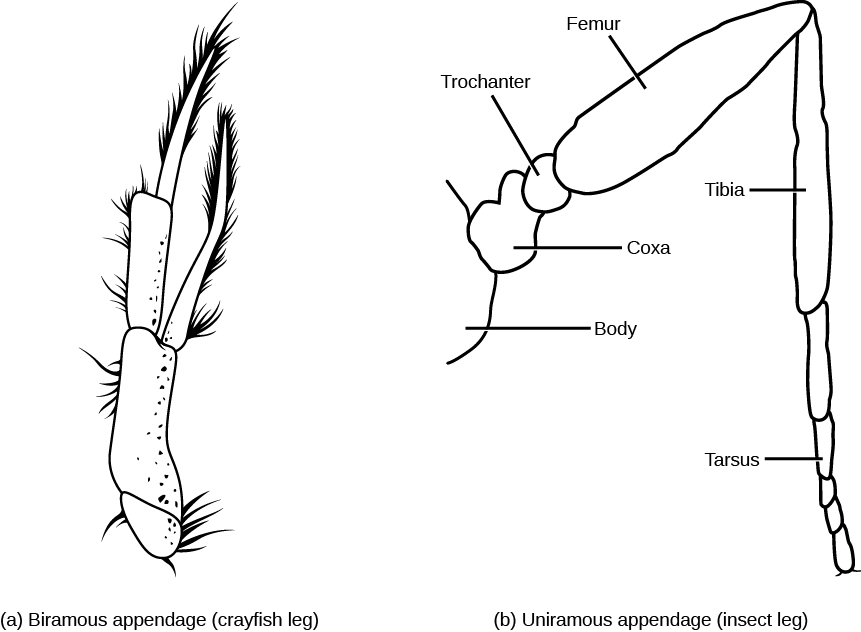
Crustaceans typically possess two pairs of antennae, mandibles as mouthparts, and biramous (“two branched”) appendages, which means that their legs are formed in two parts called endopods and exopods, which appear superficially distinct from the uniramous (“one branched”) legs of myriapods and hexapods (Figure 28.42). Since biramous appendages are also seen in the trilobites, biramous appendages represent the ancestral condition in the arthropods. Currently, we describe various arthropods as having uniramous or biramous appendages, but these are descriptive only, and do not necessarily reflect evolutionary relationships other than that all jointed legs of arthropods share common ancestry.
OpenStax, Rice University; Biology 2e. (credit b: modification of work by Nicholas W. Beeson) · CC BY 4.0 · Source出典
Figure 28.42図 28.42
Arthropod appendages. Arthropods may have (a) biramous (two-branched) appendages or (b) uniramous (one-branched) appendages. (credit b: modification of work by Nicholas W. Beeson)
節足動物の付属肢。節足動物の付属肢には、(a)二叉型(二枝)と(b)単叉型(一枝)がある。(b:Nicholas W. Beesonの作品を改変)
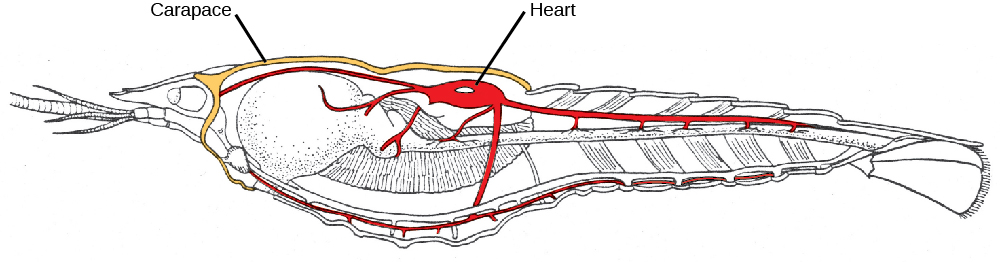
In most crustaceans, the head and thorax is fused to form a cephalothorax (Figure 28.43), which is covered by a plate called the carapace, thus producing a body plan comprising two tagmata: cephalothorax and abdomen. Crustaceans have a chitinous exoskeleton that is shed by molting and ecdysis whenever the animal requires an increase in size or the next stage of development. The exoskeletons of many aquatic species are also infused with calcium carbonate, which makes them even stronger than those of other arthropods. Crustaceans have an open circulatory system where blood is pumped into the hemocoel by the dorsally located heart. Hemocyanin is the major respiratory pigment present in crustaceans, but hemoglobin is found in a few species and both are dissolved in the hemolymph rather than carried in cells.
OpenStax, Rice University; Biology 2e. (credit: Jane Whitney) · CC BY 4.0 · Source出典
Figure 28.43図 28.43
Crustacean anatomy. The crayfish is an example of a crustacean. It has a carapace around the cephalothorax and the heart in the dorsal thorax area. (credit: Jane Whitney)
As in the chelicerates, most crustaceans are dioecious. However, some species like barnacles may be hermaphrodites. Serial hermaphroditism, where the gonad can switch from producing sperm to ova, is also exhibited in some species. Fertilized eggs may be held within the female of the species or may be released in the water. Terrestrial crustaceans seek out damp spaces in their habitats to lay eggs.
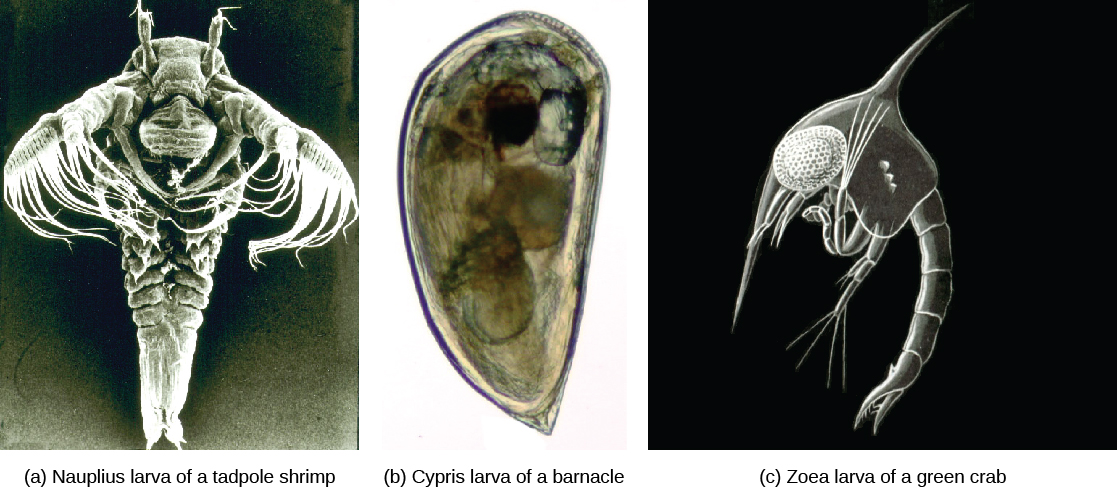
Larval stages—nauplius or zoea—are seen in the early development of aquatic crustaceans. A cypris larva is also seen in the early development of barnacles (Figure 28.44).
OpenStax, Rice University; Biology 2e. (credit a: modification of work by USGS; credit b: modification of work by Mª. C. Mingorance Rodríguez; credit c: modification of work by B. Kimmel based on original work by Ernst Haeckel) · CC BY 4.0 · Source出典
Figure 28.44図 28.44
Crustacean larvae. All crustaceans go through different larval stages. Shown are (a) the nauplius larval stage of a tadpole shrimp, (b) the cypris larval stage of a barnacle, and (c) the zoea larval stage of a green crab. (credit a: modification of work by USGS; credit b: modification of work by Mª. C. Mingorance Rodríguez; credit c: modification of work by B. Kimmel based on original work by Ernst Haeckel)
甲殻類の幼生。すべての甲殻類は異なる幼生段階を経る。(a)カブトエビのノープリウス幼生、(b)フジツボのキプリス幼生、(c)ミドリガニのゾエア幼生を示す。(a:USGSの作品を改変。b:Mª. C. Mingorance Rodríguezの作品を改変。c:Ernst Haeckelの原図に基づくB. Kimmelの作品を改変)
Crustaceans possess a brain formed by the fusion of the first three segmental ganglia, as well as two compound eyes. A ventral nerve cord connects additional segmental ganglia. Most crustaceans are carnivorous, but herbivorous and detritivorous species, and even endoparasitic species are known. A highly evolved endoparasitic species, such as Sacculina spp., parasitizes its crab host and ultimately destroys it after it forces the host to incubate the parasite’s eggs! Crustaceans may also be cannibalistic when extremely high populations of these organisms are present.
The name Hexapoda describes the presence of six legs (three pairs) in these animals, which differentiates them from other groups of arthropods that have different numbers of legs. In some cases, however, the number of legs has been evolutionarily reduced, or the legs have been highly modified to accommodate specific conditions, such as endoparasitism. Hexapod bodies are organized into three tagmata: head, thorax, and abdomen. Individual segments of the head have mouthparts derived from jointed legs, and the thorax has three pairs of jointed appendages, and also wings, in most derived groups. For example, in the pterygotes (winged insects), in addition to a pair of jointed legs on all three segments comprising the thorax—prothorax, mesothorax, and metathorax—there are veined wings on the mesothorax and metathorax.
Appendages found on other body segments are also evolutionarily derived from modified legs. Typically, the head bears an upper “lip” or labrum and mandibles (or derivation of mandibles) that serve as mouthparts; maxillae, and a lower “lip” called a labium: both of which manipulate food. The head also has one pair of sensory antennae, as well as sensory organs such as a pair of compound eyes, ocelli (simple eyes), and numerous sensory hairs. The abdomen usually has 11 segments and bears external reproductive apertures. The subphylum Hexapoda includes some insects that are winged (such as fruit flies) and others that are secondarily wingless (such as fleas). The only order of “primitively wingless” insects is the Thysanura, the bristletails. All other orders are winged or are descendants of formally winged insects.
The evolution of wings is a major, unsolved mystery. Unlike vertebrates, whose “wings” are simply preadaptations of “arms” that served as the structural foundations for the evolution of functional wings (this has occurred independently in pterosaurs, dinosaurs [birds], and bats), the evolution of wings in insects is a what we call a de novo (new) development that has given the pteryogotes domination over the Earth. Winged insects existed over 425 million years ago, and by the Carboniferous, several orders of winged insects (Paleoptera), most of which are now extinct, had evolved. There is good physical evidence that Paleozoic nymphs with thoracic winglets (perhaps hinged, former gill covers of semi-aquatic species) used these devices on land to elevate the thoracic temperature (the thorax is where the legs are located) to levels that would enable them to escape predators faster, find more food resources and mates, and disperse more easily. The thoracic winglets (which can be found on fossilized insects preceding the advent of truly winged insects) could have easily been selected for thermoregulatory purposes prior to reaching a size that would have allowed them the capacity for gliding or actual flapping flight. Even modern insects with broadly attached wings, such as butterflies, use the basal one-third of their wings (the area next to the thorax) for thermoregulation, and the outer two-thirds for flight, camouflage, and mate selection.
Many of the common insects we encounter on a daily basis—including ants, beetles, cockroaches, butterflies, crickets and flies—are examples of Hexapoda. Among these, adult ants, beetles, flies, and butterflies develop by complete metamorphosis from grub-like or caterpillar-like larvae, whereas adult cockroaches and crickets develop through a gradual or incomplete metamorphosis from wingless immatures. All growth occurs during the juvenile stages. Adults do not grow further (but may become larger) after their final molt. Variations in wing, leg, and mouthpart morphology all contribute to the enormous variety seen in the insects. Insect variability was also encouraged by their activity as pollinators and their coevolution with flowering plants. Some insects, especially termites, ants, bees, and wasps, are eusocial, meaning that they live in large groups with individuals assigned to specific roles or castes, like queen, drone, and worker. Social insects use pheromones—external chemical signals—to communicate and maintain group structure as well as a cohesive colony.