第28章無脊椎動物
28.3 Superphylum Lophotrochozoa: Flatworms, Rotifers, and Nemerteans28.3 冠輪動物上門:扁形動物、輪形動物、紐形動物
Learning Objectives学習目標
By the end of this section, you will be able to do the following:
この節を学ぶと、次のことができるようになる。
- Describe the unique anatomical and morphological features of flatworms, rotifers, and Nemertea扁形動物、輪形動物、紐形動物に固有の解剖学的・形態学的特徴を説明する。
- Identify an important extracoelomic cavity found in Nemertea紐形動物に見られる、体腔外の重要な空洞を挙げる。
- Explain the key features of Platyhelminthes and their importance as parasites扁形動物の主要な特徴と、寄生虫としての重要性を説明する。
Animals belonging to superphylum Lophotrochozoa are triploblastic (have three germ layers) and unlike the cnidarians, they possess an embryonic mesoderm sandwiched between the ectoderm and endoderm. These phyla are also bilaterally symmetrical, meaning that a longitudinal section will divide them into right and left sides that are superficially symmetrical. In these phyla, we also see the beginning of cephalization, the evolution of a concentration of nervous tissues and sensory organs in the head of the organism—exactly where a mobile bilaterally symmetrical organism first encounters its environment.
英語のヒント
冠輪動物上門に属する動物は三胚葉性であり、三つの胚葉をもつ。刺胞動物とは異なり、胚には外胚葉と内胚葉の間に挟まれた中胚葉がある。また、これらの門は左右相称であり、縦断面によって、外見上対称な右側と左側に分けられる。これらの門では頭化の始まりも見られる。頭化とは、神経組織と感覚器官が頭部に集中する進化である。頭部は、移動する左右相称の生物が最初に環境に出会う、まさにその場所である。
Lophotrochozoa are also protostomes, in which the blastopore, or the point of invagination of the ectoderm (outer germ layer), becomes the mouth opening into the alimentary canal. This developmental pattern is called protostomy or “first mouth.” Protostomes include acoelomate, pseudocoelomate, and eucoelomate phyla. The coelom is a cavity that separates the ectoderm from the endoderm. In acoelomates, a solid mass of mesoderm is sandwiched between the ectoderm and endoderm and does not form a cavity or “coelom,” leaving little room for organ development; in pseudocoelomates, there is a cavity or pseudocoelom that replaces the blastocoel (the cavity within the blastula), but it is only lined by mesoderm on the outside of the cavity, leaving the gut tube and organs unlined; in eucoelomates, the cavity that obliterates the blastocoel as the coelom develops is lined both on the outside of the cavity (parietal layer) and also on the inside of the cavity, around the gut tube and the internal organs (visceral layer).
英語のヒント
冠輪動物は前口動物でもある。前口動物では、原口、すなわち外胚葉(外側の胚葉)が陥入する点が、消化管へ開く口になる。この発生様式は、前口型(「最初の口」の意)と呼ばれる。前口動物には、無体腔、偽体腔、真体腔をもつ門が含まれる。体腔は、外胚葉と内胚葉を隔てる空洞である。無体腔動物では、外胚葉と内胚葉の間に中胚葉の中実の塊が挟まり、空洞、すなわち「体腔」を形成しないため、器官が発達する空間がほとんどない。偽体腔動物では、胞胚腔(胞胚の内部の空洞)に代わる空洞、すなわち偽体腔がある。しかし中胚葉で裏打ちされるのは腔の外側だけで、腸管や器官は覆われない。真体腔動物では、体腔の発生に伴い胞胚腔に取って代わる空洞が、腔の外側(壁側層)だけでなく、内側、すなわち腸管や内臓器官の周囲(臓側層)でも裏打ちされる。
Eucoelmate protostomes are schizocoels, in which mesoderm-producing cells typically migrate into the blastocoel during gastrulation and multiply to form a solid mass of cells. Cavities then develop within the cell mass to form the coelom. Since the forming body cavity splits the mesoderm, this protostomic coelom is termed a schizocoelom. As we will see later in this chapter, chordates, the phylum to which we belong, generally develop a coelom by enterocoely: pouches of mesoderm pinch off the invaginating primitive gut, or archenteron, and then fuse to form a complete coelom. We should note here that a eucoelomate can form its “true coelom” by either schizocoely or enterocoely. The process that produces the coelom is different and of taxonomic importance, but the result is the same: a complete, mesodermally lined coelom.
英語のヒント
真体腔をもつ前口動物は裂体腔性であり、通常、中胚葉を生み出す細胞が原腸形成の際に胞胚腔へ移動し、増殖して中実の細胞塊をつくる。その後、この細胞塊内に空洞ができて体腔になる。形成される体腔が中胚葉を裂くため、この前口動物の体腔は裂体腔と呼ばれる。この章の後半で見るように、私たちが属する脊索動物門では、一般に腸体腔形成によって体腔が発生する。陥入する原始的な腸、すなわち原腸から中胚葉の袋がくびれて離れ、その後に融合して完全な体腔となる。ここで注意したいのは、真体腔動物は裂体腔形成と腸体腔形成のどちらでも「真の体腔」をつくれることである。体腔を生じる過程は異なり、分類学的に重要だが、結果は同じく、完全に中胚葉で裏打ちされた体腔となる。
Most organisms placed in the superphylum Lophotrochozoa possess either a lophophore feeding apparatus or a trochophore larvae (thus the contracted name, “lopho-trocho-zoa”). The lophophore is a feeding structure composed of a set of ciliated tentacles surrounding the mouth. A trochophore is a free-swimming larva characterized by two bands of cilia surrounding a top-like body. Some of the phyla classified as Lophotrochozoa may be missing one or both of these defining structures. Nevertheless their placement with the Lophotrochozoa is upheld when ribosomal RNA and other gene sequences are compared. The systematics of this complex group is still unclear and much more work remains to resolve the cladistic relationships among them.
英語のヒント
冠輪動物上門に置かれる生物の多くは、触手冠という摂食装置か、トロコフォア幼生のいずれかをもつ。このため、名称は「lopho-trocho-zoa」と縮めて組み合わされている。触手冠は、口を囲む、繊毛のある触手の集まりからなる摂食構造である。トロコフォアは自由遊泳性の幼生で、独楽形の体を囲む二つの繊毛帯が特徴である。冠輪動物に分類される門の中には、これらの特徴的な構造の一方または両方を欠くものもある。それでも、リボソームRNAやほかの遺伝子配列を比較すると、冠輪動物への所属は支持される。この複雑な群の系統分類はまだ明確でなく、群内の分岐関係を解明するには、さらに多くの研究が必要である。
Phylum Platyhelminthes扁形動物門
The flatworms are acoelomate organisms that include many free-living and parasitic forms. The flatworms possess neither a lophophore nor trochophore larvae, although the larvae of one group of flatworms, the Polycladida (named after its many-branched digestive tract), are considered to be homologous to trochophore larvae. Spiral cleavage is also seen in the polycladids and other basal flatworm groups. The developmental pattern of some of the free-living forms is obscured by a phenomenon called "blastomere anarchy," in which a sort of temporary feeding larva forms, followed by a regrouping of cells within the embryo that gives rise to a second-stage embryo. However, both the monophyly of the flatworms and their placement in the Lophotrochozoa has been supported by molecular analyses.
英語のヒント
扁形動物は無体腔の生物で、自由生活性と寄生性の形態を数多く含む。触手冠もトロコフォア幼生ももたないが、扁形動物の一群である多岐腸類の幼生は、トロコフォア幼生と相同と考えられている。多岐腸類の名は、多くの枝に分かれた消化管に由来する。多岐腸類など、基部の扁形動物群では、らせん卵割も見られる。一部の自由生活性の形態では、「割球の無秩序」と呼ばれる現象のために、発生様式が分かりにくくなる。この現象では、一種の一時的な摂食幼生ができ、その後、胚内で細胞が再配置され、第二段階の胚が生じる。それでも、扁形動物が単系統であることと、冠輪動物に属することの両方が、分子解析によって支持されている。
The Platyhelminthes consist of two monophyletic lineages: the Catenulida and the Rhabditophora. The Catenulida, or "chain worms," is a small clade of just over 100 species. These worms typically reproduce asexually by budding. However, the offspring do not fully detach from the parents and the formation resembles a chain in appearance. All of the flatworms discussed here are part of the Rhabditophora ("rhabdite bearers"). Rhabdites are rodlike structures discharged in the mucus produced by some free-living flatworms; they likely serve in both defense and to provide traction for ciliary gliding along the substrate. Unlike free-living flatworms, many species of trematodes and cestodes are parasitic, including important parasites of humans.
英語のヒント
扁形動物門は、カテヌラ類と有棒状体類という二つの単系統の系統からなる。カテヌラ類、すなわち「鎖の虫」は、100種余りの小さなクレードである。通常は出芽によって無性的に繁殖する。しかし、子は親から完全には離れず、全体は鎖のように見える。ここで扱う扁形動物はすべて、有棒状体類(「棒状体をもつもの」の意)に属する。棒状体は、一部の自由生活性扁形動物がつくる粘液中へ放出する棒状の構造であり、防御と、基質に沿って繊毛で滑走する際の足掛かりの両方に役立つと考えられる。自由生活性の扁形動物とは異なり、多くの吸虫類や条虫類は寄生性で、人にとって重要な寄生虫も含まれる。
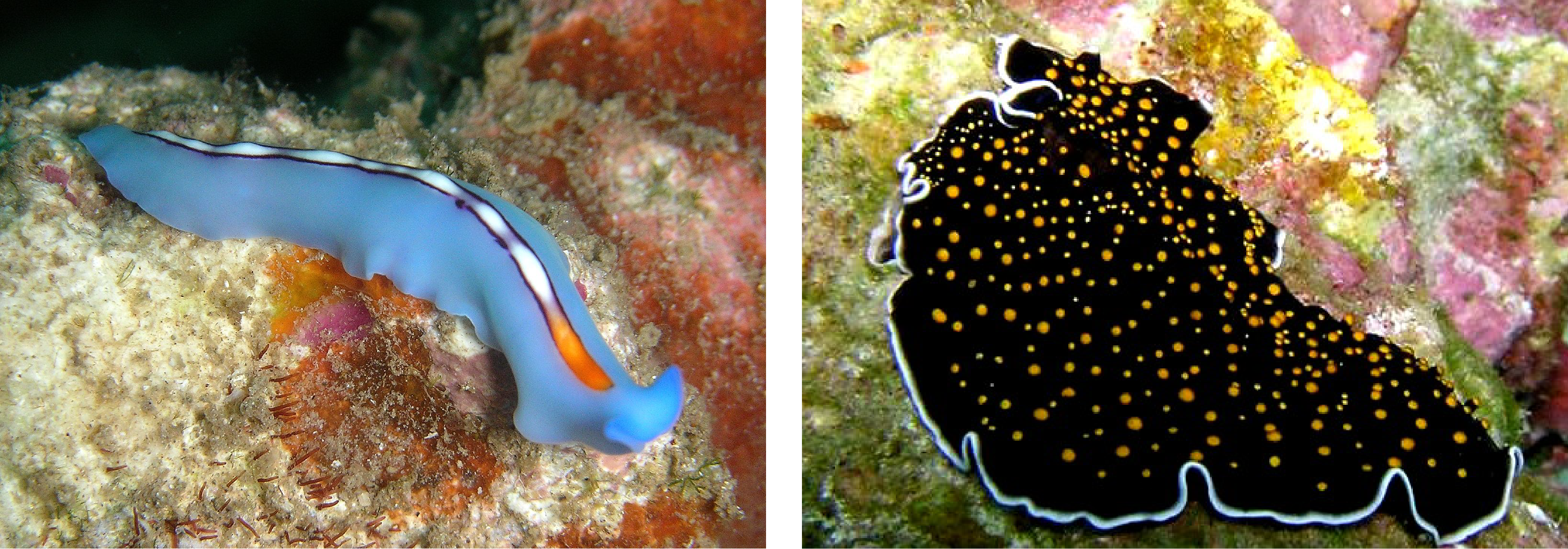
OpenStax, Rice University; Biology 2e. (credit a: modification of work by Stephen Childs; b: modification of work by Pril Fish.) · CC BY 4.0 · Source出典

Figure 28.13図 28.13
Flatworms exhibit significant diversity. (a) A blue Pseudoceros flatworm (Pseudoceros bifurcus); (b) gold speckled flatworm (Thysanozoon nigropapillosum). (credit a: modification of work by Stephen Childs; b: modification of work by Pril Fish.)
扁形動物は大きな多様性を示す。(a)青いニセツノヒラムシ Pseudoceros bifurcus。(b)金色の斑点があるヒラムシ Thysanozoon nigropapillosum。(a:Stephen Childsの作品を改変。b:Pril Fishの作品を改変)
Flatworms have three embryonic tissue layers that give rise to epidermal tissues (from ectoderm), the lining of the digestive system (from endoderm), and other internal tissues (from mesoderm). The epidermal tissue is a single layer of cells or a layer of fused cells (syncytium) that covers two layers of muscle, one circular and the other longitudinal. The mesodermal tissues include mesenchymal cells that contain collagen and support secretory cells that produce mucus and other materials at the surface. Because flatworms are acoelomates, the mesodermal layer forms a solid mass between the outer epidermal surface and the cavity of the digestive system.
英語のヒント
扁形動物は胚に三つの組織層をもち、外胚葉から表皮組織、内胚葉から消化系の内壁、中胚葉からほかの内部組織が生じる。表皮組織は一層の細胞、または融合した細胞の層(合胞体)からなり、その下にある環状筋と縦走筋という二層の筋肉を覆う。中胚葉由来の組織には、コラーゲンを含む間充織細胞があり、表面で粘液などをつくる分泌細胞を支える。扁形動物は無体腔動物であるため、中胚葉の層は、外側の表皮面と消化系の腔との間に中実の塊を形成する。