第28章無脊椎動物
Physiological Processes of Flatworms扁形動物の生理過程
The free-living species of flatworms are predators or scavengers. Parasitic forms feed by absorbing nutrients provided by their hosts. Most flatworms, such as the planarian shown in Figure 28.14, have a branching gastrovascular cavity rather than a complete digestive system. In such animals, the “mouth” is also used to expel waste materials from the digestive system, and thus also serves as an anus. (A few species may have a second anal pore or opening.) The gut may be a simple sac or highly branched. Digestion is primarily extracellular, with digested materials taken into the cells of the gut lining by phagocytosis. One parasitic group, the tapeworms (cestodes), lacks a digestive system altogether, and absorb digested food from the host.
英語のヒント
自由生活性の扁形動物は、捕食者または腐肉食者である。寄生性のものは、宿主が供給する栄養を吸収して生きる。図28.14のプラナリアなど、多くの扁形動物は、完全な消化系ではなく枝分かれした胃水管腔をもつ。これらでは「口」が消化系から老廃物を排出するためにも使われ、肛門を兼ねる。少数の種には、第二の肛門孔または開口部があることもある。腸は単純な袋状の場合も、細かく枝分かれする場合もある。消化は主に細胞外で行われ、消化された物質は食作用によって腸の内壁の細胞へ取り込まれる。寄生性の一群である条虫類には消化系がまったくなく、宿主が消化した食物を吸収する。
Flatworms have an excretory system with a network of tubules attached to flame cells, whose cilia beat to direct waste fluids concentrated in the tubules out of the body through excretory pores. The system is responsible for the regulation of dissolved salts and the excretion of nitrogenous wastes. The nervous system consists of a pair of lateral nerve cords running the length of the body with transverse connections between them. Two large cerebral ganglia—concentrations of nerve cell bodies at the anterior end of the worm—are associated with photosensory and chemosensory cells. There is neither a circulatory nor a respiratory system, with gas and nutrient exchange dependent on diffusion and cell-to-cell junctions. This necessarily limits the thickness of the body in these organisms, constraining them to be “flat” worms. Most flatworm species are monoecious (both male and female reproductive organs are found in the same individual), and fertilization is typically internal. Asexual reproduction by fission is common in some groups.
英語のヒント
扁形動物の排泄系には、炎細胞につながる細管の網がある。炎細胞の繊毛が動くことで、細管に集まった老廃液は排泄孔を通り、体外へ導かれる。この系は、溶存塩類の調節と窒素性老廃物の排泄を担う。神経系は、体の長さに沿って走る一対の側方神経索と、それらを横につなぐ連絡からなる。虫の前端には、神経細胞体が集中した二つの大きな脳神経節があり、光感覚細胞や化学感覚細胞とつながっている。循環系も呼吸系もなく、ガスや栄養の交換は拡散と細胞間の接続に依存する。このため体の厚さは必然的に制限され、これらの動物は「扁平な」虫でなければならない。多くの扁形動物は雌雄同体であり、同じ個体内に雄性・雌性の両方の生殖器官がある。受精は通常、体内で起こる。一部の群では、分裂による無性生殖が一般的である。
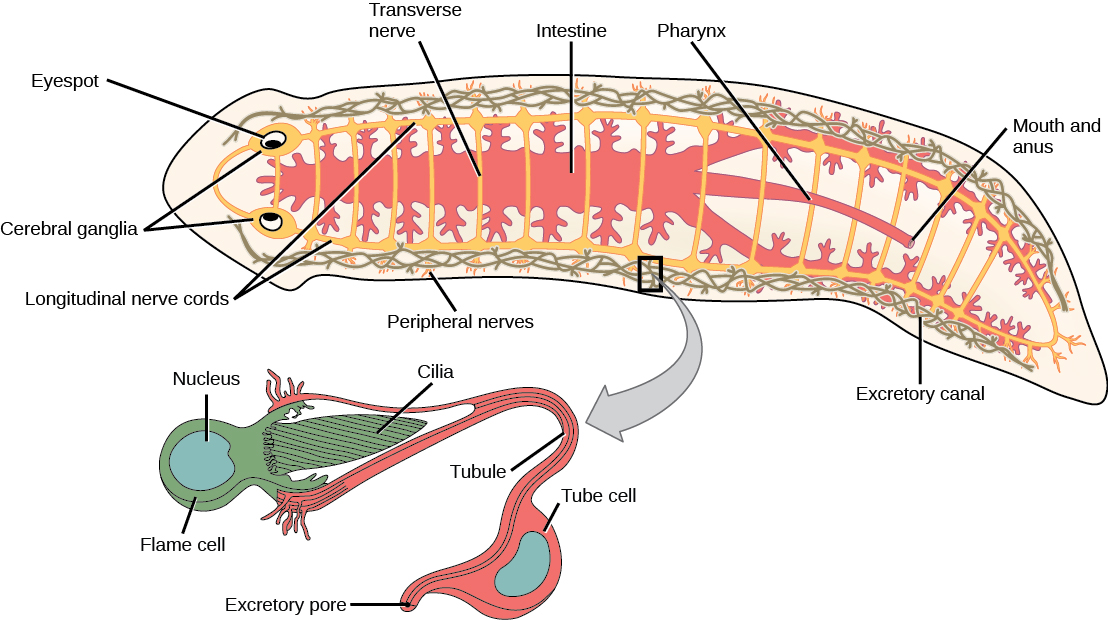
Figure 28.14図 28.14
Planaria, a free-living flatworm. The planarian is a flatworm that has a gastrovascular cavity with one opening that serves as both mouth and anus. The excretory system is made up of flame cells and tubules connected to excretory pores on both sides of the body. The nervous system is composed of two interconnected nerve cords running the length of the body, with cerebral ganglia and eyespots at the anterior end.
自由生活性の扁形動物、プラナリア。プラナリアは、口と肛門を兼ねる一つの開口部をもつ胃水管腔を備えた扁形動物である。排泄系は、炎細胞と、体の両側の排泄孔へつながる細管からなる。神経系は、体の長さに沿って走り、互いにつながる2本の神経索からなり、前端には脳神経節と眼点がある。
Diversity of Flatworms扁形動物の多様性
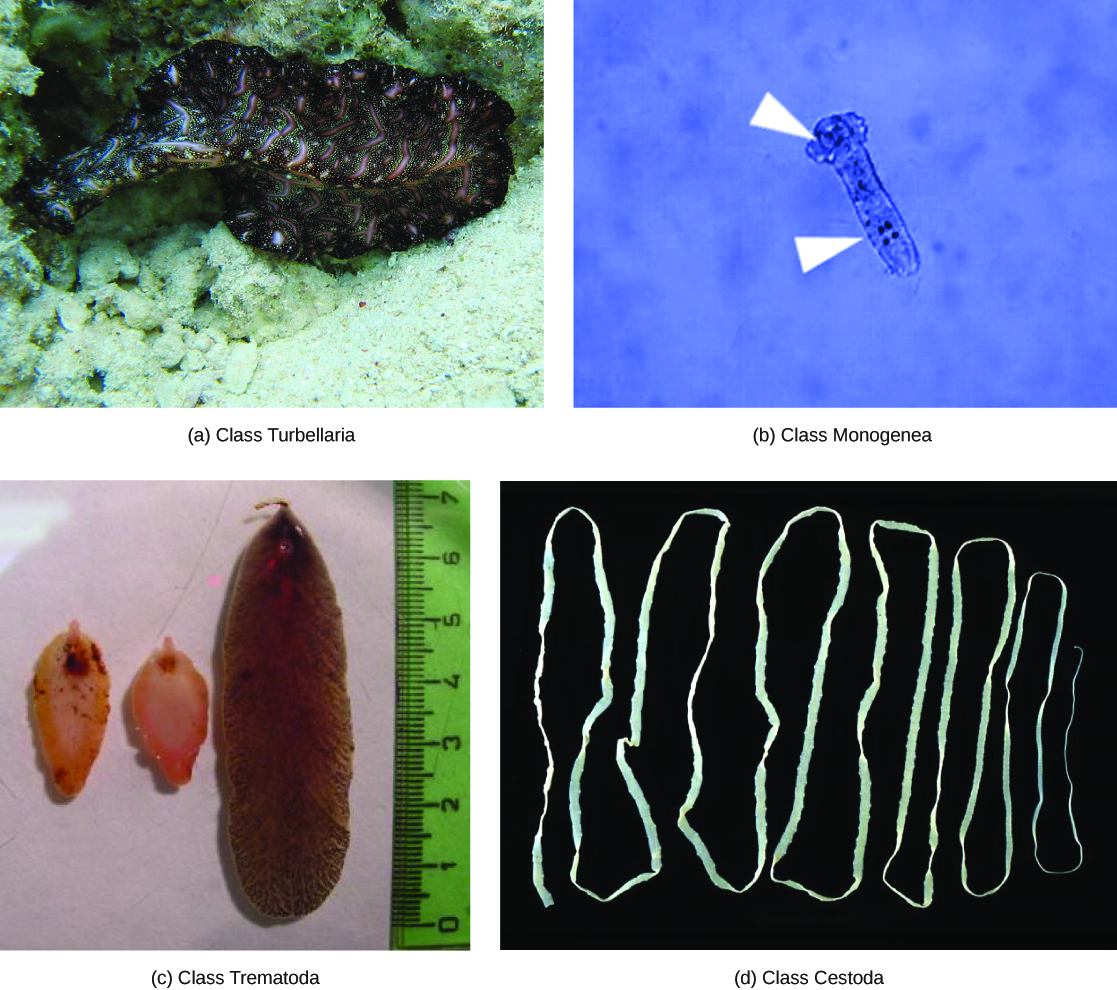
The flatworms have been traditionally divided into four classes: Turbellaria, Monogenea, Trematoda, and Cestoda (Figure 28.15). However, the relationships among members of these classes has recently been reassessed, with the turbellarians in particular now viewed as paraphyletic, since its descendants may also include members of the other three classes. Members of the clade or class Rhabditophora are now dispersed among multiple orders of Platyhelminthes, the most familiar of these being the Polycladida, which contains the large marine flatworms; the Tricladida (which includes Dugesia [“planaria”] and Planaria and its relatives); and the major parasitic orders: Monogenea (fish ectoparasites), Trematoda (flukes), and Cestoda (tapeworms), which together form a monophyletic clade.
英語のヒント
扁形動物は伝統的に、渦虫綱、単生綱、吸虫綱、条虫綱の四つに分けられてきた(図28.15)。しかし近年、これらの綱に属する動物間の関係が再評価され、特に渦虫類は現在、側系統とみなされる。ほかの三つの綱も、その子孫に含まれる可能性があるためである。有棒状体類というクレード、または綱の構成員は、現在、扁形動物の複数の目に分かれている。よく知られるものには、大型の海産ヒラムシを含む多岐腸目、Dugesia(「プラナリア」)と Planaria およびその近縁群を含む三岐腸目、そして主要な寄生性の目である単生目(魚の外部寄生虫)、吸虫目、条虫目がある。これらの寄生性の目は、合わせて一つの単系統クレードを形成する。
OpenStax, Rice University; Biology 2e. (credit a: modification of work by Jan Derk; credit d: modification of work by CDC) · CC BY 4.0 · Source出典
Figure 28.15図 28.15
Traditional flatworm classes. Phylum Platyhelminthes was previously divided into four classes. (a) Class Turbellaria includes the free-living polycladid Bedford’s flatworm (Pseudobiceros bedfordi), which is about 8 to 10 cm in length. (b) The parasitic class Monogenea includes Dactylogyrus spp., commonly called gill flukes, which are about 0.2 mm in length and have two anchors, indicated by arrows used to attach the parasite on to the gills of host fish. (c) The class Trematoda includes Fascioloides magna (right) and Fasciola hepatica (two specimens on left, also known as the common liver fluke). (d) Class Cestoda includes tapeworms such as this Taenia saginata, infects both cattle and humans, and can reach 4 to 10 meters in length; the specimen shown here is about four meters long. (credit a: modification of work by Jan Derk; credit d: modification of work by CDC)
伝統的な扁形動物の綱。扁形動物門は以前、四つの綱に分けられていた。(a)渦虫綱には、体長約8〜10 cmの自由生活性の多岐腸類、ベッドフォードヒラムシ(Pseudobiceros bedfordi)が含まれる。(b)寄生性の単生綱には、一般に鰓吸虫と呼ばれる Dactylogyrus 属の種が含まれる。体長は約0.2 mmで、矢印で示す二つの鉤を使い、宿主の魚の鰓に付着する。(c)吸虫綱には、Fascioloides magna(右)と Fasciola hepatica(左の2個体。肝蛭とも呼ばれる)が含まれる。(d)条虫綱には、ここに示す無鉤条虫 Taenia saginata のような条虫が含まれる。ウシと人の両方に感染し、長さ4〜10 mに達する。写真の標本は約4 mである。(a:Jan Derkの作品を改変。d:CDCの作品を改変)
Most free-living flatworms are marine polycladids, although tricladid species live in freshwater or moist terrestrial environments, and there are a number of members from other orders in both environments. The ventral epidermis of free-living flatworms is ciliated, which facilitates their locomotion. Some free-living flatworms are capable of remarkable feats of regeneration in which an individual may regrow its head or tail after being severed, or even several heads if the planaria is cut lengthwise.
英語のヒント
自由生活性の扁形動物の大部分は海産の多岐腸類である。一方、三岐腸類は淡水や湿った陸上環境に暮らし、両方の環境にはほかの目の動物も多数いる。自由生活性扁形動物の腹側表皮には繊毛があり、移動を助ける。一部の自由生活性扁形動物は、驚くべき再生能力をもつ。切断後に頭や尾が再生したり、プラナリアを縦に切ると複数の頭ができたりすることさえある。
The monogeneans are ectoparasites, mostly of fish, with simple life cycles that consist of a free-swimming larva that attaches to a fish, prior to its transformation to the ectoparasitic adult form. The parasite has only one host and that host is usually very specific. The worms may produce enzymes that digest the host tissues, or they may simply graze on surface mucus and skin particles. Most monogeneans are hermaphroditic, but the male gametes develop first and so cross-fertilization is quite common.
英語のヒント
単生類は主に魚の外部寄生虫で、単純な生活環をもつ。自由に泳ぐ幼生が魚に付着した後、外部寄生性の成体へ変わる。宿主は一つだけで、通常は特定の宿主に強く限定される。宿主組織を消化する酵素をつくる場合もあれば、表面の粘液や皮膚の粒子を食べるだけの場合もある。多くの単生類は雌雄同体だが、雄性配偶子が先に発達するため、他家受精がよく起こる。
The trematodes, or flukes, are internal parasites of mollusks and many other groups, including humans. Trematodes have complex life cycles that involve a primary host in which sexual reproduction occurs, and one or more secondary hosts in which asexual reproduction occurs. The primary host is usually a vertebrate and the secondary host is almost always a mollusk, in which multiple larvae are produced asexually. Trematodes, which attach internally to the host via an oral and medial sucker, are responsible for serious human diseases including schistosomiasis, caused by several species of the blood fluke, Schistosoma spp. Various forms of schistosomiasis infect an estimated 200 million people in the tropics, leading to organ damage, secondary infection by bacteria, and chronic symptoms like fatigue. Infection occurs when the human enters the water and metacercaria larvae, released from the snail host, locate and penetrate the skin. The parasite infects various organs in the body and feeds on red blood cells before reproducing.
英語のヒント
吸虫類は、軟体動物や、人を含む多くの群の内部寄生虫である。有性生殖を行う終宿主と、無性生殖を行う一つ以上の中間宿主を含む、複雑な生活環をもつ。終宿主は通常、脊椎動物であり、中間宿主はほぼ必ず軟体動物である。中間宿主内では、多数の幼生が無性的に生じる。吸虫類は、口側と体中央の吸盤で宿主の内部に付着し、人に重い病気を引き起こす。例として、住血吸虫属 Schistosoma の複数の種による住血吸虫症がある。さまざまな型の住血吸虫症には、熱帯で推定2億人が感染しており、臓器障害、細菌による二次感染、疲労などの慢性的な症状を引き起こす。感染は、人が水に入ったとき、巻貝の宿主から放出されたメタセルカリア幼生が皮膚を見つけて侵入することで起こる。寄生虫は体内のさまざまな器官に感染し、赤血球を食べた後に繁殖する。
Many of the eggs are released in feces and find their way into a waterway, where they are able to reinfect the snail host. The eggs, which have a barb on them, can damage the vascular system of the human host, causing ulceration, abscesses, and bloody diarrhea, wherever they reside, thereby allowing other pathogens to cause secondary infections. In fact, it is the parasite’s eggs that produce most of the main ill effects of schistosomiasis. Many eggs do not make the transit through the veins of the host for elimination, and are swept by blood flow back to the liver and other locations, where they can cause severe inflammation. In the liver, the errant eggs may impede circulation and cause cirrhosis. Control is difficult in impoverished areas in unsanitary, crowded conditions, and prognosis is poor in people with heavy infections of Schistosoma japonicum, without early treatment.
英語のヒント
卵の多くは糞便中へ放出され、水路へたどり着くと、巻貝の宿主へ再感染できる。卵には棘があり、人の宿主の血管系を傷つけ、存在する場所で潰瘍、膿瘍、血性下痢を起こしうる。これにより、ほかの病原体による二次感染も可能になる。実際、住血吸虫症の主な悪影響の大部分を生むのは、寄生虫の卵である。多くの卵は、排出されるために宿主の静脈を通り抜けることができず、血流に押し戻されて肝臓などに達し、そこで重い炎症を引き起こすことがある。肝臓では、迷入した卵が循環を妨げ、肝硬変を起こすこともある。不衛生で過密な条件にある貧困地域では制御が難しく、日本住血吸虫 Schistosoma japonicum に重度に感染した人は、早期治療がなければ予後が悪い。
The cestodes, or tapeworms, are also internal parasites, mainly of vertebrates (Figure 28.16). Tapeworms, such as those of Taenia spp, live in the intestinal tract of the primary host and remain fixed using a sucker or hooks on the anterior end, or scolex, of the tapeworm body, which is essentially a colony of similar subunits called proglottids. Each proglottid may contain an excretory system with flame cells, along with reproductive structures, both male and female. Because they are so long and flat, tapeworms do not need a digestive system; instead, they absorb nutrients from the food matter surrounding them in the host’s intestine by diffusion.
英語のヒント
条虫類も内部寄生虫で、主に脊椎動物に寄生する(図28.16)。Taenia 属などの条虫は終宿主の腸管内に住み、体の前端、すなわち頭節にある吸盤や鉤で固定される。条虫の体は、基本的には片節という似た小単位が集まった群体である。各片節には、雄性・雌性の両方の生殖構造に加え、炎細胞を備えた排泄系が含まれることがある。条虫は非常に長く平たいため、消化系を必要としない。その代わり、宿主の腸内で周囲にある食物から、拡散によって栄養を吸収する。
Proglottids are produced at the scolex and gradually migrate to the end of the tapeworm; at this point, they are “mature” and all structures except fertilized eggs have degenerated. Most reproduction occurs by cross-fertilization between different worms in the same host, but may also occur between proglottids. The mature proglottids detach from the body of the worm and are released into the feces of the organism. The eggs are eaten by an intermediate host, typically another vertebrate. The juvenile worm infects the intermediate host and takes up residence, usually in muscle tissue. When the muscle tissue is consumed by the primary host, the cycle is completed. There are several tapeworm parasites of humans that are transmitted by eating uncooked or poorly cooked pork, beef, or fish.
英語のヒント
片節は頭節のところでつくられ、徐々に条虫の後端へ移動する。後端に達すると「成熟」しており、受精卵以外のすべての構造は退化している。生殖の多くは、同じ宿主内にいる別々の虫体間の他家受精によって起こるが、片節間でも起こりうる。成熟した片節は虫体から離れ、宿主の糞便中へ放出される。卵は中間宿主に食べられる。中間宿主は通常、別の脊椎動物である。幼虫は中間宿主に感染し、通常は筋組織内に定着する。その筋組織が終宿主に食べられると、生活環が一巡する。人に寄生する条虫には、生または加熱不十分の豚肉、牛肉、魚を食べることで感染するものがいくつかある。
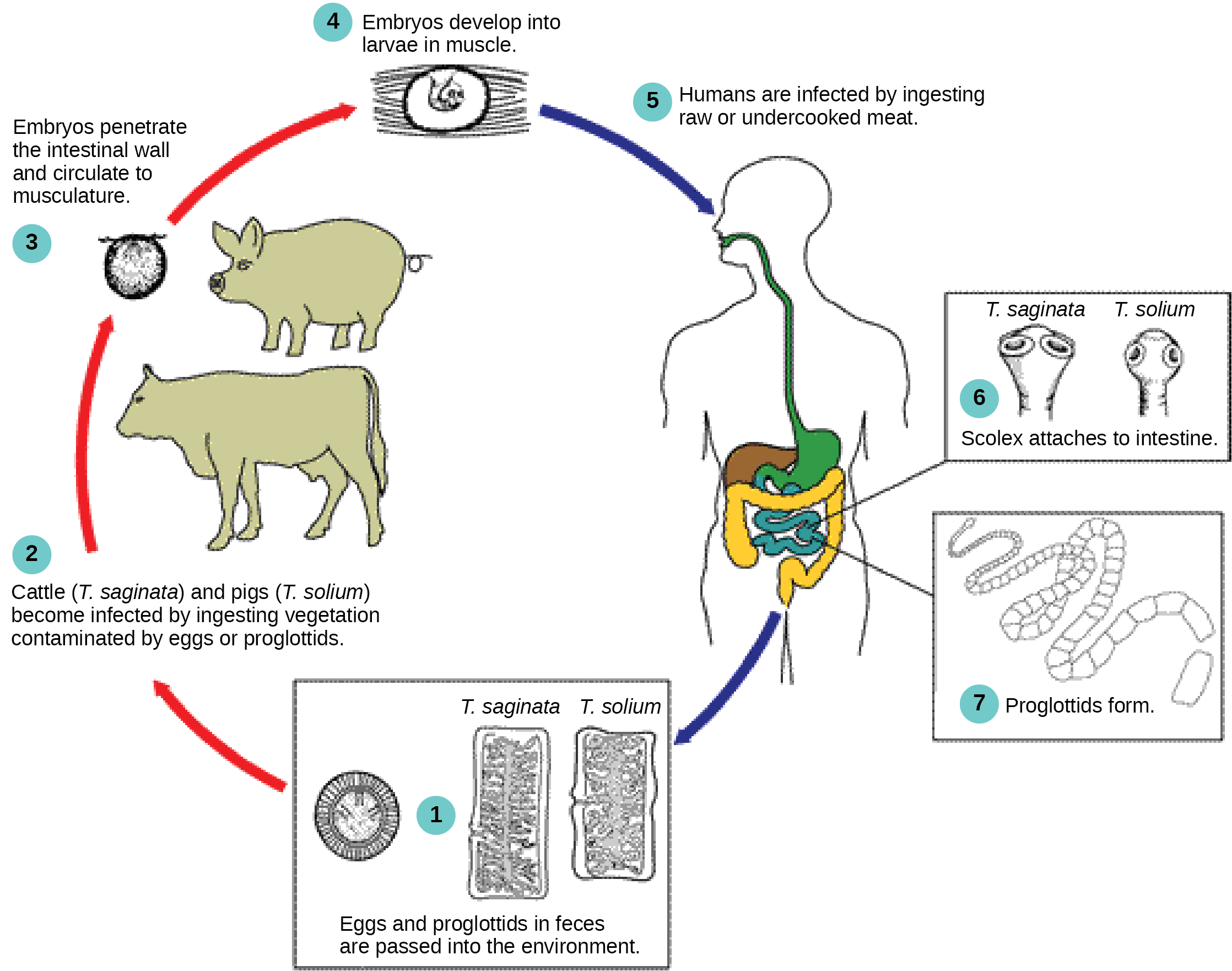


Figure 28.16図 28.16
Tapeworm life cycle. Tapeworm (Taenia spp.) infections occur when humans consume raw or undercooked infected meat. (credit: modification of work by CDC)
条虫の生活環。条虫(Taenia 属)への感染は、人が感染した肉を生または加熱不十分で食べることで起こる。(提供:CDCの作品を改変)