第28章無脊椎動物
28.2 Phylum Cnidaria28.2 刺胞動物門
Learning Objectives学習目標
By the end of this section, you will be able to do the following:
この節を学ぶと、次のことができるようになる。
- Compare structural and organization characteristics of Porifera and Cnidaria海綿動物と刺胞動物の構造・構成上の特徴を比較する。
- Describe the progressive development of tissues and their relevance to animal complexity組織の発達の進行と、動物の複雑さとの関係を説明する。
- Identify the two general body forms found in the Cnidaria刺胞動物に見られる二つの基本的な体形を挙げる。
- Describe the identifying features of the major cnidarian classes刺胞動物の主要な綱を区別する特徴を説明する。
Phylum Cnidaria includes animals that exhibit radial or biradial symmetry and are diploblastic, meaning that they develop from two embryonic layers, ectoderm and endoderm. Nearly all (about 99 percent) cnidarians are marine species.
英語のヒント
刺胞動物門には、放射相称または二放射相称を示す二胚葉性の動物が含まれる。二胚葉性とは、外胚葉と内胚葉という二つの胚葉から発生することを意味する。刺胞動物のほぼすべて(約99%)は海産種である。
Whereas the defining cell type for the sponges is the choanocyte, the defining cell type for the cnidarians is the cnidocyte, or stinging cell. These cells are located around the mouth and on the tentacles, and serve to capture prey or repel predators. Cnidocytes have large stinging organelles called nematocysts, which usually contain barbs at the base of a long coiled thread. The outer wall of the cell has a hairlike projection called a cnidocil, which is sensitive to tactile stimulation. If the cnidocils are touched, the hollow threads evert with enormous acceleration, approaching 40,000 times that of gravity. The microscopic threads then either entangle the prey or instantly penetrate the flesh of the prey or predator, releasing toxins (including neurotoxins and pore-forming toxins that can lead to cell lysis) into the target, thereby immobilizing it or paralyzing it (see Figure 28.5).
英語のヒント
海綿を特徴づける細胞型が襟細胞であるのに対し、刺胞動物を特徴づけるのは、刺す細胞である刺細胞である。これらは口の周囲や触手上にあり、獲物を捕らえたり、捕食者を撃退したりする。刺細胞には刺胞と呼ばれる大きな刺す細胞小器官があり、通常、長く巻かれた糸の基部に逆棘を備えている。細胞の外側の壁には刺針という毛状の突起があり、接触刺激に敏感である。刺針に何かが触れると、中空の糸が裏返りながら飛び出す。その加速度はきわめて大きく、重力加速度の4万倍近くに達する。この微小な糸は、獲物を絡め取るか、獲物や捕食者の肉へ瞬時に突き刺さる。そして神経毒や、細胞溶解を引き起こしうる孔形成毒素などを標的へ放出し、動きを止めたり麻痺させたりする(図28.5)。
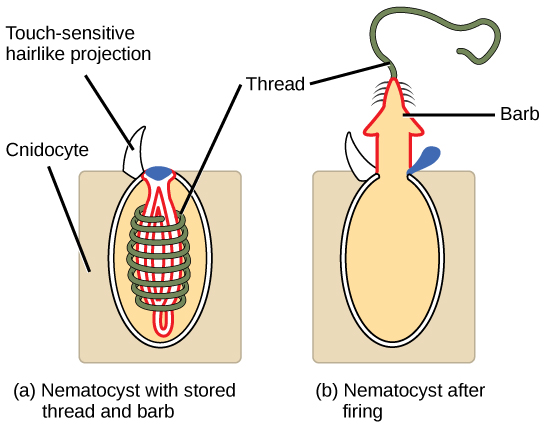
Figure 28.5図 28.5
Cnidocytes. Animals from the phylum Cnidaria have stinging cells called cnidocytes. Cnidocytes contain large organelles called (a) nematocysts that store a coiled thread and barb, the nematocyst. When the hairlike cnidocil on the cell surface is touched, even lightly, (b) the thread, barb, and a toxin are fired from the organelle.
刺細胞。刺胞動物門の動物は、刺細胞と呼ばれる刺す細胞をもつ。刺細胞には、巻かれた糸と逆棘を収める(a)刺胞という大きな細胞小器官がある。細胞表面の毛状の刺針にごく軽く触れるだけでも、(b)糸、逆棘、毒素が細胞小器官から発射される。
Two distinct body plans are found in Cnidarians: the polyp or tuliplike "stalk" form and the medusa or "bell" form. (Figure 28.6). An example of the polyp form is found in the genus Hydra, whereas the most typical form of medusa is found in the group called the “sea jellies” (jellyfish). Polyp forms are sessile as adults, with a single opening (the mouth/anus) to the digestive cavity facing up with tentacles surrounding it. Medusa forms are motile, with the mouth and tentacles hanging down from an umbrella-shaped bell.
英語のヒント
刺胞動物には、ポリプというチューリップの「茎」のような形と、メデューサという「鐘」のような形の、二つの異なる体制がある(図28.6)。ポリプ型の例はヒドラ属に、最も典型的なメデューサ型は「シージェリー」(クラゲ)と呼ばれる群に見られる。ポリプ型の成体は固着性である。消化腔へ通じる一つの開口部(口と肛門を兼ねる)が上を向き、その周囲を触手が囲む。メデューサ型は運動性があり、傘形の鐘状部から口と触手が下向きに垂れている。
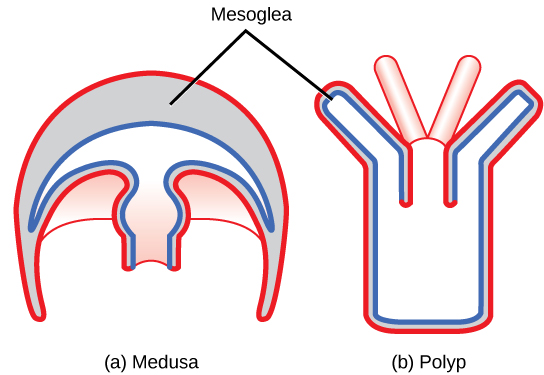
Figure 28.6図 28.6
Cnidarian body forms. Cnidarians have two distinct body plans, the medusa (a) and the polyp (b). All cnidarians have two membrane layers, with a jelly-like mesoglea between them.
刺胞動物の体形。刺胞動物には、メデューサ(a)とポリプ(b)という二つの異なる体制がある。すべての刺胞動物は二つの膜状の層をもち、その間にゼリー状の中膠がある。
Some cnidarians are dimorphic, that is, they exhibit both body plans during their life cycle. In these species, the polyp serves as the asexual phase, while the medusa serves as the sexual stage and produces gametes. However, both body forms are diploid.
英語のヒント
一部の刺胞動物は二形性を示す。つまり生活環の中で、両方の体制が現れる。これらの種では、ポリプが無性世代として、メデューサが配偶子をつくる有性世代として働く。ただし、どちらの体形も二倍体である。
An example of cnidarian dimorphism can be seen in the colonial hydroid Obelia. The sessile asexual colony has two types of polyps, shown in Figure 28.7. The first is the gastrozooid, which is adapted for capturing prey and feeding. In Obelia, all polyps are connected through a common digestive cavity called a coenosarc. The other type of polyp is the gonozooid, adapted for the asexual budding and the production of sexual medusae. The reproductive buds from the gonozooid break off and mature into free-swimming medusae, which are either male or female (dioecious). Each medusa has either several testes or several ovaries in which meiosis occurs to produce sperm or egg cells. Interestingly, the gamete-producing cells do not arise within the gonad itself, but migrate into it from the tissues in the gonozooid. This separate origin of gonad and gametes is common throughout the eumetazoa. The gametes are released into the surrounding water, and after fertilization, the zygote develops into a blastula, which soon develops into a ciliated, bilaterally symmetrical planula larva. The planula swims freely for a while, but eventually attaches to a substrate and becomes a single polyp, from which a new colony of polyps is formed by budding.
英語のヒント
刺胞動物の二形性の例は、群体性のヒドロ虫であるオベリア(Obelia)に見られる。固着性の無性群体には、図28.7に示す二種類のポリプがある。一つは、捕食と摂食に適応した栄養個虫である。オベリアでは、すべてのポリプが、共肉という共通の消化腔を通じてつながっている。もう一つは生殖個虫で、無性的に出芽し、有性のメデューサを生み出すのに適応している。生殖個虫から生じた生殖芽は離れ、自由に泳ぐメデューサへ成熟する。各メデューサは雄か雌のいずれかである(雌雄異体)。それぞれに複数の精巣または複数の卵巣があり、そこで減数分裂が起きて精子または卵細胞ができる。興味深いことに、配偶子をつくる細胞は生殖腺そのものの中に生じるのではなく、生殖個虫の組織から移動してくる。生殖腺と配偶子の起源が別であることは、真正後生動物全体に共通している。配偶子は周囲の水中に放出され、受精後、接合子は胞胚へ発生する。胞胚はすぐに、繊毛をもち左右相称のプラヌラ幼生へ発生する。プラヌラはしばらく自由に泳ぐが、やがて基質に付着して一つのポリプとなり、そこから出芽によって新しいポリプ群体が形成される。
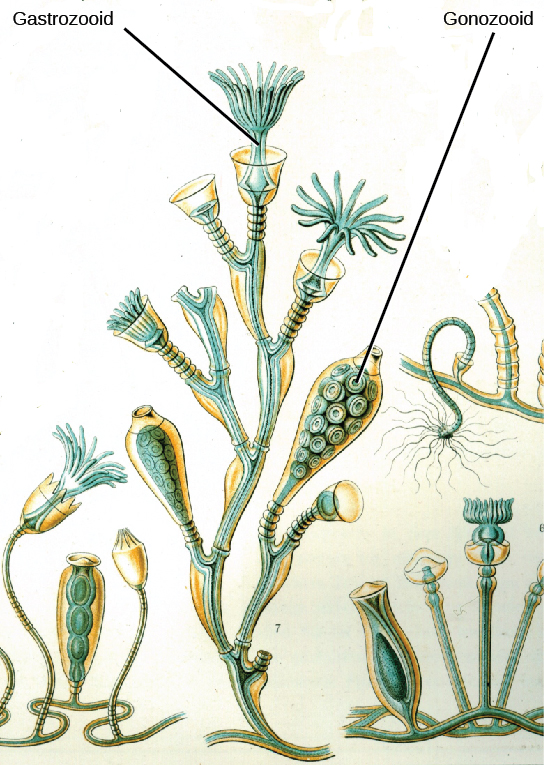


Figure 28.7図 28.7
Obelia. The colonial sessile form of Obelia geniculata has two types of polyps: gastrozooids, which are adapted for capturing prey, and gonozooids, which asexually bud to produce medusae.
オベリア。Obelia geniculata の固着性の群体には、獲物の捕獲に適応した栄養個虫と、無性的に出芽してメデューサをつくる生殖個虫という、二種類のポリプがある。
All cnidarians are diploblastic and thus have two “epithelial” layers in the body that are derived from the endoderm and ectoderm of the embryo. The outer layer (from ectoderm) is called the epidermis and lines the outside of the animal, whereas the inner layer (from endoderm) is called the gastrodermis and lines the digestive cavity. In the planula larva, a layer of ectoderm surrounds a solid mass of endoderm, but as the polyp develops, the digestive or gastrovascular cavity opens within the endoderm. A non-living, jelly-like mesoglea lies between these two epithelial layers. In terms of cellular complexity, cnidarians show the presence of differentiated cell types in each tissue layer, such as nerve cells, contractile epithelial cells, enzyme-secreting cells, and nutrient-absorbing cells, as well as the presence of intercellular connections. However, with a few notable exceptions such as statocysts and rhopalia (see below), the development of organs or organ systems is not advanced in this phylum.
英語のヒント
すべての刺胞動物は二胚葉性であり、胚の内胚葉と外胚葉に由来する二つの「上皮」層を体にもつ。外胚葉から生じる外側の層は表皮と呼ばれ、体の外面を覆う。一方、内胚葉から生じる内側の層は胃皮と呼ばれ、消化腔の内面を覆う。プラヌラ幼生では、外胚葉の層が内胚葉の中実の塊を囲むが、ポリプが発生するにつれ、内胚葉の内部に消化腔、すなわち胃水管腔が開く。この二つの上皮層の間には、生きた組織ではないゼリー状の中膠がある。細胞の複雑さに着目すると、刺胞動物の各組織層には、神経細胞、収縮性の上皮細胞、酵素分泌細胞、栄養吸収細胞など、分化した細胞型があり、細胞間の連結もある。しかし、平衡胞や感覚体などのいくつかの顕著な例外(後述)を除けば、この門では器官や器官系の発達は進んでいない。
The nervous system is rudimentary, with nerve cells organized in a network scattered across the body. This nerve net may show the presence of groups of cells that form nerve plexi (singular: plexus) or nerve cords. Organization of the nervous system in the motile medusa is more complex than that of the sessile polyp, with a nerve ring around the edge of the medusa bell that controls the action of the tentacles. Cnidarian nerve cells show mixed characteristics of motor and sensory neurons. The predominant signaling molecules in these primitive nervous systems are peptides, which perform both excitatory and inhibitory functions. Despite the simplicity of the nervous system, it is remarkable that it coordinates the complicated movement of the tentacles, the drawing of captured prey to the mouth, the digestion of food, and the expulsion of waste.
英語のヒント
神経系は初歩的であり、神経細胞は体全体に広がる網目状に配置されている。この神経網には、神経叢や神経索を形成する細胞群が見られることがある。運動性のメデューサでは、固着性のポリプよりも神経系の構成が複雑で、傘の縁を巡る神経環が触手の動きを制御する。刺胞動物の神経細胞には、運動ニューロンと感覚ニューロンの特徴が混在している。この原始的な神経系で主要な情報伝達分子となるのは、興奮性と抑制性の両方の機能を果たすペプチドである。神経系が単純でありながら、触手の複雑な動き、捕らえた獲物を口へ引き寄せること、食物の消化、老廃物の排出を調整できることは注目に値する。
The gastrovascular cavity has only one opening that serves as both a mouth and an anus; this arrangement is called an incomplete digestive system. In the gastrovascular cavity, extracellular digestion occurs as food is taken into the gastrovascular cavity, enzymes are secreted into the cavity, and the cells lining the cavity absorb nutrients. However, some intracellular digestion also occurs. The gastrovascular cavity distributes nutrients throughout the body of the animal, with nutrients passing from the digestive cavity across the mesoglea to the epidermal cells. Thus, this cavity serves both digestive and circulatory functions.
英語のヒント
胃水管腔には、口と肛門を兼ねる一つの開口部しかない。この構成は、不完全な消化系と呼ばれる。食物が胃水管腔へ入ると、腔内に酵素が分泌され、内面に並ぶ細胞が栄養を吸収するという形で、細胞外消化が行われる。ただし、細胞内消化も一部で起こる。胃水管腔は栄養を体全体に配分し、栄養は消化腔から中膠を通って表皮細胞へ達する。したがって、この腔は消化と循環の両方の機能を果たす。
Cnidarian cells exchange oxygen and carbon dioxide by diffusion between cells in the epidermis and water in the environment, and between cells in the gastrodermis and water in the gastrovascular cavity. The lack of a circulatory system to move dissolved gases limits the thickness of the body wall and necessitates a non-living mesoglea between the layers. In the cnidarians with a thicker mesoglea, a number of canals help to distribute both nutrients and gases. There is neither an excretory system nor organs, and nitrogenous wastes simply diffuse from the cells into the water outside the animal or into the gastrovascular cavity.
英語のヒント
刺胞動物の細胞は、表皮の細胞と周囲の水との間、また胃皮の細胞と胃水管腔内の水との間の拡散によって、酸素と二酸化炭素を交換する。溶存ガスを運ぶ循環系がないため、体壁を厚くするには限界があり、二つの層の間には生きた組織ではない中膠が必要となる。中膠の厚い刺胞動物では、複数の水管が栄養とガスの分配を助ける。排泄系も排泄器官もなく、窒素性老廃物は、細胞から体外の水や胃水管腔内の水へ単純に拡散する。
The phylum Cnidaria contains about 10,000 described species divided into two monophyletic clades: the Anthozoa and the Medusozoa. The Anthozoa include the corals, sea fans, sea whips, and the sea anemones. The Medusozoa include several classes of Cnidaria in two clades: The Hydrozoa include sessile forms, some medusoid forms, and swimming colonial forms like the Portuguese man-of-war. The other clade contains various types of jellies including both Scyphozoa and Cubozoa. The Anthozoa contain only sessile polyp forms, while the Medusozoa include species with both polyp and medusa forms in their life cycle.
英語のヒント
刺胞動物門には約1万種の記載種があり、花虫類とクラゲ類という二つの単系統クレードに分かれる。花虫類には、サンゴ、ウミウチワ、ウミムチ、イソギンチャクが含まれる。クラゲ類には、二つのクレードに分かれる複数の綱が含まれる。ヒドロ虫綱には、固着性の形態、一部のクラゲ型、そしてカツオノエボシのような遊泳する群体型がある。もう一つのクレードには、鉢虫綱と箱虫綱の両方を含む、さまざまなクラゲが属する。花虫類には固着性のポリプ型しかないが、クラゲ類には生活環の中でポリプ型とメデューサ型の両方を示す種が含まれる。