第28章無脊椎動物
28.6 Superphylum Ecdysozoa: Arthropods28.6 脱皮動物上門:節足動物
Learning Objectives学習目標
By the end of this section, you will be able to do the following:
この節を学ぶと、次のことができるようになる。
- Compare the internal systems and appendage specializations of phylum Arthropoda節足動物門の内部の器官系と、付属肢の特殊化を比較する。
- Discuss the environmental importance of arthropods節足動物の環境上の重要性を論じる。
- Discuss the reasons for arthropod success and abundance節足動物が成功し、豊富に存在する理由を論じる。
The superphylum Ecdysozoa also includes the phylum Arthropoda, one of the most successful clades of animals on the planet. Arthropods are coelomate organisms characterized by a sturdy chitinous exoskeleton and jointed appendages. There are well over a million arthropod species described, and systematists believe that there are millions of species awaiting proper classification. Like other Ecdysozoa, all arthropods periodically go through the physiological process of molting, followed by ecdysis (the actual shedding of the exoskeleton), as they grow. Arthropods are eucoelomate, protostomic organisms, often with incredibly complicated life cycles.
英語のヒント
脱皮動物上門には、地球上で最も成功した動物クレードの一つ、節足動物門も含まれる。節足動物は、頑丈なキチン質の外骨格と、関節のある付属肢を特徴とする体腔動物である。記載種は100万種を大きく超え、系統分類学者は、適切な分類を待つ種がさらに何百万もいると考えている。ほかの脱皮動物と同じく、すべての節足動物は成長に伴い、定期的に脱皮の生理過程を経て、実際に外骨格を脱ぎ捨てる。節足動物は真体腔をもつ前口動物で、しばしば驚くほど複雑な生活環をもつ。
Phylum Arthropoda節足動物門
The name “arthropoda” means “jointed feet.” The name aptly describes the invertebrates included in this phylum. Arthropods have probably always dominated the animal kingdom in terms of number of species and likely will continue to do so: An estimated 85 percent of all known species are included in this phylum! In effect, life on Earth could conceivably be called the Age of Arthropods beginning nearly 500 million years ago.
英語のヒント
「Arthropoda」は「関節のある足」を意味し、この門の無脊椎動物を適切に表している。節足動物はおそらく、種数という点では常に動物界で優勢であり、今後もそうであり続けるだろう。知られている全種の推定85%が、この門に含まれる。実際、地球の生命は、約5億年前から始まった「節足動物の時代」にあると呼べるかもしれない。
The principal characteristics of all the animals in this phylum are the structural and functional segmentation of the body and the presence of jointed appendages. Arthropods have an exoskeleton made principally of chitin—a waterproof, tough polysaccharide composed of N-acetylglucosamine. Phylum Arthropoda is the most speciose clade in the animal world (Table 28.1), and insects form the single largest class within this phylum. For comparison, refer to the approximate numbers of species in the phyla listed below.
英語のヒント
この門のすべての動物に共通する主要な特徴は、構造上・機能上の体の分節と、関節のある付属肢の存在である。節足動物の外骨格は主にキチンでできている。キチンは、N-アセチルグルコサミンからなる、防水性があって丈夫な多糖である。節足動物門は動物界で最も種数の多いクレードであり(表28.1)、その中で昆虫綱が最大の綱を形成する。比較のため、以下に挙げる各門のおよその種数を参照しよう。
Phylum 門 |
# species 種数 |
Ctenophora 有櫛動物門 |
100 |
Porifera 海綿動物門 |
5,000 |
Cnidaria 刺胞動物門 |
11,000 |
Platyhelminthes 扁形動物門 |
25,000 |
Rotifera 輪形動物門 |
2,000 |
Nemertea 紐形動物門 |
1,200 |
Annelida 環形動物門 |
22,000 |
Mollusca 軟体動物門 |
112,000 |
Nematoda 線形動物門 |
28,000+ |
Tardigrades 緩歩動物 |
>1,000 |
Arthropoda 節足動物門 |
1,134,000 |
Echinodermata 棘皮動物門 |
7,000 |
Chordata 脊索動物門 |
100,000 |
Phylum Arthropoda includes animals that have been successful in colonizing terrestrial, aquatic, and aerial habitats. This phylum is further classified into five subphyla: Trilobita (trilobites, all extinct), Chelicerata (horseshoe crabs, spiders, scorpions, ticks, mites, and daddy longlegs or harvestmen), Myriapoda (millipedes, centipedes, and their relatives), Crustacea (crabs, lobsters, crayfish, isopods, barnacles, and some zooplankton), and Hexapoda (insects and their six-legged relatives). Trilobites, an extinct group of arthropods found chiefly during the Cambrian Era (about 500 million years ago), are probably most closely related to the Chelicerata. These are identified based on their fossils; they were quite diverse and radiated significantly into thousands of species before their complete extinction at the end of the Permian about 240 million years ago (Figure 28.36).
英語のヒント
節足動物門には、陸上、水中、空中の生息環境への進出に成功した動物が含まれる。この門はさらに、三葉虫亜門(三葉虫。すべて絶滅)、鋏角亜門(カブトガニ、クモ、サソリ、マダニ、ダニ、ザトウムシ)、多足亜門(ヤスデ、ムカデ、その近縁群)、甲殻亜門(カニ、ロブスター、ザリガニ、等脚類、フジツボ、一部の動物プランクトン)、六脚亜門(昆虫と、その6本脚の近縁群)の五つに分類される。主にカンブリア紀(約5億年前)に見られる絶滅した節足動物の群、三葉虫は、おそらく鋏角類に最も近縁である。化石に基づいて同定され、非常に多様で、何千もの種へ大きく放散した後、約2億4,000万年前のペルム紀末に完全に絶滅した(図28.36)。
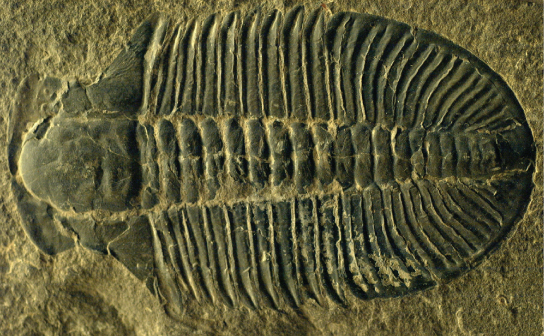

Figure 28.36図 28.36
A trilobite. Trilobites, like the one in this fossil, are an extinct group of arthropods. Their name "trilobite" refers to the three longitudinal lobes making up the body: right pleural lobe, axial lobe, and left pleural lobe (credit: Kevin Walsh).
三葉虫。この化石に見られるような三葉虫は、絶滅した節足動物の群である。「三葉虫」という名は、体を構成する縦方向の三つの葉、右側の側葉、軸葉、左側の側葉に由来する。(提供:Kevin Walsh)
Morphology形態
Characteristic features of the arthropods include the presence of jointed appendages, body segmentation, and chitinized exoskeleton. Fusion of adjacent groups of segments gave rise to functional body regions called tagmata (singular = tagma). Tagmata may be in the form of a head, thorax, and abdomen, or a cephalothorax and abdomen, or a head and trunk, depending on the taxon. Commonly described tagmata may be composed of different numbers of segments; for example, the head of most insects results from the fusion of six ancestral segments, whereas the “head” of another arthropod may be made of fewer ancestral segments, due to independent evolutionary events. Jointed arthropod appendages, often in segmental pairs, have been specialized for various functions: sensing their environment (antennae), capturing and manipulating food (mandibles and maxillae), as well as for walking, jumping, digging, and swimming.
英語のヒント
節足動物の特徴には、関節のある付属肢、体の分節、キチン化した外骨格がある。隣り合う体節群の融合によって、合体節と呼ばれる機能的な体の領域が生じた。分類群によって、頭部・胸部・腹部、頭胸部・腹部、または頭部・胴部という構成をとる。同じ名で呼ばれる合体節でも、構成する体節数は異なる場合がある。例えば、多くの昆虫の頭部は、祖先の6体節が融合してできた。一方、別の節足動物の「頭部」は、独立した進化の結果、より少ない祖先体節からできていることがある。関節のある付属肢は、しばしば各体節に対になって存在し、さまざまな機能に特殊化している。環境の感知(触角)、食物の捕獲や操作(大顎・小顎)、歩行、跳躍、掘削、遊泳などである。
In the arthropod body, a central cavity, called the hemocoel (or blood cavity), is present, and the hemocoel fluids are moved by contraction of regions of the tubular dorsal blood vessel called "hearts." Groups of arthropods also differ in the organs used for nitrogenous waste excretion, with crustaceans possessing green glands and insects using Malpighian tubules, which work in conjunction with the hindgut to reabsorb water while ridding the body of nitrogenous waste. The nervous system tends to be distributed among the segments, with larger ganglia in segments with sensory structures or appendages. The ganglia are connected by a ventral nerve cord.
英語のヒント
節足動物の体の中央には、血体腔という空洞がある。その液体は、管状の背側血管のうち「心臓」と呼ばれる部分が収縮することで動く。窒素性老廃物の排泄器官も群ごとに異なり、甲殻類には緑腺があり、昆虫はマルピーギ管を使う。マルピーギ管は後腸と協力して、水を再吸収しながら、体から窒素性老廃物を除く。神経系は各体節に分散する傾向があり、感覚構造や付属肢のある体節では神経節が大きい。神経節同士は腹側神経索でつながる。
Respiratory systems vary depending on the group of arthropod. Insects and myriapods use a series of tubes (tracheae) that branch through the body, ending in minute tracheoles. These fine respiratory tubes perform gas exchange directly between the air and cells within the organism. The major tracheae open to the surface of the cuticle via apertures called spiracles. We should note that these tracheal systems of ventilation have evolved independently in hexapods, myriapods, and arachnids. Although the tracheal system works extremely well in terrestrial environments, it also works well in freshwater aquatic environments: In fact, numerous species of aquatic insects in both immature and adult stages possess tracheal systems. However, although there are insects that live on the surface of marine environments, none is strictly marine—meaning that they complete their entire metamorphosis in salt water.
英語のヒント
呼吸系は節足動物の群によって異なる。昆虫と多足類は、体内で枝分かれする一連の管(気管)を使い、末端は微細な気管小枝となる。この細い呼吸管は、空気と体内の細胞との間で直接ガス交換を行う。主要な気管は、気門と呼ばれる開口部を通じてクチクラの表面へ開く。こうした気管による換気系は、六脚類、多足類、クモ類で独立に進化したことに注意したい。気管系は陸上で非常によく機能するが、淡水環境でもよく働く。実際、多くの水生昆虫が、未成熟期と成体期の両方で気管系をもつ。しかし、海面で暮らす昆虫はいるものの、完全に海産の昆虫、すなわち変態の全過程を塩水中で完了する昆虫はいない。
In contrast, aquatic crustaceans utilize gills, terrestrial chelicerates employ book lungs, and aquatic chelicerates use book gills (Figure 28.37). The book lungs of arachnids (scorpions, spiders, ticks, and mites) contain a vertical stack of hemocoel wall tissue that somewhat resembles the pages of a book. Between each of the "pages" of tissue is an air space. This allows both sides of the tissue to be in contact with the air at all times, greatly increasing the efficiency of gas exchange. The gills of crustaceans are filamentous structures that exchange gases with the surrounding water.
英語のヒント
対照的に、水生の甲殻類は鰓、陸生の鋏角類は書肺、水生の鋏角類は書鰓を使う(図28.37)。クモ類(サソリ、クモ、マダニ、ダニ)の書肺には、血体腔壁の組織が縦に積み重なり、本のページに似た構造がある。組織の各「ページ」の間には空気の空間があるため、両面が常に空気に接し、ガス交換の効率が大きく高まる。甲殻類の鰓は糸状の構造で、周囲の水とガスを交換する。
The cuticle is the hard “covering” of an arthropod. It is made up of two layers: the epicuticle, which is a thin, waxy, water-resistant outer layer containing no chitin, and the layer beneath it, the chitinous procuticle, which itself is composed of an exocuticle and a lower endocuticle, all supported ultimately by a basement membrane. The exoskeleton is very protective (it is sometimes difficult to squish a big beetle!), but does not sacrifice flexibility or mobility. Both the exocuticle (which is secreted before a molt), and an endocuticle, (which is secreted after a molt), are composed of chitin bound with a protein; chitin is insoluble in water, alkalis, and weak acids. The procuticle is not only flexible and lightweight, but also provides protection against dehydration and other biological and physical stresses. Some arthropods, such as the crustaceans, add calcium salts to their exoskeleton, which increases the strength of the cuticle, but does reduce its flexibility. In some cases, such as lobsters, the amount of calcium salt deposited within the chitin is extreme. In order to grow, the arthropod must “shed” the exoskeleton during the physiological process called molting, following by the actual stripping of the outer cuticle, called ecdysis (“to strip off”). At first, this seems to be a dangerous method of growth, because while the new exoskeleton is hardening, the animal is vulnerable to predation; however, molting and ecdysis also allow for growth and change in morphology, as well as for great diversification in size, simply because the numbers of molts can be modified through evolution.
英語のヒント
クチクラは節足動物の硬い「覆い」である。二つの層からなり、外側のエピクチクラは、キチンを含まない、薄くろう状で耐水性の層である。その下にはキチン質のプロクチクラがあり、さらにエクソクチクラと、その下のエンドクチクラに分かれる。全体は最終的に基底膜で支えられる。外骨格は高い保護力をもつ。大きな甲虫をつぶすのが難しいこともあるほどだが、柔軟性や運動性は失われていない。脱皮前に分泌されるエクソクチクラと、脱皮後に分泌されるエンドクチクラは、どちらもタンパク質と結合したキチンからなる。キチンは水、アルカリ、弱酸に溶けない。プロクチクラは柔軟で軽量なだけでなく、脱水などの生物的・物理的ストレスから体を保護する。甲殻類など一部の節足動物では、外骨格にカルシウム塩を加え、柔軟性を下げる一方で強度を増している。ロブスターなどでは、キチン内に沈着するカルシウム塩の量が非常に多い。成長するには、脱皮と呼ばれる生理過程で外骨格を脱ぐ準備をし、その後、外側のクチクラを実際に脱ぎ捨てる必要がある。最初は危険な成長方法に見える。新しい外骨格が硬くなる間、捕食されやすいからである。しかし、脱皮は成長や形態の変化を可能にするだけでなく、大きさの著しい多様化も可能にする。進化によって脱皮の回数そのものを変えられるためである。
The characteristic morphology of representative animals from each subphylum is described below.
以下に、各亜門を代表する動物の特徴的な形態を述べる。
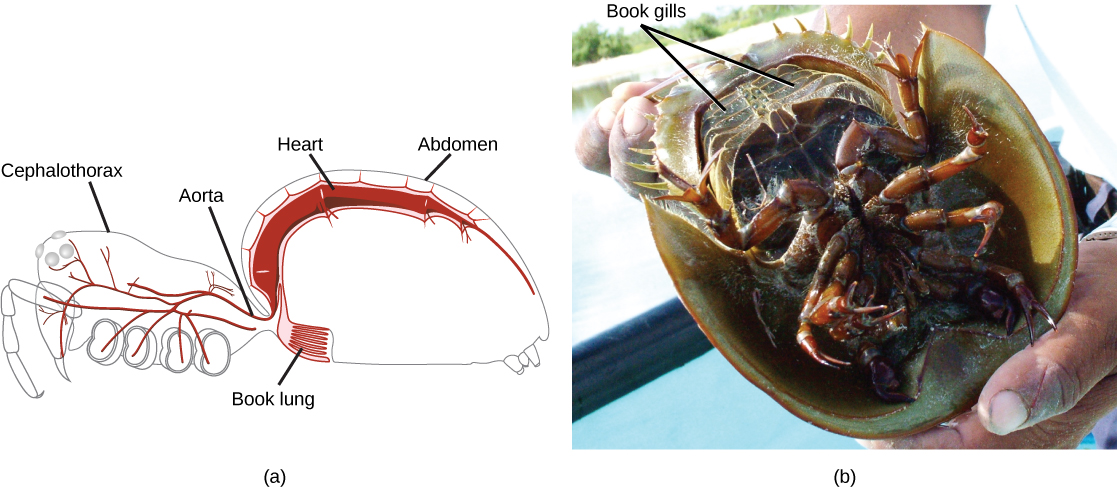
OpenStax, Rice University; Biology 2e. (credit a: modification of work by Ryan Wilson based on original work by John Henry Comstock; credit b: modification of work by Angel Schatz) · CC BY 4.0 · Source出典

Figure 28.37図 28.37
Arthropod respiratory structures. The book lungs of (a) arachnids are made up of alternating air pockets and hemocoel tissue shaped like a stack of books (hence the name, “book lung”). The book gills of (b) chelicerates, horseshoe crabs, are similar to book lungs but are external so that gas exchange can occur with the surrounding water. (credit a: modification of work by Ryan Wilson based on original work by John Henry Comstock; credit b: modification of work by Angel Schatz)
節足動物の呼吸構造。(a)クモ類の書肺は、本を積み重ねたような形の血体腔組織と、空気の空間が交互に並んでできている。これが「書肺」という名の由来である。(b)鋏角類であるカブトガニの書鰓は書肺に似ているが、外側にあるため、周囲の水とガス交換できる。(a:John Henry Comstockの原図に基づくRyan Wilsonの作品を改変。b:Angel Schatzの作品を改変)