第28章無脊椎動物
Class Cubozoa箱虫綱
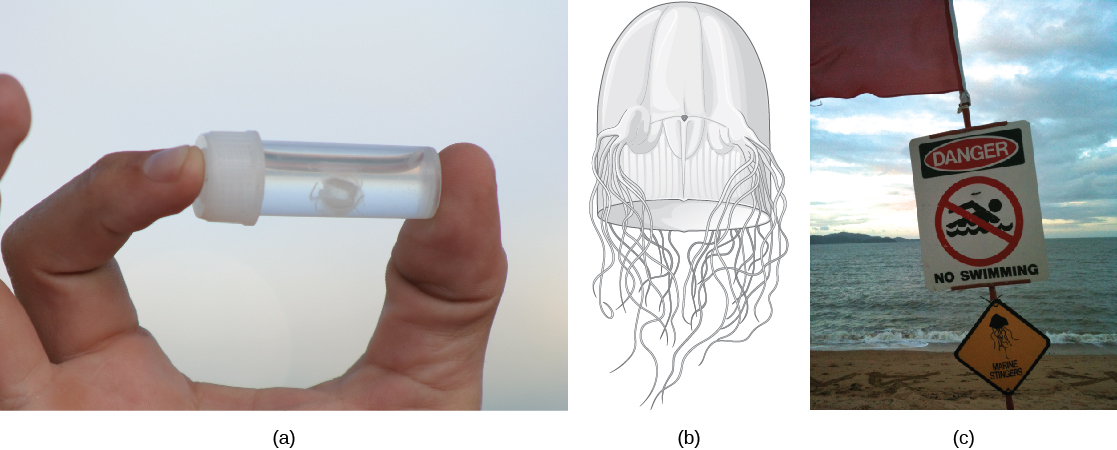
This class includes jellies that have a box-shaped medusa, or a bell that is square in cross-section, and are colloquially known as “box jellyfish.” These species may achieve sizes of 15 to 25 cm, but typically members of the Cubozoa are not as large as those of the Scyphozoa. However, cubozoans display overall morphological and anatomical characteristics that are similar to those of the scyphozoans. A prominent difference between the two classes is the arrangement of tentacles. The cubozoans contain muscular pads called pedalia at the corners of the square bell canopy, with one or more tentacles attached to each pedalium. In some cases, the digestive system may extend into the pedalia. Nematocysts may be arranged in a spiral configuration along the tentacles; this arrangement helps to effectively subdue and capture prey. Cubozoans include the most venomous of all the cnidarians (Figure 28.11).
英語のヒント
この綱には、箱形のメデューサ、すなわち横断面が正方形の傘をもつクラゲが含まれ、一般に「箱クラゲ」と呼ばれる。大きさ15〜25 cmに達する種もあるが、箱虫類は通常、鉢虫類ほど大きくない。ただし、全体的な形態や解剖学的特徴は鉢虫類に似ている。両綱の顕著な違いは、触手の配置である。箱虫類では、四角い傘の角に葉状体という筋肉質の台座があり、各葉状体に1本以上の触手が付く。消化系が葉状体の内部へ伸びることもある。触手に沿って刺胞がらせん状に配置される場合があり、この配置は獲物を効果的に動けなくして捕らえるのに役立つ。箱虫類には、全刺胞動物の中で最も強い毒をもつものが含まれる(図28.11)。
These animals are unusual in having image-forming eyes, including a cornea, lens, and retina. Because these structures are made from a number of interactive tissues, they can be called true organs. Eyes are located in four clusters between each pair of pedalia. Each cluster consists of four simple eye spots plus two image-forming eyes oriented in different directions. How images formed by these very complex eyes are processed remains a mystery, since cubozoans have extensive nerve nets but no distinct brain. Nonetheless, the presence of eyes helps the cubozoans to be active and effective hunters of small marine animals like worms, arthropods, and fish.
英語のヒント
これらの動物は、角膜、水晶体、網膜を含む、像を結ぶ眼をもつ点で独特である。この構造は、相互に働き合う複数の組織でできているため、真の器官と呼べる。眼は、隣り合う葉状体の間にある四つの集まりに配置されている。各集まりは、四つの単純な眼点と、異なる方向を向く二つの結像眼からなる。この非常に複雑な眼が結ぶ像をどのように処理するかは、まだ謎である。箱虫類には広範な神経網があるものの、明確な脳はないためである。それでも眼の存在は、虫類、節足動物、魚などの小さな海産動物を、活動的かつ効果的に狩るのに役立つ。
Cubozoans have separate sexes and fertilization occurs inside the female. Planula larvae may develop inside the female or be released, depending on species. Each planula develops into a polyp. These polyps may bud to form more polyps to create a colony; each polyp then transforms into a single medusa.
英語のヒント
箱虫類は雌雄異体で、受精は雌の体内で起こる。種によって、プラヌラ幼生は雌の体内で発生する場合と、外へ放出される場合がある。各プラヌラはポリプへ発生する。ポリプは出芽して数を増やし、群体をつくることがあり、その後、それぞれのポリプが1個体のメデューサへ変わる。
OpenStax, Rice University; Biology 2e. (credit c: modification of work by Peter Shanks) · CC BY 4.0 · Source出典

Figure 28.11図 28.11
A cubozoan. The (a) tiny cubozoan jelly Malo kingi is thimble-shaped and, like all cubozoan jellies, (b) has four muscular pedalia to which the tentacles attach. M. kingi is one of two species of jellies known to cause Irukandji syndrome, a condition characterized by excruciating muscle pain, vomiting, increased heart rate, and psychological symptoms. Two people in Australia, where Irukandji jellies are most commonly found, are believed to have died from Irukandji stings. (c) A sign on a beach in northern Australia warns swimmers of the danger. (credit c: modification of work by Peter Shanks)
箱虫類。(a)小さな箱クラゲ Malo kingi は指ぬき形で、ほかの箱クラゲと同じく、(b)触手が付着する四つの筋肉質の葉状体をもつ。M. kingi は、イルカンジ症候群を引き起こすと知られる2種のクラゲの一つである。この症状は、激しい筋肉痛、嘔吐、心拍数増加、精神的な症状を特徴とする。イルカンジクラゲが最もよく見られるオーストラリアでは、2人が刺されて死亡したと考えられている。(c)オーストラリア北部の砂浜の看板は、泳ぐ人に危険を警告している。(c:Peter Shanksの作品を改変)
Class Hydrozoaヒドロ虫綱
Hydrozoa is a diverse group that includes nearly 3,200 species; most are marine, although some freshwater species are known (Figure 28.12). Most species exhibit both polypoid and medusoid forms in their lifecycles, although the familiar Hydra has only the polyp form. The medusoid form has a muscular veil or velum below the margin of the bell and for this reason is called a hydromedusa. In contrast, the medusoid form of Scyphozoa lacks a velum and is termed a scyphomedusa.
英語のヒント
ヒドロ虫類は約3,200種を含む多様な群である。大部分は海産だが、淡水産の種も知られている(図28.12)。多くの種は生活環でポリプ型とメデューサ型の両方を示すが、よく知られたヒドラにはポリプ型しかない。メデューサ型には、傘の縁の下に縁膜という筋肉質の膜がある。このため、ヒドロクラゲと呼ばれる。これに対し、鉢虫類のメデューサ型には縁膜がなく、鉢クラゲと呼ばれる。
The polyp form in these animals often shows a cylindrical morphology with a central gastrovascular cavity lined by the gastrodermis. The gastrodermis and epidermis have a simple layer of mesoglea sandwiched between them. A mouth opening, surrounded by tentacles, is present at the oral end of the animal. Many hydrozoans form sessile, branched colonies of specialized polyps that share a common, branching gastrovascular cavity (coenosarc), such as is found in the colonial hydroid Obelia.
英語のヒント
これらの動物のポリプ型はしばしば円筒形を示し、中央には胃皮で裏打ちされた胃水管腔がある。胃皮と表皮の間には、単純な中膠の層が挟まる。体の口側の端には、触手に囲まれた口が開く。多くのヒドロ虫類では、特殊化したポリプが固着性の枝分かれした群体をつくり、共通の分岐した胃水管腔(共肉)を共有する。群体性のヒドロ虫であるオベリアがその例である。
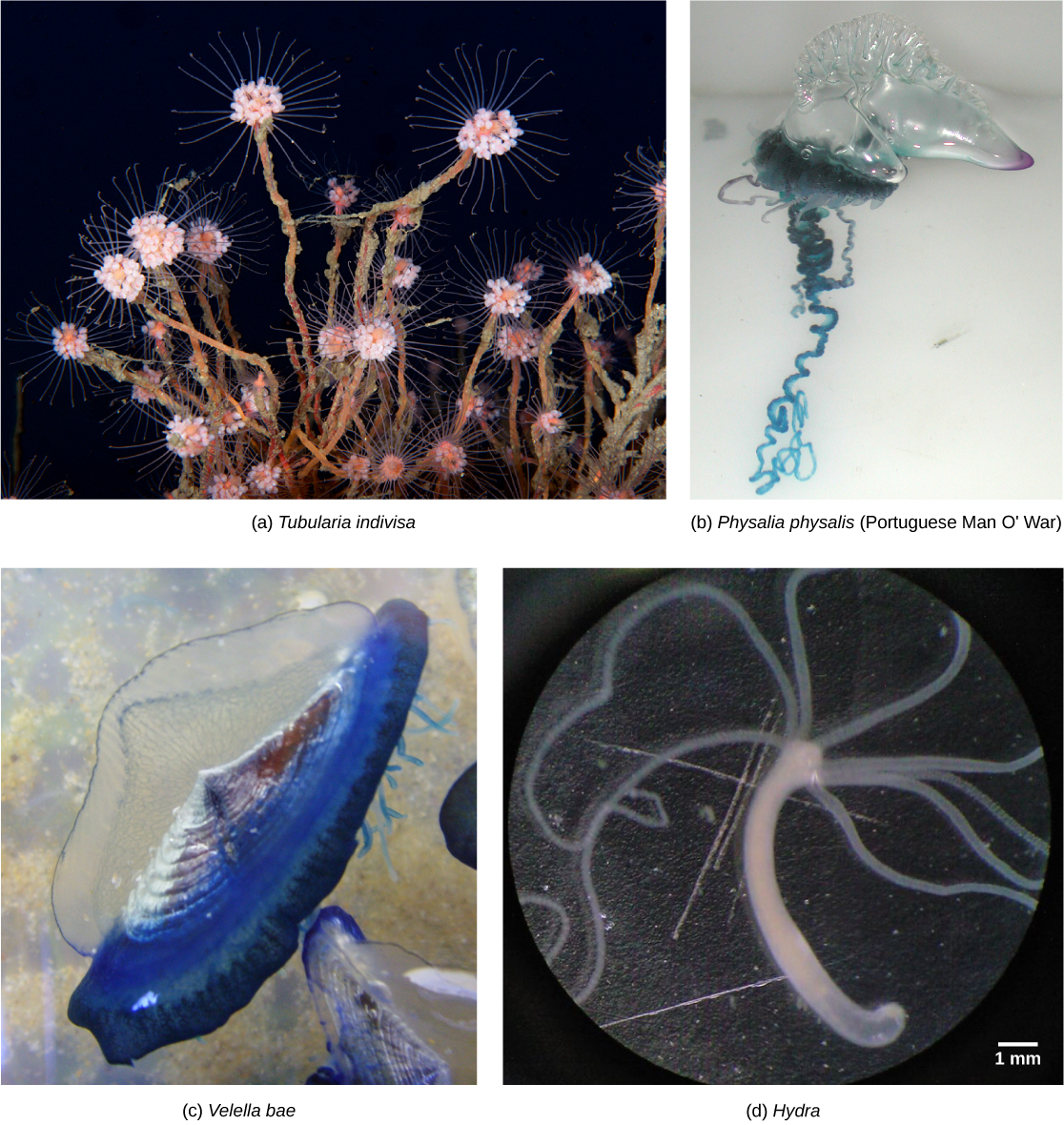
Free-floating colonial species called siphonophores contain both medusoid and polypoid individuals that are specialized for feeding, defense, or reproduction. The distinctive rainbow-hued float of the Portuguese man o’ war (Physalia physalis) creates a pneumatophore with which it regulates buoyancy by filling and expelling carbon monoxide gas. At first glance, these complex superorganisms appear to be a single organism; but the reality is that even the tentacles are actually composed of zooids laden with nematocysts. Thus, although it superficially resembles a typical medusozoan jellyfish, P. physalis is a free-floating hydrozoan colony; each specimen is made up of many hundreds of organisms, each specialized for a certain function, including motility and buoyancy, feeding, reproduction and defense. Although they are carnivorous and feed on many soft bodied marine animals, P. physalis lack stomachs and instead have specialized polyps called gastrozooids that they use to digest their prey in the open water.
英語のヒント
クダクラゲと呼ばれる、自由に浮遊する群体性の種には、摂食、防御、生殖に特殊化したメデューサ型とポリプ型の個体が含まれる。カツオノエボシ(Physalia physalis)の特徴的な虹色の浮きは気胞体をつくり、一酸化炭素ガスを満たしたり排出したりして浮力を調節する。この複雑な超個体は、一見すると一つの生物に見える。しかし実際には、触手さえも、刺胞を多数備えた個虫でできている。したがって、P. physalis は表面的には典型的なクラゲ類に似ているものの、自由に浮遊するヒドロ虫の群体である。各標本は何百もの個体からなり、それぞれが運動と浮力、摂食、生殖、防御など、特定の機能に特殊化している。P. physalis は肉食性で、体の柔らかい多くの海産動物を食べるが、胃をもたない。その代わりに栄養個虫という特殊化したポリプがあり、それを使って水中で獲物を消化する。
Physalia has male and female colonies, which release their gametes into the water. The zygote develops into a single individual, which then buds asexually to form a new colony. Siphonophores include the largest known floating cnidarian colonies such as Praya dubia, whose chain of zooids can get up to 50 meters (165 feet) long. Other hydrozoan species are solitary polyps (Hydra) or solitary hydromedusae (Gonionemus). One defining characteristic shared by the hydrozoans is that their gonads are derived from epidermal tissue, whereas in all other cnidarians they are derived from gastrodermal tissue.
英語のヒント
カツオノエボシには雄の群体と雌の群体があり、水中へ配偶子を放出する。接合子は1個体へ発生し、それが無性的に出芽して新しい群体を形成する。クダクラゲには、知られている中で最大の浮遊性刺胞動物群体が含まれる。例えば Praya dubia では、個虫が連なった鎖が長さ50 m(165フィート)に達することがある。ほかのヒドロ虫類には、単独性のポリプ(Hydra)や、単独性のヒドロクラゲ(Gonionemus)がある。ヒドロ虫類に共通する特徴の一つは、生殖腺が表皮組織に由来することである。それ以外のすべての刺胞動物では、生殖腺は胃皮組織に由来する。
OpenStax, Rice University; Biology 2e. (credit a: modification of work by Bernard Picton/Wikimedia Commons; credit b: modification of work by NOAA; scale-bar data from Matt Russell) · CC BY 4.0 · Source出典

Figure 28.12図 28.12
Hydrozoans. The Tubularia indivisa (a), siphonophore colonies Physalia physalis, known as the Portuguese man o‘ war (b), Velella bae (c), and the solitary polyp Hydra (d) have different body shapes but all belong to the family Hydrozoa. (credit a: modification of work by Bernard Picton/Wikimedia Commons; credit b: modification of work by NOAA; scale-bar data from Matt Russell)
ヒドロ虫類。Tubularia indivisa(a)、カツオノエボシとして知られるクダクラゲの群体 Physalia physalis(b)、Velella bae(c)、単独性のポリプである Hydra(d)は、体形は異なるが、いずれも Hydrozoa 科に属する。(a:Bernard Picton/Wikimedia Commonsの作品を改変。b:NOAAの作品を改変。スケールバーのデータ:Matt Russell)