第39章呼吸器系
Introductionはじめに
OpenStax, Rice University; Biology 2e. (credit a: modification of work by Geoff Stearns; credit b: modification of work by Cory Zanker) · CC BY 4.0 · Source出典

Figure 39.1図 39.1
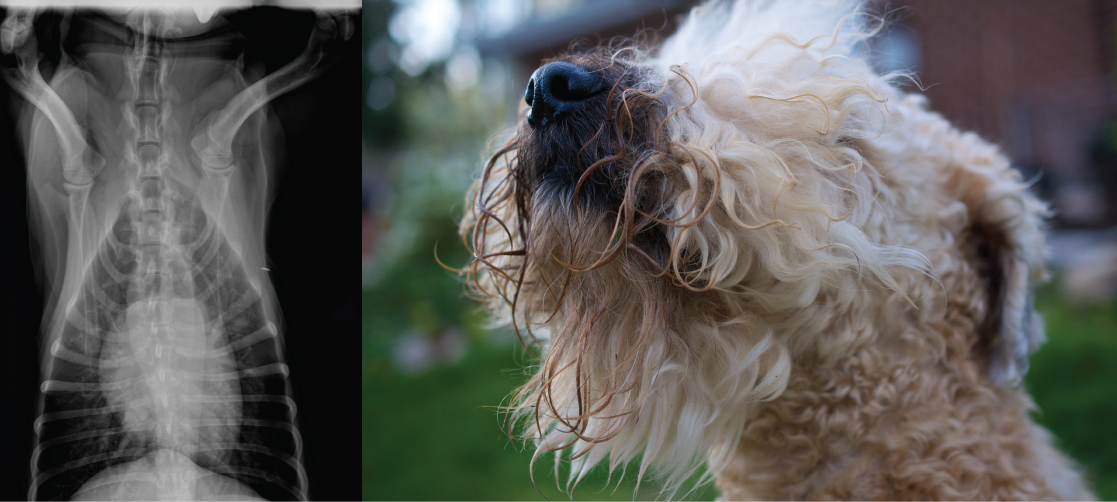
Lungs, which appear as nearly transparent tissue surrounding the heart in this X-ray of a dog (left), are the central organs of the respiratory system. The left lung is smaller than the right lung to accommodate space for the heart. A dog’s nose (right) has a slit on the side of each nostril. When tracking a scent, the slits open, blocking the front of the nostrils. This allows the dog to exhale though the now-open area on the side of the nostrils without losing the scent that is being followed. (credit a: modification of work by Geoff Stearns; credit b: modification of work by Cory Zanker)
肺は呼吸器系の中心となる器官であり、このイヌのX線画像(左)では、心臓の周囲にあるほぼ透明な組織として見える。心臓を収める空間を確保するため、左肺は右肺より小さい。イヌの鼻(右)には、左右の鼻孔の側面に切れ込みがある。においを追うときには、この切れ込みが開いて鼻孔の前面がふさがる。そのため、追っているにおいを見失うことなく、開いた鼻孔側面から息を吐ける。(出典a:Geoff Stearnsの作品を改変。出典b:Cory Zankerの作品を改変)
Breathing is an involuntary event. How often a breath is taken and how much air is inhaled or exhaled are tightly regulated by the respiratory center in the brain. Humans, when they aren’t exerting themselves, breathe approximately 15 times per minute on average. Canines, like the dog in Figure 39.1, have a respiratory rate of about 15–30 breaths per minute. With every inhalation, air fills the lungs, and with every exhalation, air rushes back out. That air is doing more than just inflating and deflating the lungs in the chest cavity. The air contains oxygen that crosses the lung tissue, enters the bloodstream, and travels to organs and tissues. Oxygen (O2) enters the cells where it is used for metabolic reactions that produce ATP, a high-energy compound. At the same time, these reactions release carbon dioxide (CO2) as a by-product. CO2 is toxic and must be eliminated. Carbon dioxide exits the cells, enters the bloodstream, travels back to the lungs, and is expired out of the body during exhalation.
英語のヒント
呼吸は不随意に起こる。呼吸の頻度と、吸い込む空気や吐き出す空気の量は、脳の呼吸中枢によって厳密に調節されている。ヒトは体を動かしていないとき、平均で1分間に約15回呼吸する。図39.1のイヌのようなイヌ科の動物では、呼吸数は1分間に約15〜30回である。息を吸うたびに肺は空気で満たされ、息を吐くたびに空気は再び外へ勢いよく出ていく。空気の役割は、胸腔内の肺を膨らませたりしぼませたりするだけではない。空気に含まれる酸素は、肺組織を通り抜けて血流に入り、器官や組織へ運ばれる。酸素(O2)は細胞に入り、高エネルギー化合物であるATPをつくる代謝反応に使われる。同時に、これらの反応では副産物として二酸化炭素(CO2)が放出される。CO2 は有毒であり、除去しなければならない。二酸化炭素は細胞を出て血流に入り、肺へ戻り、呼気とともに体外へ吐き出される。