第23章原生生物
Introductionはじめに
OpenStax, Rice University; Biology 2e. (credit a: modification of work by Yuiuji Tsukii; credit b: modification of work by Richard Robinson, Public Library of Science; credit c: modification of work by Kip Evans, NOAA; scale-bar data from Matt Russell) · CC BY 4.0 · Source出典

Figure 23.1図 23.1
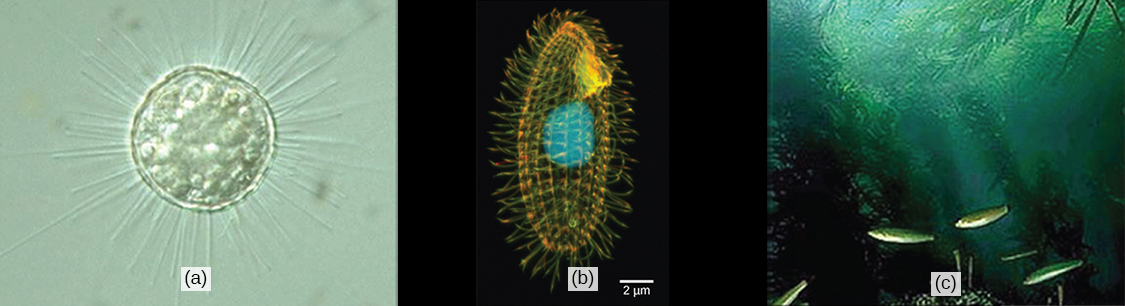
Protists range from the microscopic, single-celled (a) Acanthocystis turfacea and the (b) ciliate Tetrahymena thermophila, both visualized here using light microscopy, to the enormous, multicellular (c) kelps (Chromalveolata) that extend for hundreds of feet in underwater “forests.” (credit a: modification of work by Yuiuji Tsukii; credit b: modification of work by Richard Robinson, Public Library of Science; credit c: modification of work by Kip Evans, NOAA; scale-bar data from Matt Russell)
英語のヒント
原生生物は、ここで光学顕微鏡によって示した、微小な単細胞の(a)Acanthocystis turfaceaや、(b)繊毛虫Tetrahymena thermophilaから、水中の「森林」で何百フィートにも伸びる、巨大な多細胞の(c)ケルプ(クロムアルベオラータ)まで、多岐にわたる。(クレジットa:Yuiuji Tsukiiの作品を改変。クレジットb:Richard Robinson、Public Library of Scienceの作品を改変。クレジットc:Kip Evans、NOAAの作品を改変。スケールバーのデータ:Matt Russell)
Humans have been familiar with macroscopic organisms (organisms big enough to see with the unaided eye) since before there was a written history, and it is likely that most cultures distinguished between animals and land plants, and most probably included the macroscopic fungi as plants. Therefore, it became an interesting challenge to deal with the world of microorganisms once microscopes were developed a few centuries ago. Many different naming schemes were used over the last couple of centuries, but it has become the most common practice to refer to eukaryotes that are not land plants, animals, or fungi as protists.
英語のヒント
ヒトは、文字による歴史が始まる前から、肉眼で見えるほど大きい生物を知っていた。おそらく大半の文化では、動物と陸上植物を区別し、肉眼で見える菌類の大半も植物に含めていただろう。そのため、数世紀前に顕微鏡が発達すると、微生物の世界をどう扱うかが興味深い課題となった。ここ2世紀ほどの間、さまざまな命名体系が使われてきたが、現在では、陸上植物、動物、菌類ではない真核生物を、原生生物と呼ぶのが最も一般的になっている。
This name was first suggested by Ernst Haeckel in the late nineteenth century. It has been applied in many contexts and has been formally used to represent a kingdom-level taxon called Protista. However, many modern systematists (biologists who study the relationships among organisms) are beginning to shy away from the idea of formal ranks such as kingdom and phylum. Instead, they are naming taxa as groups of organisms thought to include all the descendants of a last common ancestor (monophyletic group). During the past two decades, the field of molecular genetics has demonstrated that some protists are more related to animals, plants, or fungi than they are to other protists. Therefore, not including animals, plants, and fungi make the kingdom Protista a paraphyletic group, or one that does not include all descendents of its common ancestor. For this reason, protist lineages originally classified into the kingdom Protista continue to be examined and debated. In the meantime, the term “protist” still is used informally to describe this tremendously diverse group of eukaryotes.
英語のヒント
この名前は、19世紀後半にエルンスト・ヘッケルが初めて提案した。多くの文脈で使われ、正式には、プロティスタ、すなわち原生生物界という界レベルの分類群を表してきた。しかし現代の系統分類学者、すなわち生物同士の関係を研究する生物学者の多くは、界や門のような正式な階級という考え方から距離を置き始めている。代わりに、最終共通祖先のすべての子孫を含むと考えられる生物群、すなわち単系統群として、分類群に名前をつけている。過去20年間、分子遺伝学は、一部の原生生物が、ほかの原生生物よりも、動物、植物、菌類に近縁であることを示してきた。そのため、動物、植物、菌類を含めない原生生物界は、共通祖先のすべての子孫を含まない、側系統群となる。この理由から、もともと原生生物界へ分類されていた系統は、今も調査と議論の対象である。その間も「原生生物」という語は、この極めて多様な真核生物群を記述する非公式の語として、使われ続けている。
Most protists are microscopic, unicellular organisms that are abundant in soil, freshwater, brackish, and marine environments. They are also common in the digestive tracts of animals and in the vascular tissues of plants. Others invade the cells of other protists, animals, and plants. Not all protists are microscopic. Some have huge, macroscopic cells, such as the plasmodia (giant amoebae) of myxomycete slime molds or the marine green alga Caulerpa, which can have single cells that can be several meters in size. Some protists are multicellular, such as the red, green, and brown seaweeds. It is among the protists that one finds the wealth of ways that organisms can grow.
英語のヒント
原生生物の大半は微小な単細胞生物で、土壌、淡水、汽水、海水の環境に豊富に存在する。動物の消化管や、植物の維管束組織にもよく見られる。ほかの原生生物、動物、植物の細胞へ侵入するものもいる。すべてが微小というわけではない。変形菌の変形体、すなわち巨大アメーバや、数メートルもの単一細胞をもつことがある海産緑藻Caulerpaのように、肉眼で見える巨大な細胞をもつものもいる。紅藻、緑藻、褐藻のように、多細胞の原生生物もいる。生物が成長できる仕方の豊かさを見いだせるのは、原生生物の中なのである。