第23章原生生物
23.3 Groups of Protists23.3 原生生物の諸群
Learning Objectives学習目標
By the end of this section, you will be able to do the following:
この節を学ぶと、次のことができるようになる。
- Describe representative protist organisms from each of the six presently recognized supergroups of eukaryotes現在認められている真核生物の六つのスーパーグループから、それぞれ代表的な原生生物を説明する。
- Identify the evolutionary relationships of plants, animals, and fungi within the six presently recognized supergroups of eukaryotes現在認められている真核生物の六つのスーパーグループにおける、植物、動物、菌類の進化的関係を特定する。
- Identify defining features of protists in each of the six supergroups of eukaryotes.真核生物の六つのスーパーグループそれぞれについて、原生生物を特徴づける性質を特定する。
In the span of several decades, the Kingdom Protista has been disassembled because sequence analyses have revealed new genetic (and therefore evolutionary) relationships among these eukaryotes. Moreover, protists that exhibit similar morphological features may have evolved analogous structures because of similar selective pressures—rather than because of recent common ancestry. This phenomenon, called convergent evolution, is one reason why protist classification is so challenging. The emerging classification scheme groups the entire domain Eukarya into six “supergroups” that contain all of the protists as well as animals, plants, and fungi that evolved from a common ancestor (Figure 23.9). Each of the supergroups is believed to be monophyletic, meaning that all organisms within each supergroup are believed to have evolved from a single common ancestor, and thus all members are most closely related to each other than to organisms outside that group. There is still evidence lacking for the monophyly of some groups. Each supergroup can be viewed as representing one of many variants on eukaryotic cell structure. In each group, one or more of the defining characters of the eukaryotic cell—the nucleus, the cytoskeleton, and the endosymbiotic organelles—may have diverged from the "typical" pattern.
英語のヒント
数十年の間に、原生生物界は解体されてきた。配列解析によって、これらの真核生物の間に、新たな遺伝的関係、したがって進化的関係が明らかになったためである。さらに、似た形態的特徴を示す原生生物は、最近の共通祖先をもつからではなく、似た選択圧のために、相似の構造を進化させたのかもしれない。収斂進化と呼ばれるこの現象は、原生生物の分類が難しい理由の一つである。新たに現れつつある分類体系は、真核生物ドメイン全体を、共通祖先から進化したすべての原生生物と動物、植物、菌類を含む、六つの「スーパーグループ」に分ける(図23.9)。各スーパーグループは単系統と考えられる。つまり、それぞれの群内のすべての生物が単一の共通祖先から進化し、群外の生物よりも群内の成員同士のほうが、互いに最も近縁だと考えられる。ただし、一部の群が単系統であるという証拠は、まだ不足している。各スーパーグループは、真核細胞構造の多くの変型の一つを代表するものと見なせる。各群では、真核細胞を特徴づける核、細胞骨格、細胞内共生由来の細胞小器官のうち、一つ以上が「典型的な」型から分岐した可能性がある。
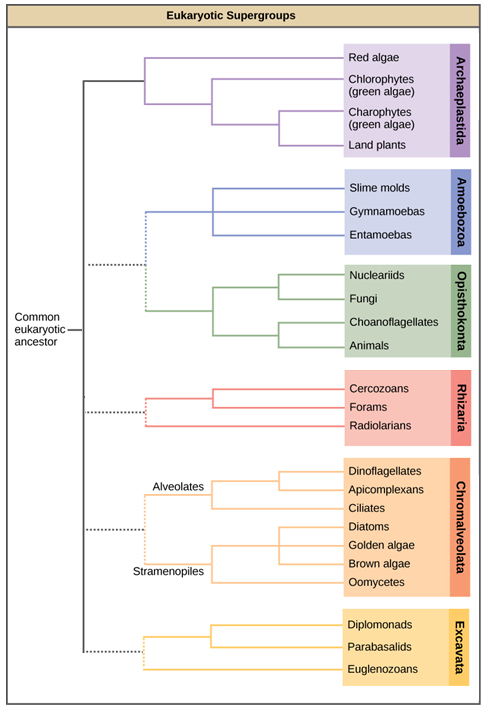

Figure 23.9図 23.9
Eukaryotic supergroups. This diagram shows a proposed classification of the domain Eukarya. Currently, the domain Eukarya is divided into six supergroups. Within each supergroup are multiple kingdoms. Although each supergroup is believed to be monophyletic, the dotted lines suggest evolutionary relationships among the supergroups that continue to be debated.
英語のヒント
真核生物のスーパーグループ。真核生物ドメインについて提案された分類を示す図。現在、真核生物ドメインは六つのスーパーグループに分けられ、それぞれに複数の界が含まれる。各スーパーグループは単系統と考えられるが、点線は、いまだ議論されている群間の進化的関係を示す。
Keep in mind that the classification scheme presented here represents just one of several hypotheses, and the true evolutionary relationships are still to be determined. The six supergroups may be modified or replaced by a more appropriate hierarchy as genetic, morphological, and ecological data accumulate. When learning about protists, it is helpful to focus less on the nomenclature and more on the commonalities and differences that illustrate how each group has exploited the possibilities of eukaryotic life.
英語のヒント
ここで示す分類体系は、複数の仮説の一つにすぎず、真の進化的関係は、まだ確定していないことを覚えておこう。遺伝、形態、生態のデータが蓄積するにつれ、六つのスーパーグループは修正され、より適切な階層に置き換えられるかもしれない。原生生物を学ぶ際には、名称そのものよりも、各群が真核生物としての可能性をどのように活用してきたかを示す、共通点と相違点に注目すると役立つ。
Archaeplastidaアーケプラスチダ
Molecular evidence supports the hypothesis that all Archaeplastida are descendents of an endosymbiotic relationship between a heterotrophic protist and a cyanobacterium. The protist members of the group include the red algae and green algae. It was from a common ancestor of these protists that the land plants evolved, since their closest relatives are found in this group. The red and green algae include unicellular, multicellular, and colonial forms. A variety of algal life cycles exists, but the most complex is alternation of generations, in which both haploid and diploid stages are multicellular. A diploid sporophyte contains cells that undergo meiosis to produce haploid spores. The spores germinate and grow into a haploid gametophyte, which then makes gametes by mitosis. The gametes fuse to form a zygote that grows into a diploid sporophyte. Alternation of generations is seen in some species of Archaeplastid algae, as well as some species of Stramenopiles (Figure 23.10). In some species, the gametophyte and sporophyte look quite different, while in others they are nearly indistinguishable.
英語のヒント
分子的な証拠は、すべてのアーケプラスチダが、従属栄養性原生生物とシアノバクテリアの細胞内共生関係から生じた子孫だという仮説を支持する。この群の原生生物には、紅藻と緑藻が含まれる。陸上植物の最も近縁な生物がこの群に見つかることから、陸上植物が進化したのは、これらの原生生物の共通祖先からである。紅藻と緑藻には、単細胞、多細胞、群体の形が含まれる。藻類にはさまざまな生活環があるが、最も複雑なのは、半数体と二倍体の両段階が多細胞となる世代交代である。二倍体の胞子体には、減数分裂して半数体の胞子を作る細胞がある。胞子は発芽して半数体の配偶体へ成長し、配偶体は有糸分裂で配偶子を作る。配偶子は融合して接合子となり、二倍体の胞子体へ成長する。世代交代は、アーケプラスチダに属する藻類の一部の種と、ストラメノパイルの一部の種に見られる(図23.10)。配偶体と胞子体が大きく異なって見える種もあれば、ほぼ見分けがつかない種もある。
Glaucophytes灰色藻
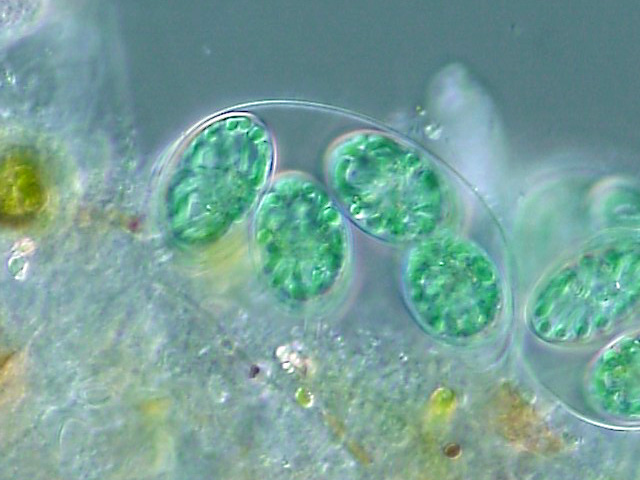
Glaucophytes are a small group of Archaeplastida interesting because their chloroplasts retain remnants of the peptidoglycan cell wall of the ancestral cyanobacterial endosymbiont (Figure 23.10).
英語のヒント
灰色藻は、アーケプラスチダの小さな群である。その葉緑体には、祖先である細胞内共生シアノバクテリアのペプチドグリカン細胞壁の名残が保たれている点が、興味深い(図23.10)。
NEON / NEON_ja; Glaucocystis sp. OpenStax, Biology 2e adaptation. · CC BY-SA 2.5 · Source出典
Figure 23.10図 23.10
Glaucocystis. (credit: By ja:User:NEON / commons:User:NEON_ja - Own work, CC BY-SA 2.5, https://commons.wikimedia.org/w/index.php?curid=1706641)
Glaucocystis。(クレジット:ja:User:NEON / commons:User:NEON_ja、本人の作品、CC BY-SA 2.5、https://commons.wikimedia.org/w/index.php?curid=1706641)
Red Algae紅藻
Red algae, or rhodophytes lack flagella, and are primarily multicellular, although they range in size from microscopic, unicellular protists to large, multicellular forms grouped into the informal seaweed category. Red algae have a second cell wall outside an inner cellulose cell wall. Carbohydrates in this wall are the source of agarose used for electrophoresis gels and agar for solidifying bacterial media. The "red" in the red algae comes from phycoerythrins, accessory photopigments that are red in color and obscure the green tint of chlorophyll in some species. Other protists classified as red algae lack phycoerythrins and are parasites. Both the red algae and the glaucophytes store carbohydrates in the cytoplasm rather than in the plastid. Red algae are common in tropical waters where they have been detected at depths of 260 meters. Other red algae exist in terrestrial or freshwater environments. The red algae life cycle is an unusual alternation of generations that includes two sporophyte phases, with meiosis occurring only in the second sporophyte.
英語のヒント
紅藻(ロドファイタ)は鞭毛をもたず、主に多細胞であるが、その大きさは、顕微鏡で見る単細胞原生生物から、非公式に海藻と呼ばれる大型多細胞のものまで及ぶ。紅藻は、内側のセルロース細胞壁の外に、2枚目の細胞壁をもつ。この壁の炭水化物は、電気泳動ゲルに用いるアガロースや、細菌培地を固める寒天の原料となる。紅藻の「紅」は、赤い補助光合成色素のフィコエリトリンに由来し、一部の種では葉緑素の緑色を覆い隠す。紅藻に分類される別の原生生物には、フィコエリトリンを欠く寄生性のものもある。紅藻と灰色藻はどちらも、炭水化物を色素体ではなく細胞質に貯蔵する。紅藻は熱帯の水域によく見られ、水深260メートルでも確認されている。陸上や淡水環境に存在する紅藻もいる。紅藻の生活環は、胞子体の段階が二つあり、2番目の胞子体だけで減数分裂が起こる、特殊な世代交代である。