第23章原生生物
Mitochondriaミトコンドリア
One of the major features distinguishing prokaryotes from eukaryotes is the presence of mitochondria, or their reduced derivatives, in virtually all eukaryotic cells. Eukaryotic cells may contain anywhere from one to several thousand mitochondria, depending on the cell’s level of energy consumption, in humans being most abundant in the liver and skeletal muscles. Each mitochondrion measures 1 to 10 or greater micrometers in length and exists in the cell as an organelle that can be ovoid to worm-shaped to intricately branched (Figure 23.2). However, although they may have originated as free-living aerobic organisms, mitochondria can no longer survive and reproduce outside the cell.
英語のヒント
原核生物と真核生物を区別する主要な特徴の一つは、ほぼすべての真核細胞に、ミトコンドリア、またはその縮小した派生構造が存在することである。真核細胞は、エネルギー消費量に応じて、1個から数千個のミトコンドリアを含む。ヒトでは肝臓と骨格筋に最も豊富にある。各ミトコンドリアの長さは1〜10 µm、またはそれ以上で、卵形、虫のような形、複雑に枝分かれした形などの細胞小器官として、細胞内に存在する(図23.2)。しかし、自由生活性の好気性生物に由来する可能性はあるものの、今では細胞外で生存・増殖することはできない。
Mitochondria have several features that suggest their relationship to alpha-proteobacteria (Figure 23.5). Alpha-proteobacteria are a large group of bacteria that includes species symbiotic with plants, disease organisms that can infect humans via ticks, and many free-living species that use light for energy. Mitochondria have their own genomes, with a circular chromosome stabilized by attachments to the inner membrane. Mitochondria also have special ribosomes and transfer RNAs that resemble these same components in prokaryotes. An intriguing feature of mitochondria is that many of them exhibit minor differences from the universal genetic code. However, many of the genes for respiratory proteins are now relocated in the nucleus. When these genes are compared to those of other organisms, they appear to be of alpha-proteobacterial origin. In some eukaryotic groups, such genes are found in the mitochondria, whereas in other groups, they are found in the nucleus. This has been interpreted as evidence that over evolutionary time, genes have been transferred from the endosymbiont chromosome to those of the host genome. This apparent “loss” of genes by the endosymbiont is probably one explanation why mitochondria cannot live without a host.
英語のヒント
ミトコンドリアには、アルファプロテオバクテリアとの関係を示唆する特徴がいくつもある(図23.5)。アルファプロテオバクテリアは大きな細菌群で、植物と共生する種、ダニを介してヒトに感染する病原体、光をエネルギー源にする多数の自由生活性の種を含む。ミトコンドリアは独自のゲノムをもち、環状染色体は内膜への付着によって安定している。また、原核生物の同じ構成要素に似た、特殊なリボソームと転移RNAももつ。興味深い特徴として、多くのミトコンドリアでは、普遍的な遺伝暗号とわずかな違いがある。しかし、呼吸に関わるタンパク質の遺伝子の多くは、現在、核へ移っている。ほかの生物の遺伝子と比べると、アルファプロテオバクテリアに由来するとみられる。真核生物のある群ではミトコンドリア内にあり、別の群では核内にある。これは、進化の過程で、細胞内共生体の染色体から宿主ゲノムの染色体へ、遺伝子が移った証拠と解釈される。共生体によるこの見かけ上の遺伝子の「喪失」は、ミトコンドリアが宿主なしで生きられない理由の一つだろう。
Another line of evidence supporting the idea that mitochondria were derived by endosymbiosis comes from the structure of the mitochondrion itself. Most mitochondria are shaped like alpha-proteobacteria and are surrounded by two membranes; the inner membrane is bacterial in nature whereas the outer membrane is eukaryotic in nature. This is exactly what one would expect if one membrane-bound organism was engulfed into a vacuole by another membrane-bound organism. The outer mitochondrial membrane was derived by the enclosing vesicle, while the inner membrane was derived from the plasma membrane of the endosymbiont. The mitochondrial inner membrane is extensive and involves substantial infoldings called cristae that resemble the textured, outer surface of alpha-proteobacteria. The matrix and inner membrane are rich with the enzymes necessary for aerobic respiration.
英語のヒント
ミトコンドリアが細胞内共生から生じたという考えを支える、別の証拠は、ミトコンドリア自身の構造にある。大半のミトコンドリアはアルファプロテオバクテリアに似た形で、二つの膜に囲まれる。内膜は細菌的な性質をもち、外膜は真核生物的な性質をもつ。これは、膜に囲まれた一つの生物が、別の膜に囲まれた生物によって液胞内へ取り込まれた場合に、まさに予想されることである。外側のミトコンドリア膜は、包み込んだ小胞に由来し、内膜は細胞内共生体の細胞膜に由来した。ミトコンドリアの内膜は広く、クリステと呼ばれる大きな内向きの折り込みをもつ。これは、アルファプロテオバクテリアの凹凸のある外表面に似ている。マトリックスと内膜は、好気呼吸に必要な酵素に富む。
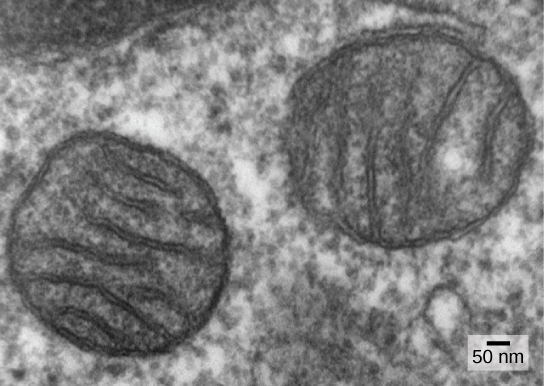

Figure 23.2図 23.2
Mitochondria. In this transmission electron micrograph of mitochondria in a mammalian lung cell, the cristae, infoldings of the mitochondrial inner membrane, can be seen in cross-section. (credit: Louise Howard)
ミトコンドリア。哺乳類の肺細胞内のミトコンドリアを示す透過型電子顕微鏡写真で、内膜が内向きに折り込まれたクリステの断面が見える。(クレジット:Louise Howard)
The third line of evidence comes from the production of new mitochondria. Mitochondria divide independently by a process that resembles binary fission in prokaryotes. Mitochondria arise only from previous mitochondria; they are not formed from scratch (de novo) by the eukaryotic cell. Mitochondria may fuse together; and they may be moved around inside the cell by interactions with the cytoskeleton. They reproduce within their enclosing cell and are distributed with the cytoplasm when a cell divides or two cells fuse. Therefore, although these organelles are highly integrated into the eukaryotic cell, they still reproduce as if they were independent organisms within the cell. However, their reproduction is synchronized with the activity and division of the cell. These features all support the theory that mitochondria were once free-living prokaryotes.
英語のヒント
三つ目の証拠は、新しいミトコンドリアの生じ方にある。ミトコンドリアは、原核生物の二分裂に似た過程によって独立に分裂する。既存のミトコンドリアからしか生じず、真核細胞がゼロから新規に作るわけではない。ミトコンドリア同士は融合することがあり、細胞骨格との相互作用で細胞内を移動することもある。自身を包む細胞内で増殖し、細胞が分裂したり、二つの細胞が融合したりするとき、細胞質とともに分配される。したがって、真核細胞へ高度に統合されていながら、細胞内の独立した生物であるかのように増殖し続ける。ただし、その増殖は細胞の活動や分裂と同期している。これらの特徴はすべて、ミトコンドリアがかつて自由生活性の原核生物だったという説を支える。
Some living eukaryotes are anaerobic and cannot survive in the presence of too much oxygen. However, a few appear to lack organelles that could be recognized as mitochondria. In the 1970s and on into the early 1990s, many biologists suggested that some of these eukaryotes were descended from ancestors whose lineages had diverged from the lineage of mitochondrion-containing eukaryotes before endosymbiosis occurred. Later findings suggest that reduced organelles are found in most, if not all, anaerobic eukaryotes, and that virtually all eukaryotes appear to carry some genes in their nuclei that are of mitochondrial origin.
英語のヒント
現生真核生物の中には嫌気性で、酸素が多すぎると生きられないものがいる。しかし、少数のものには、ミトコンドリアと認識できる細胞小器官がないように見える。1970年代から1990年代初めにかけて、多くの生物学者は、その一部が、細胞内共生の起こる前に、ミトコンドリアをもつ真核生物の系統から分岐した祖先の子孫だと提案した。その後の発見は、嫌気性真核生物の、すべてとはいわなくても大半に、縮小した細胞小器官があることを示唆する。また、ほぼすべての真核生物は、核内にミトコンドリア由来の遺伝子をいくらかもつようである。
In addition to the aerobic generation of ATP, mitochondria have several other metabolic functions. One of these functions is to generate clusters of iron and sulfur that are important cofactors of many enzymes. Such functions are often associated with the reduced mitochondrion-derived organelles of anaerobic eukaryotes. The protist Monocercomonoides, an inhabitant of vertebrate digestive tracts, appears to be an exception; it has no mitochondria and its genome contains neither genes derived from mitochondria nor nuclear genes related to mitochondrial maintenance. However, it is related to other protists with reduced mitochondria and probably represents an end-point in mitochondrial reduction. Although most biologists accept that the last common ancestor of eukaryotes had mitochondria, it appears that the complex relationship between mitochondria and their host cell continues to evolve.
英語のヒント
好気的なATP産生に加え、ミトコンドリアには、いくつかの代謝機能がある。その一つは、多くの酵素の重要な補因子となる、鉄と硫黄のクラスターを作ることである。こうした機能は、嫌気性真核生物の、縮小したミトコンドリア由来の細胞小器官にも、しばしば関わる。脊椎動物の消化管に住む原生生物Monocercomonoidesは、例外のようである。ミトコンドリアがなく、ゲノムにはミトコンドリア由来の遺伝子も、その維持に関わる核遺伝子もない。しかし、縮小したミトコンドリアをもつほかの原生生物に近縁であり、おそらくミトコンドリアの縮小の終点を示す。大半の生物学者は、真核生物の最終共通祖先にミトコンドリアがあったと認めているが、ミトコンドリアと宿主細胞の複雑な関係は、今も進化し続けているようである。