第42章免疫系
Introductionはじめに
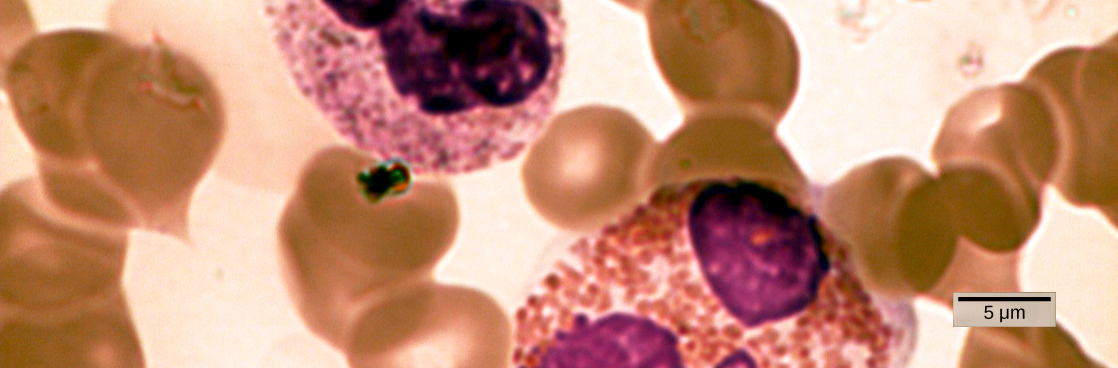
OpenStax, Rice University; Biology 2e. (credit: modification of work by Dr. David Csaba) · CC BY 4.0 · Source出典

Figure 42.1図 42.1
In this compound light micrograph purple-stained neutrophil (upper left) and eosinophil (lower right) are white blood cells that float among red blood cells in this blood smear. Neutrophils provide an early, rapid, and nonspecific defense against invading pathogens. Eosinophils play a variety of roles in the immune response. Red blood cells are about 7–8 µm in diameter, and a neutrophil is about 10–12µm. (credit: modification of work by Dr. David Csaba)
この複式光学顕微鏡写真では、紫色に染まった好中球(左上)と好酸球(右下)が、血液塗抹標本の赤血球の間に見える。これらは白血球である。好中球は、侵入した病原体に対して早期に迅速で非特異的な防御を行う。好酸球は免疫応答でさまざまな役割を担う。赤血球の直径は約7〜8 µm、好中球は約10〜12 µmである。(出典:Dr. David Csabaの作品を改変)
The environment consists of numerous pathogens, which are agents, usually microorganisms, that cause diseases in their hosts. A host is the organism that is invaded and often harmed by a pathogen. Pathogens include bacteria, protists, fungi and other infectious organisms. We are constantly exposed to pathogens in food and water, on surfaces, and in the air. Mammalian immune systems evolved for protection from such pathogens; they are composed of an extremely diverse array of specialized cells and soluble molecules that coordinate a rapid and flexible defense system capable of providing protection from a majority of these disease agents.
英語のヒント
環境には多数の病原体が存在する。病原体とは、宿主に病気を引き起こす因子で、通常は微生物である。宿主とは、病原体に侵入され、しばしば害を受ける生物をいう。病原体には細菌、原生生物、菌類、その他の感染性生物が含まれる。私たちは、食物や水、物の表面、空気の中の病原体に絶えずさらされている。哺乳類の免疫系は、このような病原体から身を守るために進化した。非常に多様な特殊化した細胞と可溶性分子からなり、それらが協調して、病気を起こす因子の大部分から体を守れる、迅速で柔軟な防御系を作り上げる。
Components of the immune system constantly search the body for signs of pathogens. When pathogens are found, immune factors are mobilized to the site of an infection. The immune factors identify the nature of the pathogen, strengthen the corresponding cells and molecules to combat it efficiently, and then halt the immune response after the infection is cleared to avoid unnecessary host cell damage. The immune system can remember pathogens to which it has been exposed to create a more efficient response upon reexposure. This memory can last several decades. Features of the immune system, such as pathogen identification, specific response, amplification, retreat, and remembrance are essential for survival against pathogens. The immune response can be classified as either innate or adaptive. The innate immune response is always present and attempts to defend against all pathogens rather than focusing on specific ones. Conversely, the adaptive immune response stores information about past infections and mounts pathogen-specific defenses.
英語のヒント
免疫系の構成要素は、病原体の徴候がないか、体内を絶えず調べている。病原体が見つかると、免疫因子が感染部位に動員される。免疫因子は病原体の性質を見極め、それに対応する細胞や分子を増強して効率よく対抗する。そして感染が除去されると、宿主の細胞に不要な損傷を与えないように、免疫応答を停止する。免疫系は、以前さらされた病原体を記憶し、再びさらされたときに、より効率的に応答できる。この記憶は数十年続くことがある。病原体の識別、特異的な応答、増幅、収束、記憶といった免疫系の特徴は、病原体に対抗して生き残るために不可欠である。免疫応答は自然免疫と獲得免疫に分類できる。自然免疫応答は常に備わっており、特定の病原体に対象を絞るのではなく、すべての病原体に対して防御を試みる。これに対し、獲得免疫応答は過去の感染に関する情報を蓄え、病原体に特異的な防御を行う。
pathogen
病原体
an agent, usually a microorganism, that causes disease in the organisms that it invades
侵入した生物に病気を引き起こす因子。通常は微生物である。
host
宿主
an organism that is invaded by a pathogen or parasite
病原体や寄生生物に侵入される生物。