第42章免疫系
42.4 Disruptions in the Immune System42.4 免疫系の障害
Learning Objectives学習目標
By the end of this section, you will be able to do the following:
この節を学ぶと、次のことができるようになる。
- Describe hypersensitivity過敏反応を説明する。
- Define autoimmunity自己免疫を定義する。
A functioning immune system is essential for survival, but even the sophisticated cellular and molecular defenses of the mammalian immune response can be defeated by pathogens at virtually every step. In the competition between immune protection and pathogen evasion, pathogens have the advantage of more rapid evolution because of their shorter generation time and other characteristics. For instance, Streptococcus pneumoniae (bacterium that cause pneumonia and meningitis) surrounds itself with a capsule that inhibits phagocytes from engulfing it and displaying antigens to the adaptive immune system. Staphylococcus aureus (bacterium that can cause skin infections, abscesses, and meningitis) synthesizes a toxin called leukocidin that kills phagocytes after they engulf the bacterium. Other pathogens can also hinder the adaptive immune system. HIV infects TH cells via their CD4 surface molecules, gradually depleting the number of TH cells in the body; this inhibits the adaptive immune system’s capacity to generate sufficient responses to infection or tumors. As a result, HIV-infected individuals often suffer from infections that would not cause illness in people with healthy immune systems but which can cause devastating illness to immune-compromised individuals. Maladaptive responses of immune cells and molecules themselves can also disrupt the proper functioning of the entire system, leading to host cell damage that could become fatal.
英語のヒント
正常に働く免疫系は生存に不可欠だが、哺乳類の免疫応答がもつ高度な細胞・分子レベルの防御でも、ほぼどの段階でも病原体に破られ得る。免疫による防御と病原体による回避の競争では、病原体は世代時間が短いことなどにより、より速く進化するという優位性をもつ。例えば、肺炎や髄膜炎を起こす細菌である肺炎球菌(Streptococcus pneumoniae)は、莢膜で自分を囲み、食細胞による取り込みと、獲得免疫系への抗原提示を妨げる。皮膚感染、膿瘍、髄膜炎を起こし得る黄色ブドウ球菌(Staphylococcus aureus)は、ロイコシジンという毒素を合成し、細菌を取り込んだ後の食細胞を殺す。他の病原体は獲得免疫系も妨げる。HIVは表面のCD4分子を介してTH細胞に感染し、体内のTH細胞の数を徐々に減らす。これにより、感染や腫瘍に対して十分な応答を作る獲得免疫系の能力が低下する。その結果、HIV感染者は、健康な免疫系をもつ人では病気を起こさない感染に苦しむことが多い。そうした感染でも、免疫機能が低下した人には深刻な病気を起こし得る。免疫細胞や分子自身の不適切な応答も、免疫系全体の正常な働きを乱し、致命的になり得る宿主細胞の損傷をもたらすことがある。
Immunodeficiency免疫不全
Failures, insufficiencies, or delays at any level of the immune response can allow pathogens or tumor cells to gain a foothold and replicate or proliferate to high enough levels that the immune system becomes overwhelmed. Immunodeficiency is the failure, insufficiency, or delay in the response of the immune system, which may be acquired or inherited. Immunodeficiency can be acquired as a result of infection with certain pathogens (such as HIV), chemical exposure (including certain medical treatments), malnutrition, or possibly by extreme stress. For instance, radiation exposure can destroy populations of lymphocytes and elevate an individual’s susceptibility to infections and cancer. Dozens of genetic disorders result in immunodeficiencies, including Severe Combined Immunodeficiency (SCID), Bare lymphocyte syndrome, and MHC II deficiencies. Rarely, primary immunodeficiencies that are present from birth may occur. Neutropenia is one form in which the immune system produces a below-average number of neutrophils, the body’s most abundant phagocytes. As a result, bacterial infections may go unrestricted in the blood, causing serious complications.
英語のヒント
免疫応答のどの段階でも、機能不全、不足、遅れがあると、病原体や腫瘍細胞が足場を築き、免疫系では対処しきれない水準まで複製・増殖することがある。免疫不全とは、免疫系の応答の機能不全、不足、遅れをいい、後天的な場合と遺伝性の場合がある。特定の病原体(HIVなど)への感染、化学物質への曝露(一部の医療処置を含む)、栄養不良、あるいは極度のストレスによって、後天的に生じることがある。例えば、放射線への曝露はリンパ球集団を破壊し、感染やがんに対する感受性を高める。重症複合免疫不全症(SCID)、裸リンパ球症候群、MHC II欠損症など、数十種類の遺伝性疾患が免疫不全をもたらす。まれに、生まれつき存在する原発性免疫不全症がある。好中球減少症はその1つで、免疫系が作る好中球の数が平均を下回る。好中球は、体内で最も数の多い食細胞である。その結果、血液中の細菌感染が抑えられず、重い合併症を起こすことがある。
Hypersensitivities過敏反応
Maladaptive immune responses toward harmless foreign substances or self antigens that occur after tissue sensitization are termed hypersensitivities. The types of hypersensitivities include immediate, delayed, and autoimmunity. A large proportion of the population is affected by one or more types of hypersensitivity.
英語のヒント
組織が感作された後に、無害な外来物質や自己抗原に対して起こる不適切な免疫応答を、過敏反応という。その種類には、即時型、遅延型、自己免疫がある。人口の大きな割合が、1種類以上の過敏反応の影響を受けている。
Allergiesアレルギー
The immune reaction that results from immediate hypersensitivities in which an antibody-mediated immune response occurs within minutes of exposure to a harmless antigen is called an allergy. In the United States, 20 percent of the population exhibits symptoms of allergy or asthma, whereas 55 percent test positive against one or more allergens. Upon initial exposure to a potential allergen, an allergic individual synthesizes antibodies of the IgE class via the typical process of APCs presenting processed antigen to TH cells that stimulate B cells to produce IgE. This class of antibodies also mediates the immune response to parasitic worms. The constant domain of the IgE molecules interact with mast cells embedded in connective tissues. This process primes, or sensitizes, the tissue. Upon subsequent exposure to the same allergen, IgE molecules on mast cells bind the antigen via their variable domains and stimulate the mast cell to release the modified amino acids histamine and serotonin; these chemical mediators then recruit eosinophils which mediate allergic responses. Figure 42.26 shows an example of an allergic response to ragweed pollen. The effects of an allergic reaction range from mild symptoms like sneezing and itchy, watery eyes to more severe or even life-threatening reactions involving intensely itchy welts or hives, airway contraction with severe respiratory distress, and plummeting blood pressure. This extreme reaction is known as anaphylactic shock. If not treated with epinephrine to counter the blood pressure and breathing effects, this condition can be fatal.
英語のヒント
無害な抗原にさらされてから数分以内に、抗体を介した免疫応答が起こる即時型過敏反応を、アレルギーという。米国では、人口の20%にアレルギーまたは喘息の症状があり、55%が1つ以上のアレルゲンの検査で陽性となる。アレルギーをもつ人は、アレルゲンとなり得る物質に最初にさらされると、IgEクラスの抗体を合成する。これは通常の過程によるもので、APCが処理した抗原をTH細胞に提示し、T細胞がB細胞を刺激してIgEを作らせる。この抗体クラスは、寄生性の蠕虫への免疫応答も仲介する。IgE分子の定常ドメインは、結合組織内の肥満細胞と相互作用する。この過程によって組織が準備状態、すなわち感作された状態になる。その後、同じアレルゲンに再びさらされると、肥満細胞上のIgE分子が可変ドメインで抗原に結合し、肥満細胞を刺激して、修飾されたアミノ酸であるヒスタミンとセロトニンを放出させる。これらの化学メディエーターが好酸球を呼び寄せ、アレルギー応答を仲介する。図42.26にブタクサ花粉へのアレルギー応答の例を示す。アレルギー反応の影響は、くしゃみ、眼のかゆみ、流涙のような軽い症状から、激しいかゆみを伴う膨疹や蕁麻疹、重い呼吸困難を伴う気道収縮、血圧の急低下など、より重く、生命を脅かす反応まで及ぶ。この極端な反応はアナフィラキシーショックと呼ばれる。血圧や呼吸への作用に対抗するためにエピネフリンで治療しなければ、致命的になり得る。
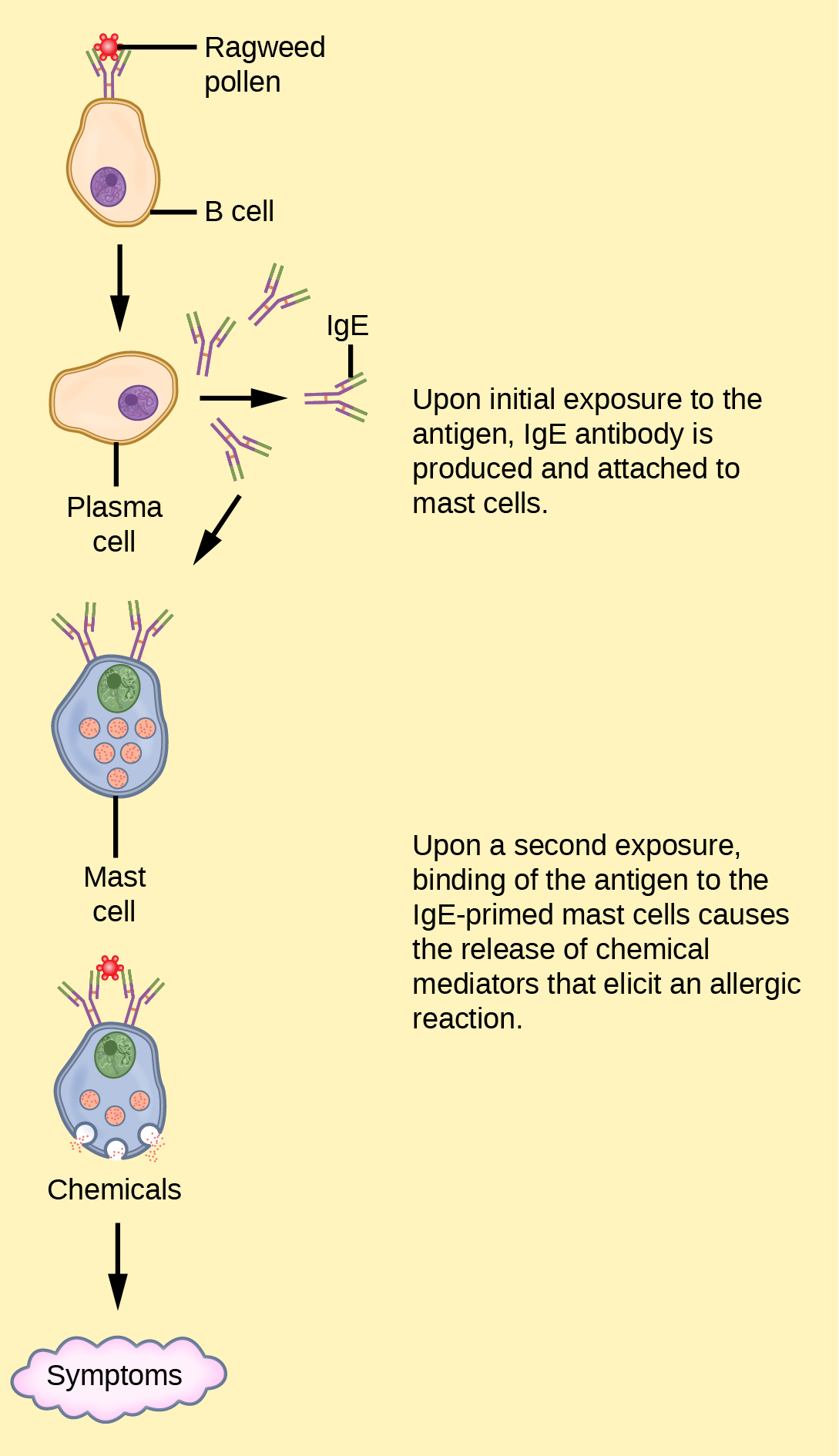

Figure 42.26図 42.26
On first exposure to an allergen, an IgE antibody is synthesized by plasma cells in response to a harmless antigen. The IgE molecules bind to mast cells, and on secondary exposure, the mast cells release histamines and other modulators that affect the symptoms of allergy. (credit: modification of work by NIH)
初めてアレルゲンにさらされると、形質細胞が無害な抗原に応答してIgE抗体を合成する。IgE分子は肥満細胞に結合し、2回目の曝露では、肥満細胞がヒスタミンなどの調節物質を放出して、アレルギー症状に影響する。(出典:NIHの作品を改変)
Delayed hypersensitivity is a cell-mediated immune response that takes approximately one to two days after secondary exposure for a maximal reaction to be observed. This type of hypersensitivity involves the TH1 cytokine-mediated inflammatory response and may manifest as local tissue lesions or contact dermatitis (rash or skin irritation). Delayed hypersensitivity occurs in some individuals in response to contact with certain types of jewelry or cosmetics. Delayed hypersensitivity facilitates the immune response to poison ivy and is also the reason why the skin test for tuberculosis results in a small region of inflammation on individuals who were previously exposed to Mycobacterium tuberculosis. That is also why cortisone is used to treat such responses: it will inhibit cytokine production.
英語のヒント
遅延型過敏反応は、2回目の曝露から最大の反応が見られるまで約1〜2日かかる、細胞性免疫応答である。TH1のサイトカインを介した炎症応答が関わり、局所の組織病変や接触皮膚炎(発疹や皮膚の刺激)として現れることがある。ある種の装飾品や化粧品との接触に応じて、遅延型過敏反応を起こす人もいる。ポイズンアイビーに対する免疫応答も促す。また、以前に結核菌(Mycobacterium tuberculosis)にさらされた人が結核の皮膚検査を受けると、小さな炎症部位が生じる理由でもある。こうした応答の治療にコルチゾンが使われるのも、サイトカインの産生を抑えるためである。