第42章免疫系
T and B LymphocytesTリンパ球とBリンパ球
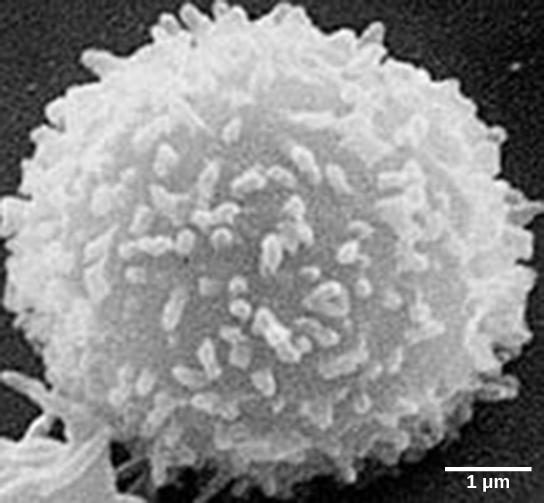
Lymphocytes in human circulating blood are approximately 80 to 90 percent T cells, shown in Figure 42.9, and 10 to 20 percent B cells. Recall that the T cells are involved in the cell-mediated immune response, whereas B cells are part of the humoral immune response.
英語のヒント
ヒトの循環血中のリンパ球は、およそ80〜90%が図42.9に示すT細胞、10〜20%がB細胞である。T細胞は細胞性免疫応答に関わり、B細胞は液性免疫応答の一部を担うことを思い出そう。
T cells encompass a heterogeneous population of cells with extremely diverse functions. Some T cells respond to APCs of the innate immune system, and indirectly induce immune responses by releasing cytokines. Other T cells stimulate B cells to prepare their own response. Another population of T cells detects APC signals and directly kills the infected cells. Other T cells are involved in suppressing inappropriate immune reactions to harmless or “self” antigens.
英語のヒント
T細胞には、極めて多様な機能をもつ、性質の異なる細胞集団が含まれる。あるT細胞は自然免疫系のAPCに応答し、サイトカインを放出して間接的に免疫応答を誘導する。別のT細胞は、B細胞を刺激して独自の応答を準備させる。さらに別のT細胞集団は、APCの信号を検出して感染細胞を直接殺す。また、無害な抗原や「自己」抗原に対する不適切な免疫反応の抑制に関わるT細胞もある。
OpenStax, Rice University; Biology 2e. (credit: modification of work by NCI; scale-bar data from Matt Russell) · CC BY 4.0 · Source出典
Figure 42.9図 42.9
This scanning electron micrograph shows a T lymphocyte, which is responsible for the cell-mediated immune response. T cells are able to recognize antigens. (credit: modification of work by NCI; scale-bar data from Matt Russell)
細胞性免疫応答を担うTリンパ球の走査電子顕微鏡写真。T細胞は抗原を認識できる。(出典:NCIの作品を改変。スケールバーのデータ:Matt Russell)
T and B cells exhibit a common theme of recognition/binding of specific antigens via a complementary receptor, followed by activation and self-amplification/maturation to specifically bind to the particular antigen of the infecting pathogen. T and B lymphocytes are also similar in that each cell only expresses one type of antigen receptor. Any individual may possess a population of T and B cells that together express a near limitless variety of antigen receptors that are capable of recognizing virtually any infecting pathogen. T and B cells are activated when they recognize small components of antigens, called epitopes, presented by APCs, illustrated in Figure 42.10. Note that recognition occurs at a specific epitope rather than on the entire antigen; for this reason, epitopes are known as “antigenic determinants.” In the absence of information from APCs, T and B cells remain inactive, or naïve, and are unable to prepare an immune response. The requirement for information from the APCs of innate immunity to trigger B cell or T cell activation illustrates the essential nature of the innate immune response to the functioning of the entire immune system.
英語のヒント
T細胞とB細胞には共通した流れがある。相補的な受容体で特定の抗原を認識・結合し、続いて活性化と自己増幅・成熟が起こり、感染した病原体の特定の抗原へ特異的に結合する。また、それぞれの細胞が1種類の抗原受容体だけを発現する点も共通する。1個体のもつT細胞とB細胞の集団は、全体としてほぼ無限の種類の抗原受容体を発現し、感染してくるほとんどあらゆる病原体を認識できる。図42.10に示すように、T細胞とB細胞は、APCが提示するエピトープという抗原の小さな構成部分を認識すると活性化される。認識は抗原全体ではなく特定のエピトープで起こる。このため、エピトープは「抗原決定基」とも呼ばれる。APCからの情報がなければ、T細胞とB細胞は不活性、すなわちナイーブな状態のままで、免疫応答を準備できない。B細胞やT細胞の活性化には自然免疫のAPCからの情報が必要であることは、免疫系全体の働きに自然免疫応答が不可欠であることを示している。
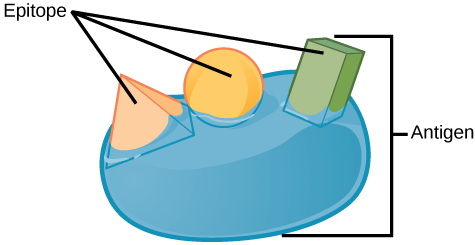
Figure 42.10図 42.10
An antigen is a macromolecule that reacts with components of the immune system. A given antigen may contain several motifs that are recognized by immune cells. Each motif is an epitope. In this figure, the entire structure is an antigen, and the orange, salmon and green components projecting from it represent potential epitopes.
抗原は、免疫系の構成要素と反応する高分子である。1つの抗原に、免疫細胞が認識する複数のモチーフが含まれることがある。各モチーフがエピトープである。この図では構造全体が抗原で、そこから突き出すオレンジ色、サーモン色、緑色の部分が、エピトープになり得る部分を表す。
Naïve T cells can express one of two different molecules, CD4 or CD8, on their surface, as shown in Figure 42.11, and are accordingly classified as CD4+ or CD8+ cells. These molecules are important because they regulate how a T cell will interact with and respond to an APC. Naïve CD4+ cells bind APCs via their antigen-embedded MHC II molecules and are stimulated to become helper T (TH) lymphocytes, cells that go on to stimulate B cells (or cytotoxic T cells) directly or secrete cytokines to inform more and various target cells about the pathogenic threat. In contrast, CD8+ cells engage antigen-embedded MHC I molecules on APCs and are stimulated to become cytotoxic T lymphocytes (CTLs), which directly kill infected cells by apoptosis and emit cytokines to amplify the immune response. The two populations of T cells have different mechanisms of immune protection, but both bind MHC molecules via their antigen receptors called T cell receptors (TCRs). The CD4 or CD8 surface molecules differentiate whether the TCR will engage an MHC II or an MHC I molecule. Because they assist in binding specificity, the CD4 and CD8 molecules are described as coreceptors.
英語のヒント
ナイーブT細胞は、図42.11のように、CD4とCD8という2種類の分子のどちらかを表面に発現し、それに応じてCD4+細胞またはCD8+細胞に分類される。これらの分子は、T細胞がAPCとどのように相互作用し、応答するかを調節するため重要である。ナイーブCD4+細胞は、APCの抗原を組み込んだMHC II分子を介して結合し、刺激を受けてヘルパーT(TH)リンパ球になる。ヘルパーTリンパ球はさらに、B細胞(または細胞傷害性T細胞)を直接刺激したり、サイトカインを分泌して、より多くのさまざまな標的細胞に病原体の脅威を伝えたりする。これに対し、CD8+細胞はAPCの抗原を組み込んだMHC I分子に結合し、刺激を受けて細胞傷害性Tリンパ球(CTL)になる。CTLは、アポトーシスによって感染細胞を直接殺し、サイトカインを放出して免疫応答を増幅する。この2つのT細胞集団は異なる仕組みで免疫防御を行うが、どちらもT細胞受容体(TCR)という抗原受容体を介してMHC分子に結合する。表面のCD4またはCD8分子によって、TCRがMHC IIとMHC Iのどちらに結合するかが決まる。CD4とCD8は結合の特異性を助けるため、共受容体と呼ばれる。
Consider the innumerable possible antigens that an individual will be exposed to during a lifetime. The mammalian adaptive immune system is adept in responding appropriately to each antigen. Mammals have an enormous diversity of T cell populations, resulting from the diversity of TCRs. Each TCR consists of two polypeptide chains that span the T cell membrane, as illustrated in Figure 42.12; the chains are linked by a disulfide bridge. Each polypeptide chain is comprised of a constant domain and a variable domain: a domain, in this sense, is a specific region of a protein that may be regulatory or structural. The intracellular domain is involved in intracellular signaling. A single T cell will express thousands of identical copies of one specific TCR variant on its cell surface. The specificity of the adaptive immune system occurs because it synthesizes millions of different T cell populations, each expressing a TCR that differs in its variable domain. This TCR diversity is achieved by the mutation and recombination of genes that encode these receptors in stem cell precursors of T cells. The binding between an antigen-displaying MHC molecule and a complementary TCR “match” indicates that the adaptive immune system needs to activate and produce that specific T cell because its structure is appropriate to recognize and destroy the invading pathogen.
英語のヒント
個体が生涯にさらされ得る、無数の抗原について考えてみよう。哺乳類の獲得免疫系は、それぞれの抗原に適切に応答する能力に優れている。哺乳類には、TCRの多様性に由来する、非常に多様なT細胞集団がある。図42.12のように、各TCRはT細胞膜を貫く2本のポリペプチド鎖からなり、その鎖どうしはジスルフィド結合でつながる。各ポリペプチド鎖は定常ドメインと可変ドメインで構成される。ここでいうドメインとは、調節や構造に関わる、タンパク質の特定の領域である。細胞内ドメインは細胞内シグナル伝達に関わる。1個のT細胞は、特定の1種類のTCRの同一コピーを、数千個、表面に発現する。獲得免疫系の特異性は、それぞれ可変ドメインの異なるTCRを発現する、数百万種類のT細胞集団を作ることで生じる。このTCRの多様性は、T細胞の幹細胞前駆体で、受容体をコードする遺伝子の変異と組換えが起こることによって生み出される。抗原を提示するMHC分子と、それに相補的に「適合する」TCRが結合すると、その特定のT細胞を獲得免疫系が活性化し、増やす必要があることが示される。その構造が、侵入した病原体の認識と破壊に適しているためである。
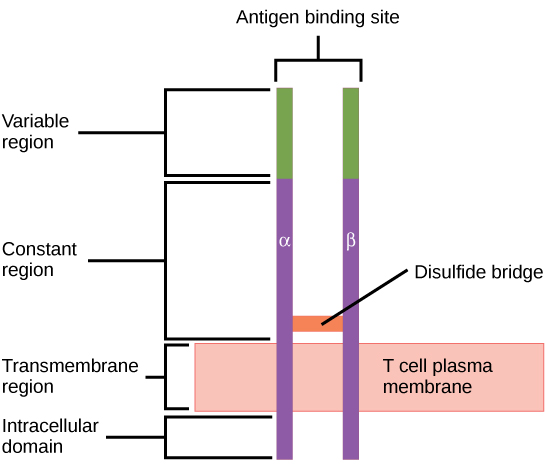


Figure 42.12図 42.12
A T cell receptor spans the membrane and projects variable binding regions into the extracellular space to bind processed antigens via MHC molecules on APCs.
T細胞受容体は膜を貫き、可変の結合領域を細胞外空間へ突き出す。これにより、APC上のMHC分子を介して、処理された抗原に結合する。