第42章免疫系
42.3 Antibodies42.3 抗体
Learning Objectives学習目標
By the end of this section, you will be able to do the following:
この節を学ぶと、次のことができるようになる。
- Explain cross-reactivity交差反応性を説明する。
- Describe the structure and function of antibodies抗体の構造と機能を説明する。
- Discuss antibody production抗体の産生について論じる。
An antibody, also known as an immunoglobulin (Ig), is a protein that is produced by plasma cells after stimulation by an antigen. Antibodies are the functional basis of humoral immunity. Antibodies occur in the blood, in gastric and mucus secretions, and in breast milk. Antibodies in these bodily fluids can bind pathogens and mark them for destruction by phagocytes before they can infect cells.
英語のヒント
抗体は免疫グロブリン(Ig)とも呼ばれ、抗原の刺激を受けた後に形質細胞が作るタンパク質である。液性免疫の機能的な基盤をなす。抗体は、血液、胃液や粘液の分泌物、母乳に存在する。これらの体液中の抗体は病原体に結合し、細胞に感染する前に食細胞によって破壊されるよう、目印を付けることができる。
Antibody Structure抗体の構造
An antibody molecule is comprised of four polypeptides: two identical heavy chains (large peptide units) that are partially bound to each other in a “Y” formation, which are flanked by two identical light chains (small peptide units), as illustrated in Figure 42.22. Bonds between the cysteine amino acids in the antibody molecule attach the polypeptides to each other. The areas where the antigen is recognized on the antibody are variable domains and the antibody base is composed of constant domains.
英語のヒント
抗体分子は4本のポリペプチドからなる。図42.22のように、同じ構造の2本の重鎖(大きなペプチド単位)が部分的に結合してY字形を作り、その両側に同じ構造の2本の軽鎖(小さなペプチド単位)が付く。抗体分子内のアミノ酸システイン間の結合が、ポリペプチドどうしをつなぐ。抗体上で抗原を認識する領域は可変ドメインであり、抗体の基部は定常ドメインからなる。
In germ-line B cells, the variable region of the light chain gene has 40 variable (V) and five joining (J) segments. An enzyme called DNA recombinase randomly excises most of these segments out of the gene, and splices one V segment to one J segment. During RNA processing, all but one V and J segment are spliced out. Recombination and splicing may result in over 106 possible VJ combinations. As a result, each differentiated B cell in the human body typically has a unique variable chain. The constant domain, which does not bind antibody, is the same for all antibodies.
英語のヒント
生殖系列型のB細胞では、軽鎖遺伝子の可変領域に40個の可変(V)セグメントと5個の結合(J)セグメントがある。DNAリコンビナーゼという酵素が、これらの大部分を遺伝子からランダムに切り取り、1つのVセグメントと1つのJセグメントをつなぐ。RNAのプロセシングでは、1組のVとJセグメントを除き、すべてがスプライシングで除かれる。組換えとスプライシングによって、106を超えるVJの組み合わせが生じ得る。その結果、ヒトの体内の分化した各B細胞は、通常それぞれ独自の可変鎖をもつ。抗体と結合しない定常ドメインは、すべての抗体で同じである。
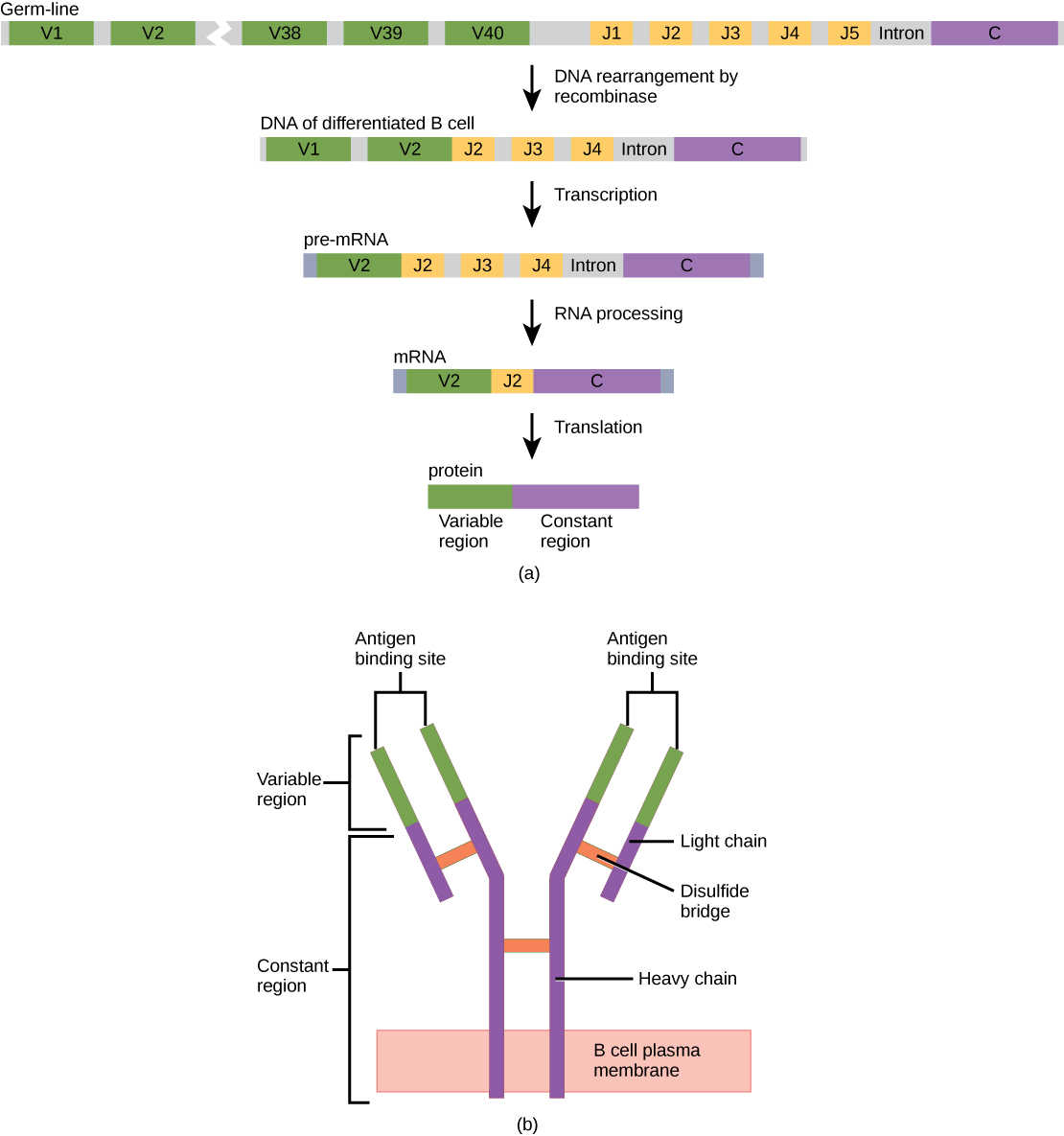
Figure 42.22図 42.22
(a) As a germ-line B cell matures, an enzyme called DNA recombinase randomly excises V and J segments from the light chain gene. Splicing at the mRNA level results in further gene rearrangement. As a result, (b) each antibody has a unique variable region capable of binding a different antigen.
(a)生殖系列型のB細胞が成熟するにつれて、DNAリコンビナーゼという酵素が、軽鎖遺伝子からVとJのセグメントをランダムに切り取る。mRNAの段階のスプライシングで、さらに遺伝子の再配列が起こる。その結果、(b)各抗体は異なる抗原に結合できる、独自の可変領域をもつ。
Similar to TCRs and BCRs, antibody diversity is produced by the mutation and recombination of approximately 300 different gene segments encoding the light and heavy chain variable domains in precursor cells that are destined to become B cells. The variable domains from the heavy and light chains interact to form the binding site through which an antibody can bind a specific epitope on an antigen. The numbers of repeated constant domains in Ig classes are the same for all antibodies corresponding to a specific class. Antibodies are structurally similar to the extracellular component of the BCRs, and B cell maturation to plasma cells can be visualized in simple terms as the cell acquires the ability to secrete the extracellular portion of its BCR in large quantities.
英語のヒント
TCRやBCRと同様、抗体の多様性は、B細胞になる予定の前駆細胞で、軽鎖と重鎖の可変ドメインをコードする約300種類の遺伝子セグメントが変異・組換えを起こすことで生じる。重鎖と軽鎖の可変ドメインは相互作用して結合部位を形成し、抗体はそこで抗原上の特定のエピトープに結合できる。Igの各クラスでは、繰り返される定常ドメインの数は、同じクラスに属するすべての抗体で等しい。抗体の構造はBCRの細胞外部分と似ている。そのため、B細胞から形質細胞への成熟は、簡単にいえば、BCRの細胞外部分を大量に分泌する能力を細胞が獲得することとして捉えられる。
Antibody Classes抗体のクラス
Antibodies can be divided into five classes—IgM, IgG, IgA, IgD, IgE—based on their physiochemical, structural, and immunological properties. IgGs, which make up about 80 percent of all antibodies in the serum, have heavy chains that consist of one variable domain and three identical constant domains. IgA and IgD also have three constant domains per heavy chain, whereas IgM and IgE each have four constant domains per heavy chain. The variable domain determines binding specificity and the constant domain of the heavy chain determines the immunological mechanism of action of the corresponding antibody class. It is possible for two antibodies to have the same binding specificities but be in different classes and, therefore, to be involved in different functions.
英語のヒント
抗体は、物理化学的、構造的、免疫学的な性質に基づいて、IgM、IgG、IgA、IgD、IgEの5つのクラスに分けられる。血清中の全抗体の約80%を占めるIgGの重鎖は、1つの可変ドメインと3つの同一の定常ドメインからなる。IgAとIgDも重鎖1本あたり3つの定常ドメインをもつが、IgMとIgEはそれぞれ4つをもつ。可変ドメインは結合の特異性を決め、重鎖の定常ドメインは、その抗体クラスの免疫学的な作用機序を決める。2つの抗体が同じ結合特異性をもちながら異なるクラスに属し、その結果、異なる機能に関わることもある。
After an adaptive defense is produced against a pathogen, typically plasma cells first secrete IgM into the blood. BCRs on naïve B cells are of the IgM class and occasionally IgD class. IgM molecules make up approximately ten percent of all antibodies. Prior to antibody secretion, plasma cells assemble IgM molecules into pentamers (five individual antibodies) linked by a joining (J) chain, as shown in Figure 42.23. The pentamer arrangement means that these macromolecules can bind ten identical antigens. However, IgM molecules released early in the adaptive immune response do not bind to antigens as stably as IgGs, which are one of the possible types of antibodies secreted in large quantities upon reexposure to the same pathogen. Figure 42.23 summarizes the properties of immunoglobulins and illustrates their basic structures.
英語のヒント
病原体に対する獲得免疫の防御が生じると、通常、形質細胞はまずIgMを血中へ分泌する。ナイーブB細胞のBCRはIgMクラスであり、ときにIgDクラスである。IgM分子は全抗体の約10%を占める。抗体を分泌する前に、形質細胞は図42.23のように、結合(J)鎖でつないだ五量体(5個の抗体)へIgM分子を組み立てる。五量体の配置により、この高分子は10個の同一の抗原に結合できる。しかし、獲得免疫応答の早期に放出されるIgM分子は、IgGほど安定には抗原に結合しない。IgGは、同じ病原体に再びさらされたときに大量に分泌される抗体の種類の1つである。図42.23に、免疫グロブリンの性質と基本構造をまとめる。
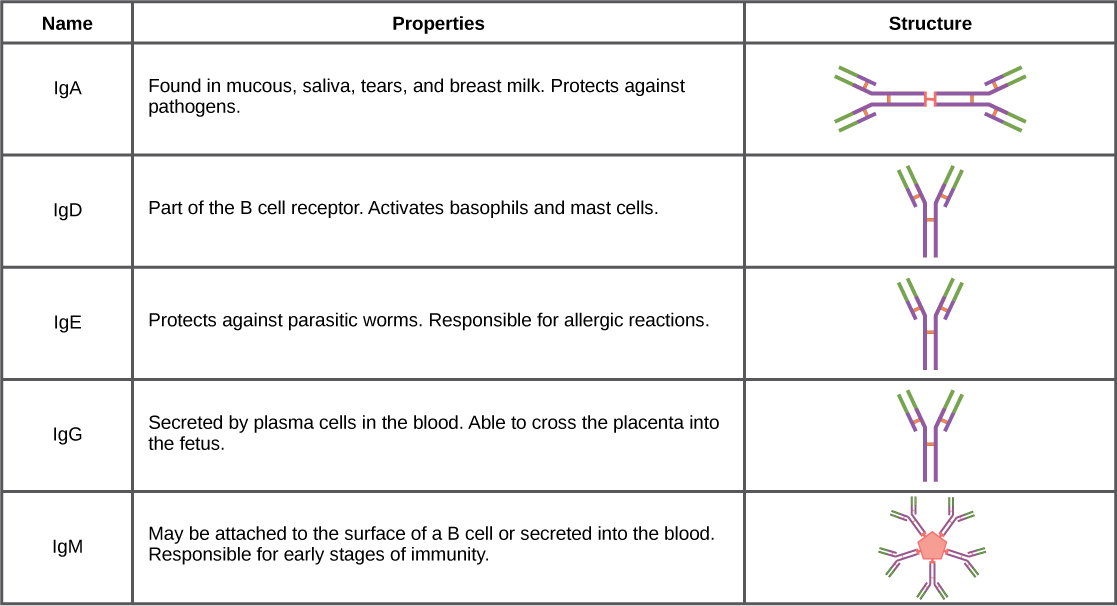


Figure 42.23図 42.23
Immunoglobulins have different functions, but all are composed of light and heavy chains that form a Y-shaped structure.
免疫グロブリンの機能はそれぞれ異なるが、すべて軽鎖と重鎖からなり、Y字形の構造を作る。
IgAs populate the saliva, tears, breast milk, and mucus secretions of the gastrointestinal, respiratory, and genitourinary tracts. Collectively, these bodily fluids coat and protect the extensive mucosa (4000 square feet in humans). The total number of IgA molecules in these bodily secretions is greater than the number of IgG molecules in the blood serum. A small amount of IgA is also secreted into the serum in monomeric form. Conversely, some IgM is secreted into bodily fluids of the mucosa. Similar to IgM, IgA molecules are secreted as polymeric structures linked with a J chain. However, IgAs are secreted mostly as dimeric molecules, not pentamers.
英語のヒント
IgAは、唾液、涙、母乳、消化管・気道・泌尿生殖路の粘液分泌物に存在する。これらの体液が全体として、広範な粘膜(ヒトでは4000平方フィート)を覆い、保護する。これらの分泌物中のIgA分子の総数は、血清中のIgG分子の数を上回る。少量のIgAは単量体として血清中にも分泌される。逆に、一部のIgMは粘膜の体液中に分泌される。IgMと同様に、IgAはJ鎖でつながった重合体として分泌される。ただし、IgAは主に二量体であり、五量体ではない。
IgE is present in the serum in small quantities and is best characterized in its role as an allergy mediator. IgD is also present in small quantities. Similar to IgM, BCRs of the IgD class are found on the surface of naïve B cells. This class supports antigen recognition and maturation of B cells to plasma cells.
英語のヒント
IgEは血清中に少量存在し、アレルギーを仲介する役割が最もよく知られている。IgDも少量存在する。IgMと同様、IgDクラスのBCRもナイーブB細胞の表面に見られる。このクラスは抗原認識と、B細胞から形質細胞への成熟を助ける。