第10章細胞の増殖
Introductionはじめに
OpenStax, Rice University; Biology 2e. (credit a: modification of work by Evelyn Spiegel, Louisa Howard; credit b: modification of work by Evelyn Spiegel, Louisa Howard; credit c: modification of work by Marco Busdraghi; scale-bar data from Matt Russell) · CC BY 4.0 · Source出典

Figure 10.1図 10.1
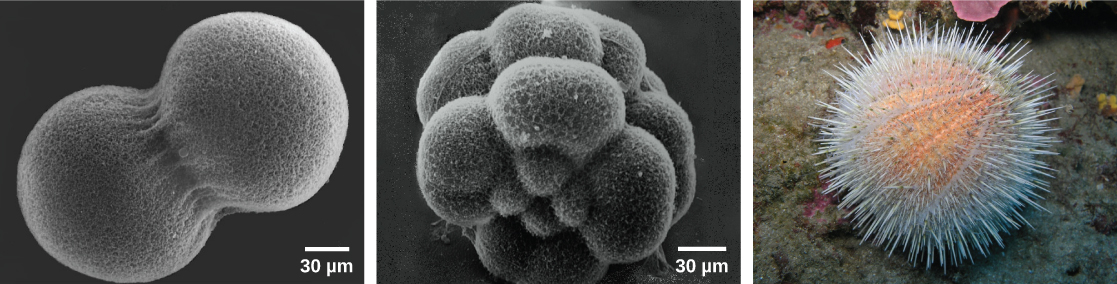
A sea urchin begins life as a single diploid cell (zygote) that (a) divides through cell division to form two genetically identical daughter cells, visible here through scanning electron microscopy (SEM). After four rounds of cell division, (b) there are 16 cells, as seen in this SEM image. After many rounds of cell division, the individual develops into a complex, multicellular organism, as seen in this (c) mature sea urchin. (credit a: modification of work by Evelyn Spiegel, Louisa Howard; credit b: modification of work by Evelyn Spiegel, Louisa Howard; credit c: modification of work by Marco Busdraghi; scale-bar data from Matt Russell)
ウニの一生は1個の二倍体細胞である接合子から始まる。(a)接合子が細胞分裂して、遺伝的に同一な2個の娘細胞を作る。写真は走査電子顕微鏡(SEM)による。(b)分裂を4回繰り返すと16細胞になる。これもSEM像である。何度も細胞分裂した後、個体は(c)の成熟したウニのような複雑な多細胞生物へ発達する。(出典a、b:Evelyn Spiegel、Louisa Howardの作品を改変、c:Marco Busdraghiの作品を改変。スケールバーのデータ:Matt Russell)
A human, like every sexually reproducing organism, begins life as a fertilized egg (embryo) or zygote. In our species, billions of cell divisions subsequently must occur in a controlled manner in order to produce a complex, multicellular human comprising trillions of cells. Thus, the original single-celled zygote is literally the ancestor of all cells in the body. However, once a human is fully grown, cell reproduction is still necessary to repair and regenerate tissues, and sometimes to increase our size! In fact, all multicellular organisms use cell division for growth and the maintenance and repair of cells and tissues. Cell division is closely regulated, and the occasional failure of this regulation can have life-threatening consequences. Single-celled organisms may also use cell division as their method of reproduction.
英語のヒント
ヒトは、他のすべての有性生殖を行う生物と同じく、受精卵(胚)、すなわち接合子として一生を始める。ヒトではその後、何兆もの細胞からなる複雑な多細胞の体を作るため、何十億回もの細胞分裂を制御された形で起こさなければならない。したがって、最初の単細胞の接合子は、文字どおり体のすべての細胞の祖先である。十分に成長した後も、組織の修復や再生、時には体を大きくするために細胞の増殖が必要である。実際、すべての多細胞生物は、成長と細胞・組織の維持や修復に細胞分裂を使う。細胞分裂は厳密に調節されており、時にその調節が失敗すると命を脅かす結果を招く。単細胞生物も、生殖の方法として細胞分裂を使うことがある。