第44章生態学と生物圏
Introductionはじめに
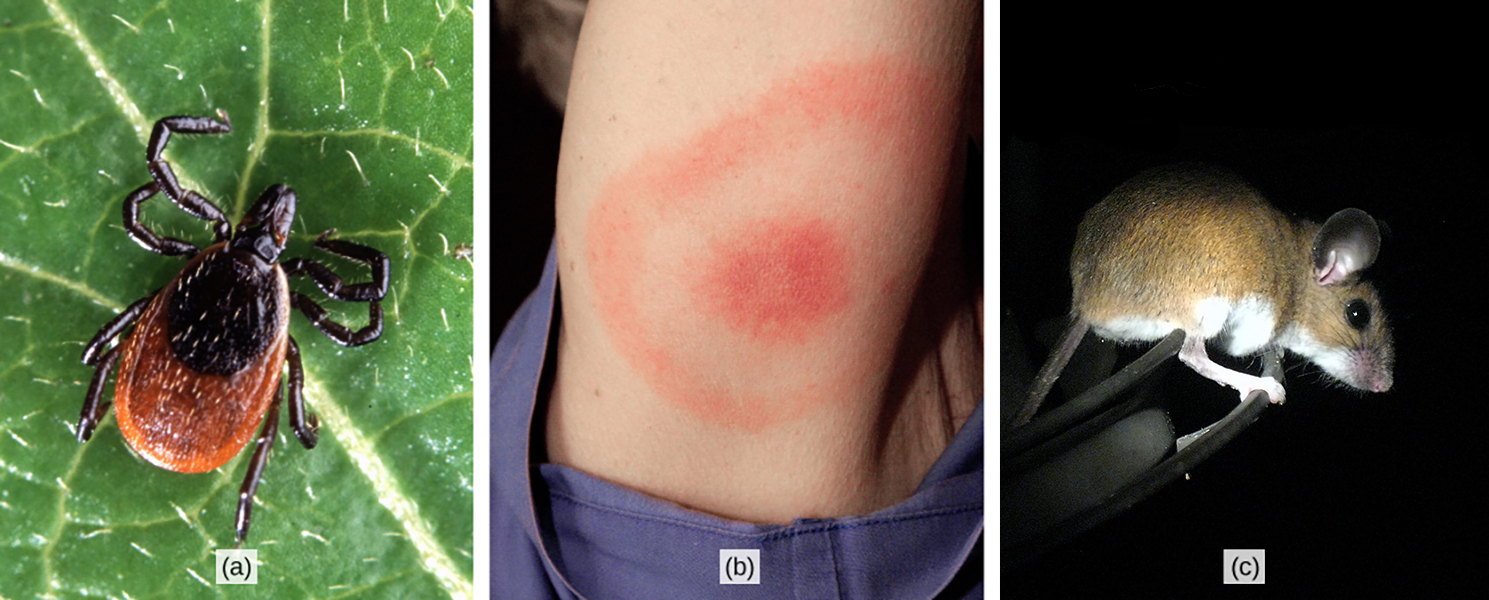
OpenStax, Rice University; Biology 2e. (credit a: modification of work by Scott Bauer, USDA ARS; credit b: modification of work by James Gathany, CDC; credit c: modification of work by Rob Ireton) · CC BY 4.0 · Source出典

Figure 44.1図 44.1
The (a) deer tick carries the bacterium that produces Lyme disease in humans, often evident in (b) a symptomatic bull’s eye rash. The (c) white-footed mouse is one well-known host to deer ticks carrying the Lyme disease bacterium. (credit a: modification of work by Scott Bauer, USDA ARS; credit b: modification of work by James Gathany, CDC; credit c: modification of work by Rob Ireton)
(a)シカダニはヒトにライム病を起こす細菌を媒介する。この病気は(b)標的の的のような輪状の発疹として現れることが多い。(c)シロアシネズミは、ライム病の細菌をもつシカダニの、よく知られた宿主の1つである。(aの出典:Scott Bauer、USDA ARSの作品を改変。bの出典:James Gathany、CDCの作品を改変。cの出典:Rob Iretonの作品を改変)
Why study ecology? Perhaps you are interested in learning about the natural world and how living things have adapted to the physical conditions of their environment. Or, perhaps you’re a future physician seeking to understand the connection between your patients' health and their environment.
英語のヒント
なぜ生態学を学ぶのだろうか。自然界や、生物が環境の物理的な条件にどのように適応してきたかに関心があるからかもしれない。あるいは、将来医師になることを目指し、患者の健康と環境とのつながりを理解したいのかもしれない。
Humans are a part of the ecological landscape, and human health is one important part of human interaction with our physical and living environment. Lyme disease, for instance, serves as one modern-day example of the connection between our health and the natural world (Figure 44.1). More formally known as Lyme borreliosis, Lyme disease is a bacterial infection that can be transmitted to humans when they are bitten by the deer tick (Ixodes scapularis in the eastern U.S., and Ixodes pacificus along the Pacific coast). Deer ticks are the primary vectors (a vector is an organism that transmits a pathogen) for this disease. However, not all ticks carry the pathogen, and not all deer ticks carry the bacteria that will cause Lyme disease in humans. Also, the ticks I. scapularis and pacificus can have other hosts besides deer. In fact, it turns out that the probability of infection depends on the type of host upon which the tick develops: a higher proportion of ticks that live on white-footed mice carry the bacterium than do ticks that live on deer. Knowledge about the environments and population densities in which the host species is abundant would help a physician or an epidemiologist better understand how Lyme disease is transmitted and how its incidence could be reduced.
英語のヒント
人間は生態学的な景観の一部であり、人間の健康は、物理的環境や生物環境との相互作用の重要な一面である。例えばライム病は、健康と自然界のつながりを示す現代の事例である(図44.1)。より正式にはライムボレリア症と呼ばれるこの病気は、シカダニに刺されることでヒトへ伝わる細菌感染症である。米国東部ではIxodes scapularis、太平洋岸ではIxodes pacificusが関わる。シカダニは、この病気の主要な媒介生物である。媒介生物とは、病原体を運ぶ生物をいう。しかし、すべてのダニが病原体をもつわけでも、すべてのシカダニがヒトにライム病を起こす細菌をもつわけでもない。また、I. scapularisとI. pacificusには、シカ以外の宿主もいる。実際、感染の確率はダニが成長する宿主の種類に左右されることが分かっている。シロアシネズミに寄生するダニでは、シカに寄生するダニよりも高い割合で、この細菌を保有する。宿主種が豊富にいる環境や個体群密度についての知識は、医師や疫学者が、ライム病の伝わり方や発生率を下げる方法をよりよく理解する助けになる。