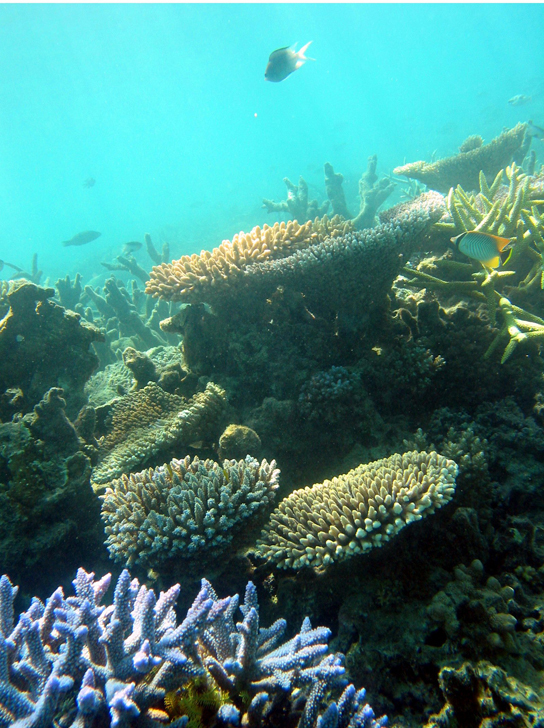
Coral reefs are ocean ridges formed by marine invertebrates, comprising mostly cnidarians and mollusks, living in warm shallow waters within the photic zone of the ocean. They are found within 30˚ north and south of the equator. The Great Barrier Reef is perhaps the best-known and largest reef system in the world—visible from the International Space Station! This massive and ancient reef is located several miles off the northeastern coast of Australia. Other coral reef systems are fringing islands, which are directly adjacent to land, or atolls, which are circular reef systems surrounding a former landmass that is now underwater. The coral organisms (members of phylum Cnidaria) are colonies of saltwater polyps that secrete a calcium carbonate skeleton. These calcium-rich skeletons slowly accumulate, forming the underwater reef (Figure 44.23). Corals found in shallower waters (at a depth of approximately 60 m or about 200 ft) have a mutualistic relationship with photosynthetic unicellular algae. The relationship provides corals with the majority of the nutrition and the energy they require. The waters in which these corals live are nutritionally poor and, without this mutualism, it would not be possible for large corals to grow. Some corals living in deeper and colder water do not have a mutualistic relationship with algae; these corals attain energy and nutrients using stinging cells called cnidocytes on their tentacles to capture prey.
It is estimated that more than 4,000 fish species inhabit coral reefs. These fishes can feed on coral, the cryptofauna (invertebrates found within the calcium carbonate substrate of the coral reefs), or the seaweed and algae that are associated with the coral. In addition, some fish species inhabit the boundaries of a coral reef; these species include predators, herbivores, and planktivores, which consume planktonic organisms such as bacteria, archaea, algae, and protists floating in the pelagic zone.
OpenStax, Rice University; Biology 2e. (credit: Terry Hughes) · CC BY 4.0 · Source出典
Figure 44.23図 44.23
Coral reefs are formed by the calcium carbonate skeletons of coral organisms, which are marine invertebrates in the phylum Cnidaria. (credit: Terry Hughes)