第44章生態学と生物圏
Inorganic Nutrients and Soil無機栄養物質と土壌
Inorganic nutrients, such as nitrogen and phosphorus, are important in determining the distribution and the abundance of living things. Plants obtain these inorganic nutrients from the soil when water moves into the plant through the roots. Therefore, soil structure (particle size of soil components), soil pH, and soil nutrient content together all play an important role in the distribution of plants. Animals obtain inorganic nutrients from the food they consume. Therefore, animal distributions are related to the distribution of what they eat. In some cases, animals will follow their food resource as it moves through the environment.
英語のヒント
窒素やリンなどの無機栄養物質は、生物の分布と多さを決めるうえで重要である。植物は、根から水を吸収するときに、土壌からこれらの物質を得る。そのため、土壌構造(土壌を構成する粒子の大きさ)、土壌pH、土壌の栄養含量は、いずれも植物の分布に重要な役割を果たす。動物は、食べる餌から無機栄養物質を得る。そのため、動物の分布は、食べるものの分布に関連する。場合によっては、餌資源が環境中を移動するのを追って移動する。
Other Aquatic Factors水界のその他の要因
Some abiotic factors, such as oxygen, are important in aquatic ecosystems as well as terrestrial environments. Terrestrial animals obtain oxygen from the air they breathe. Oxygen availability can be an issue for organisms living at very high elevations, however, where there are fewer molecules of oxygen in the air. In aquatic systems, the concentration of dissolved oxygen is related to water temperature and the speed at which the water moves. Cold water has more dissolved oxygen than warmer water. In addition, salinity, currents, and tidal changes can be important abiotic factors in aquatic ecosystems.
英語のヒント
酸素など一部の非生物的要因は、陸上でも水界生態系でも重要である。陸生動物は呼吸する空気から酸素を得る。しかし非常に高い標高では、空気中の酸素分子が少なくなるため、利用できる酸素の量が問題になり得る。水界では、溶存酸素の濃度が水温と水の流速に関係する。冷たい水には、暖かい水より多くの酸素が溶けている。また、塩分濃度、流れ、潮汐の変化も、水界生態系の重要な非生物的要因となり得る。
Other Terrestrial Factors陸上のその他の要因
Wind can be an important abiotic factor because it influences the rate of evaporation, transpiration, and convective heat loss from the surface of all organisms. The physical force of wind is also important because it can move soil, water, or other abiotic factors, as well as an ecosystem’s organisms.
英語のヒント
風は、すべての生物の表面からの蒸発、蒸散、対流による熱損失の速度に影響するため、重要な非生物的要因となり得る。風の物理的な力も重要である。生態系の生物に加え、土壌、水、その他の非生物的なものを動かすことができるからである。
Fire is another terrestrial factor that can be an important agent of disturbance in terrestrial ecosystems. Some organisms are adapted to fire and, thus, require the high heat associated with fire to complete a part of their life cycle. For example, the jack pine (Pinus banksiana) requires heat from fire for its seed cones to open (Figure 44.11). Through the burning of pine needles, fire adds nitrogen to the soil and limits competition by destroying undergrowth.
英語のヒント
火も、陸上生態系の重要な撹乱要因となり得る。火に適応した生物の中には、生活環の一部を完了するために、火に伴う高温を必要とするものもいる。例えばバンクスマツ(Pinus banksiana)は、球果が開くのに火の熱を必要とする(図44.11)。火はマツの針葉を燃やすことで土壌に窒素を加え、下生えを破壊して競争を抑える。
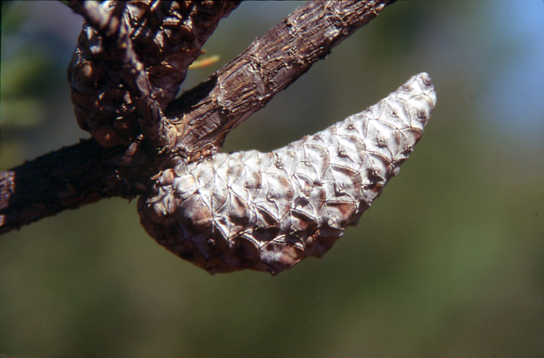

Figure 44.11図 44.11
The mature cones of the jack pine (Pinus banksiana) open only when exposed to high temperatures, such as during a forest fire. A fire is likely to kill most vegetation, so a seedling that germinates after a fire is more likely to receive ample sunlight than one that germinates under normal conditions. (credit: USDA)
バンクスマツ(Pinus banksiana)の成熟した球果は、森林火災のときのような高温にさらされた場合にだけ開く。火災では植生の大半が失われる可能性が高いため、火災後に発芽した実生は、通常の条件で発芽したものより豊富な日光を受けやすい。(出典:USDA)
Abiotic Factors Influencing Plant Growth植物の成長に影響する非生物的要因
Temperature and moisture are important influences on plant production (primary productivity) and the amount of organic matter available as food (net primary productivity). Net primary productivity is an estimation of all of the organic matter available as food; it is calculated as the total amount of carbon fixed per year minus the amount that is oxidized during cellular respiration. In terrestrial environments, net primary productivity is estimated by measuring the above-ground biomass per unit area, which is the total mass of living plants, excluding roots (whose mass is very difficult to measure). This means that a large percentage of plant biomass which exists underground is not included in this measurement. Net primary productivity is an important variable when considering differences in biomes. Very productive biomes have a high level of aboveground biomass.
英語のヒント
温度と水分は、植物の生産(一次生産力)と、餌として利用できる有機物の量(純一次生産力)に重要な影響を与える。純一次生産力は、餌として利用可能な有機物すべての量を見積もったもので、年間に固定された炭素の総量から、細胞呼吸で酸化された量を引いて求める。陸上環境では、単位面積当たりの地上部バイオマスを測定して、純一次生産力を推定する。これは、測定が非常に難しい根を除いた、生きた植物の総質量である。したがって、地下にある植物バイオマスの大きな部分は、この測定に含まれない。純一次生産力は、バイオーム間の違いを考える際の重要な変数である。非常に生産力の高いバイオームは、地上部バイオマスも多い。
Annual biomass production is directly related to the abiotic components of the environment. Environments with the greatest amount of biomass produce conditions in which photosynthesis, plant growth, and the resulting net primary productivity are optimized. The climate of these areas is warm and wet. Photosynthesis can proceed at a high rate, enzymes can work most efficiently, and stomata can remain open without the risk of excessive transpiration; together, these factors lead to the maximal amount of carbon dioxide (CO2) moving into the plant, resulting in high biomass production. The above-ground biomass produces several important resources for other living things, including habitat and food. Conversely, dry and cold environments have lower photosynthetic rates and therefore less biomass. The animal communities living there will also be affected by the decrease in available food.
英語のヒント
年間のバイオマス生産量は、環境の非生物的要素に直接関係する。バイオマスが最も多い環境では、光合成、植物の成長、その結果である純一次生産力が最適になる条件が整っている。そうした地域の気候は暖かく湿っている。光合成は速く進み、酵素は最も効率よく働き、気孔は過剰な蒸散の危険なく開いたままでいられる。これらが合わさって、二酸化炭素(CO2)が最大限に植物へ入り、多くのバイオマスが生産される。地上部バイオマスは、生息場所や餌など、ほかの生物にとって重要な資源を生み出す。逆に、乾燥して寒い環境では、光合成速度が低く、バイオマスも少ない。そこに暮らす動物群集も、利用できる餌の減少に影響される。
Section Summaryこの節のまとめ
Biogeography is the study of the geographic distribution of living things as well as the abiotic factors that affect their distribution. Endemic species are species that are naturally found only in a specific geographic area. The distribution of living things is influenced by several environmental factors that are, in part, controlled by the latitude or elevation at which a species is found. Ocean upwellings, and spring and fall turnovers are important processes regulating the distribution of nutrients and other abiotic factors important in aquatic ecosystems. Energy sources, temperature, water, inorganic nutrients, and soil are factors limiting the distribution of living things in terrestrial systems. Net primary productivity is a measure of the amount of biomass produced by a biome.
生物地理学は、生物の地理的分布と、それに影響する非生物的要因を研究する学問である。固有種とは、特定の地域にだけ自然に分布する種である。生物の分布は複数の環境要因に影響され、その一部は、種が暮らす緯度や標高によって決まる。海洋の湧昇と、春・秋の全循環は、水界生態系で重要な栄養物質やその他の非生物的要因の分布を調節する過程である。陸上では、エネルギー源、温度、水、無機栄養物質、土壌が生物の分布を制限する。純一次生産力は、バイオームが生産するバイオマス量の尺度である。