第44章生態学と生物圏
Rivers and Streams河川と小川
Rivers and streams are continuously moving bodies of water that carry large amounts of water from the source, or headwater, to a lake or ocean. The largest rivers include the Nile River in Africa, the Amazon River in South America, and the Mississippi River in North America.
英語のヒント
河川や小川は絶えず動く水域で、水源または源流から、湖や海へ大量の水を運ぶ。特に大きな河川には、アフリカのナイル川、南米のアマゾン川、北米のミシシッピ川がある。
Abiotic features of rivers and streams vary along the length of the river or stream. Streams begin at a point of origin referred to as source water. The source water is usually cold, low in nutrients, and clear. The channel (the width of the river or stream) is narrower than at any other place along the length of the river or stream. Because of this, the current is often faster here than at any other point of the river or stream.
英語のヒント
河川や小川の非生物的な特徴は、流路に沿って変わる。川は水源という起点から始まり、水源の水は通常、冷たく、栄養物質が少なく、澄んでいる。流路の幅は、川のほかのどの場所よりも狭い。そのため、流れはほかのどの地点より速いことが多い。
The fast-moving water results in minimal silt accumulation at the bottom of the river or stream; therefore, the water is usually clear and free of debris. Photosynthesis here is mostly attributed to algae that are growing on rocks; the swift current inhibits the growth of phytoplankton. An additional input of energy can come from leaves and other organic material that fall downstream into the river or stream, as well as from trees and other plants that border the water. When the leaves decompose, the organic material and nutrients in the leaves are returned to the water. Plants and animals have adapted to this fast-moving water. For instance, some species of mayfly (phylum Arthropoda) have flattened bodies and legs with modified claws to help them cling to the underside of submerged rocks. This body form reduces drag and allows these species to benefit from the high oxygen concentrations in fast-moving currents without being dislodged. Freshwater trout species (phylum Chordata) are an important predator in these fast-moving rivers and streams.
英語のヒント
流れが速いと川底にシルトがほとんどたまらないため、水は通常、澄んでいて残骸がない。ここでの光合成は主に岩に生える藻類が担い、速い流れは植物プランクトンの成長を妨げる。エネルギーは、水際の木々やほかの植物からだけでなく、下流で川に落ちる葉やその他の有機物からも入る。葉が分解すると、その有機物と栄養物質が水へ戻る。動植物は、この速い流れに適応している。例えば一部のカゲロウ(節足動物門)は、平たい体と特殊化した爪をもつ脚で、水中の岩の裏面へしがみつく。この体形は抵抗を減らし、流されずに、速い流れの高い酸素濃度を利用できるようにする。淡水のマス類(脊索動物門)は、こうした流れの速い河川の重要な捕食者である。
As the river or stream flows away from the source, the width of the channel gradually widens and the current slows. This slow-moving water, caused by the gradient decrease and the volume increase as tributaries unite, has more sedimentation. Phytoplankton can also be suspended in slow-moving water. Therefore, the water will not be as clear as it is near the source. The water is also warmer. Worms (phylum Annelida) and insects (phylum Arthropoda) can be found burrowing into the mud. The higher order predator vertebrates (phylum Chordata) include waterfowl, frogs, and fishes. These predators must find food in these slow moving, sometimes murky, waters and, unlike the trout in the waters at the source, these vertebrates may not be able to use vision as their primary sense to find food. Instead, they are more likely to use taste or chemical cues to find prey.
英語のヒント
川が水源から離れて流れるにつれ、川幅は徐々に広がり、流れは遅くなる。勾配の低下と、支流が合流することによる水量の増加で生じる遅い流れでは、堆積が多くなる。植物プランクトンも水中に浮遊できる。そのため、水源近くほど澄んではいない。水温も高くなる。泥の中には、環形動物の蠕虫や、節足動物の昆虫が穴を掘って暮らす。高次の捕食者である脊椎動物(脊索動物門)には、水鳥、カエル、魚が含まれる。これらは、流れが遅く、ときに濁る水中で餌を探さなければならない。水源のマスとは異なり、視覚を主な感覚として使えない場合があり、代わりに味覚や化学的な手掛かりで獲物を探すことが多い。
Wetlands湿地
Wetlands are environments in which the soil is either permanently or periodically saturated with water. Wetlands are different from lakes because wetlands are shallow bodies of water whereas lakes vary in depth. Emergent vegetation consists of wetland plants that are rooted in the soil but have portions of leaves, stems, and flowers extending above the water’s surface. There are several types of wetlands including marshes, swamps, bogs, mudflats, and salt marshes (Figure 44.25). The three shared characteristics among these types—what makes them wetlands—are their hydrology, hydrophytic vegetation, and hydric soils.
英語のヒント
湿地は、土壌が恒常的または周期的に水で飽和する環境である。湖は深さがさまざまだが、湿地は浅い水域である点が異なる。抽水植生は、土壌に根を張り、葉、茎、花の一部を水面上へ伸ばす湿地植物からなる。湿地には、草本性湿地、樹林性湿地、泥炭湿地、干潟、塩性湿地など、いくつかの種類がある(図44.25)。これらに共通し、湿地として特徴付ける3つの性質は、水文条件、水生・湿生植生、過湿土壌である。
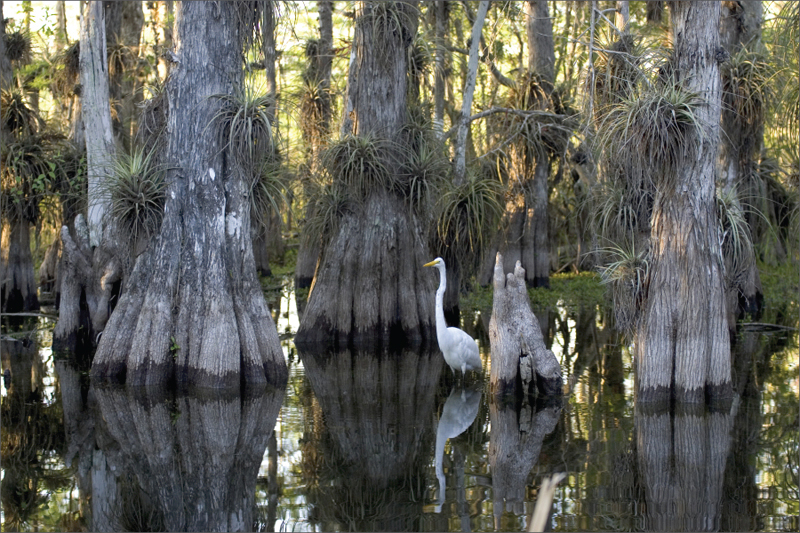

Figure 44.25図 44.25
Located in southern Florida, Everglades National Park is vast array of wetland environments, including sawgrass marshes, cypress swamps, and estuarine mangrove forests. Here, a great egret walks among cypress trees. (credit: NPS)
フロリダ南部のエバーグレーズ国立公園には、ソーグラスの草本性湿地、ヌマスギの樹林性湿地、河口域のマングローブ林など、広大で多様な湿地環境がある。ここではダイサギがヌマスギの間を歩いている。(出典:NPS)
Freshwater marshes and swamps are characterized by slow and steady water flow. Bogs, however, develop in depressions where water flow is low or nonexistent. Bogs usually occur in areas where there is a clay bottom with poor percolation of water. (Percolation is the movement of water through the pores in the soil or rocks.) The water found in a bog is stagnant and oxygen-depleted because the oxygen used during the decomposition of organic matter is not readily replaced. As the oxygen in the water is depleted, decomposition slows. This leads to a buildup of acids and a lower water pH. The lower pH creates challenges for plants because it limits the available nitrogen. As a result, some bog plants (such as sundews, pitcher plants, and Venus flytraps) capture insects in order to extract the nitrogen from their bodies. Bogs have low net primary productivity because the water found in bogs has low levels of nitrogen and oxygen.
英語のヒント
淡水の草本性湿地と樹林性湿地は、遅く安定した水の流れを特徴とする。一方、泥炭湿地は、水の流れが少ないか、まったくない窪地に発達する。通常、底が粘土質で、水が浸透しにくい場所にできる。浸透とは、土壌や岩石の隙間を水が通ることである。泥炭湿地の水は停滞し、酸素が乏しい。有機物の分解で使われた酸素が、すぐには補給されないためである。酸素が減ると分解が遅くなり、酸が蓄積して水のpHが下がる。低いpHは利用可能な窒素を制限するため、植物にとって課題となる。その結果、モウセンゴケ、袋状の捕虫葉をもつ植物、ハエトリグサなど、一部の泥炭湿地の植物は昆虫を捕らえ、その体から窒素を得る。泥炭湿地の水は窒素と酸素が少ないため、純一次生産力は低い。