第21章ウイルス
Introductionはじめに
OpenStax, Rice University; Biology 2e. (credit a: USDA ARS; credit b: modification of work by USDA Forest Service, Department of Plant Pathology Archive North Carolina State University; scale-bar data from Matt Russell) · CC BY 4.0 · Source出典

Figure 21.1図 21.1
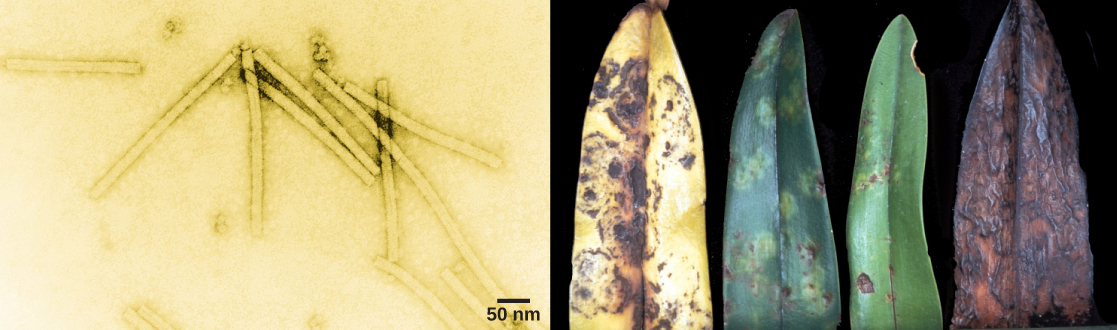
The tobacco mosaic virus, seen here by transmission electron microscopy (left), was the first virus to be discovered. The virus causes disease in tobacco and other plants, such as the orchid (right). (credit a: USDA ARS; credit b: modification of work by USDA Forest Service, Department of Plant Pathology Archive North Carolina State University; scale-bar data from Matt Russell)
透過型電子顕微鏡で見たタバコモザイクウイルス(左)は、最初に発見されたウイルスである。タバコや、ラン(右)などの他の植物に病気を起こす。(a:USDA ARS。b:USDA Forest Service、Department of Plant Pathology Archive、North Carolina State Universityの作品を改変。スケールバーのデータ:Matt Russell)
Viruses are noncellular parasitic entities that cannot be classified within any kingdom. They can infect organisms as diverse as bacteria, plants, and animals. In fact, viruses exist in a sort of netherworld between a living organism and a nonliving entity. Living things grow, metabolize, and reproduce. In contrast, viruses are not cellular, do not have a metabolism or grow, and cannot divide by cell division. Viruses can copy, or replicate themselves; however, they are entirely dependent on resources derived from their host cells to produce progeny viruses—which are assembled in their mature form. No one knows exactly when or how viruses evolved or from what ancestral source because viruses have not left a fossil record. Some virologists contend that modern viruses are a mosaic of bits and pieces of nucleic acids picked up from various sources along their respective evolutionary paths.
英語のヒント
ウイルスは細胞構造をもたない寄生体であり、どの界にも分類できない。細菌、植物、動物という多様な生物に感染できる。実際、ウイルスは、生物と非生物の中間のような世界に存在する。生物は成長し、代謝し、繁殖する。それに対しウイルスは細胞ではなく、代謝も成長もせず、細胞分裂で分かれることもできない。ウイルスは自分自身をコピー、すなわち複製できるが、子孫ウイルスを作るには宿主細胞由来の資源に完全に依存する。子孫ウイルスは、成熟した形へと組み立てられる。ウイルスは化石記録を残していないため、いつ、どのように、どのような祖先から進化したかは、正確には分かっていない。現代のウイルスは、それぞれの進化の道筋でさまざまな供給源から拾い集めた核酸の断片によるモザイクだと主張するウイルス学者もいる。