第21章ウイルス
Vaccines and Antiviral Drugs for Treatment治療のためのワクチンと抗ウイルス薬
In some cases, vaccines can be used to treat an active viral infection. The concept behind this is that by giving the vaccine, immunity is boosted without adding more disease-causing virus. In the case of rabies, a fatal neurological disease transmitted via the saliva of rabies virus-infected animals, the progression of the disease from the time of the animal bite to the time it enters the central nervous system may be two weeks or longer. This is enough time to vaccinate individuals who suspect that they have been bitten by a rabid animal, and their boosted immune response is sufficient to prevent the virus from entering nervous tissue. Thus, the potentially fatal neurological consequences of the disease are averted, and the individual only has to recover from the infected bite. This approach is also being used for the treatment of Ebola, one of the fastest and most deadly viruses on Earth. Transmitted by bats and great apes, this disease can cause death in 70 to 90 percent of infected humans within two weeks. Using newly developed vaccines that boost the immune response in this way, there is hope that affected individuals will be better able to control the virus, potentially saving a greater percentage of infected persons from a rapid and very painful death.
英語のヒント
場合によっては、進行中のウイルス感染の治療にワクチンを使うことができる。その考え方は、ワクチン接種によって、病気を起こすウイルスをさらに加えずに免疫を強める、というものである。狂犬病は、狂犬病ウイルスに感染した動物の唾液を介して伝わる、致死的な神経系の病気である。動物にかまれてから中枢神経系へ達するまで、病気の進行に2週間以上かかることがある。狂犬病の動物にかまれた疑いのある人へワクチンを接種するには十分な時間であり、強化された免疫応答は、ウイルスの神経組織への侵入を防ぐのに十分である。こうして、命に関わりうる神経系への影響が避けられ、その人は感染したかみ傷から回復すればよい。この方法は、地球上で最も進行が速く、致死性の高いウイルスの一つであるエボラの治療にも使われている。コウモリや大型類人猿が媒介するこの病気は、感染した人の70〜90%を2週間以内に死亡させることがある。このように免疫応答を強める新たなワクチンを使えば、感染者がウイルスをよりよく抑え、感染した人のより大きな割合を、急速で非常に苦痛の大きい死から救える可能性があると期待される。
Another way of treating viral infections is the use of antiviral drugs. Because viruses use the resources of the host cell for replication and the production of new virus proteins, it is difficult to block their activities without damaging the host. For many years, scientists thought that drugs capable of impacting viruses would be too toxic for the body to endure. To meet this challenge, researcher Gertrude Elion sought to develop drugs that would target only the virus through processes such as inhibiting only viral DNA replication. For example, some of her medicines focused on purines, while others affected DNA polymerase. (Elion has 45 patents ranging from antivirals to immunosuppressants to cancer drugs.) However, we do have some effective antiviral drugs, such as those used to treat HIV and influenza. Some antiviral drugs are specific for a particular virus and others have been used to control and reduce symptoms for a wide variety of viral diseases. For most viruses, antiviral drugs can inhibit the virus by blocking the actions of one or more of its proteins. It is important to note that the targeted proteins be encoded by viral genes and that these molecules are not present in a healthy host cell. In this way, viral growth is inhibited without damaging the host. Elion's work with George Hitchens not only led to direct treatments, but, more importantly, changed the entire methodology of drug development. By targeting specific aspects of tumor cells, viruses, and bacteria, they laid the groundwork for many of today's most common and important medicines, used to help millions of people each year. They were awarded the Nobel Prize in 1988.
英語のヒント
ウイルス感染を治療するもう一つの方法は、抗ウイルス薬の使用である。ウイルスは複製や新たなウイルスタンパク質の産生に宿主細胞の資源を使うため、宿主を傷つけずにその活動を妨げることは難しい。長い間、科学者は、ウイルスに作用できる薬は、体が耐えられないほど毒性が高いだろうと考えていた。この課題に取り組むため、研究者ガートルード・エリオンは、ウイルスDNAの複製だけを阻害するなどの過程を通じ、ウイルスのみを標的とする薬を開発しようとした。たとえば、彼女の薬の一部はプリンに着目し、別の薬はDNAポリメラーゼに作用した。(エリオンは、抗ウイルス薬、免疫抑制薬、抗がん薬に及ぶ45件の特許をもつ。)しかし、HIVやインフルエンザの治療に使う薬など、有効な抗ウイルス薬は実際に存在する。特定のウイルスに特異的なものもあれば、幅広いウイルス疾患の症状を制御し、軽減するために使われてきたものもある。大半のウイルスでは、抗ウイルス薬は、ウイルスのタンパク質の一つ以上の働きを妨げてウイルスを抑えられる。標的タンパク質がウイルス遺伝子にコードされ、健康な宿主細胞には存在しない分子であることが重要である。こうして、宿主を傷つけずにウイルスの増殖を阻害できる。エリオンとジョージ・ヒッチンズの研究は、直接的な治療法につながっただけでなく、さらに重要なことに、医薬品開発の方法全体を変えた。腫瘍細胞、ウイルス、細菌の特定の側面を標的にすることで、二人は、現在広く用いられる重要な医薬品の多くの基礎を築いた。それらの薬は毎年、何百万人もの人を助けている。二人は1988年にノーベル賞を受賞した。
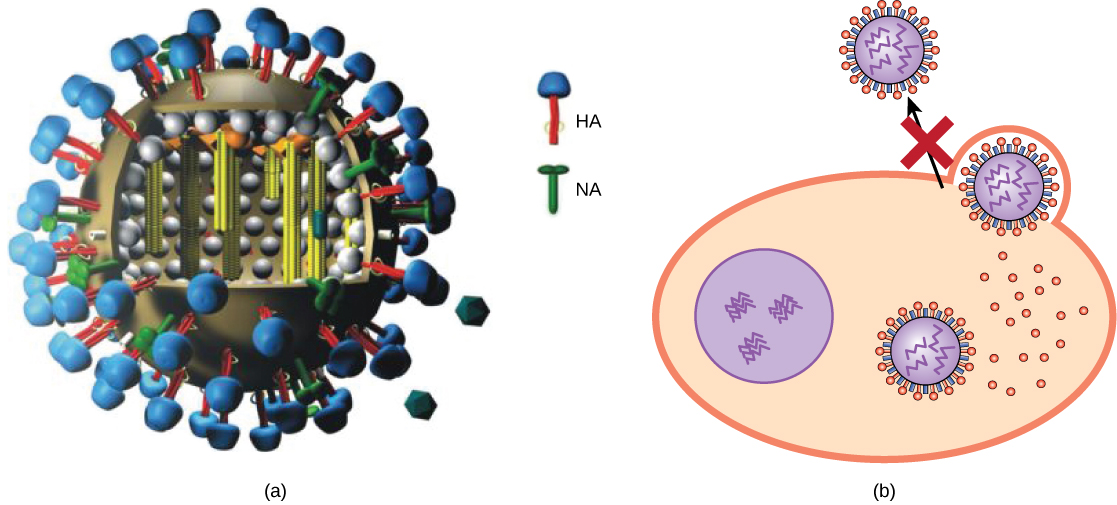
Antivirals have been developed to treat genital herpes (herpes simplex II) and influenza. For genital herpes, drugs such as acyclovir, developed by Elion, can reduce the number and duration of episodes of active viral disease, during which patients develop viral lesions in their skin cells. As the virus remains latent in nervous tissue of the body for life, this drug is not curative but can make the symptoms of the disease more manageable. For influenza, drugs like Tamiflu (oseltamivir) (Figure 21.15) can reduce the duration of “flu” symptoms by one or two days, but the drug does not prevent symptoms entirely. Tamiflu works by inhibiting an enzyme (viral neuraminidase) that allows new virions to leave their infected cells. Thus, Tamiflu inhibits the spread of virus from infected to uninfected cells. Other antiviral drugs, such as Ribavirin, have been used to treat a variety of viral infections, although its mechanism of action against certain viruses remains unclear.
英語のヒント
抗ウイルス薬は、性器ヘルペス(単純ヘルペスII型)とインフルエンザを治療するために開発されてきた。性器ヘルペスでは、エリオンが開発したアシクロビルなどの薬によって、活動性のウイルス疾患の発症回数や持続期間を減らせる。発症中には、患者の皮膚細胞にウイルス性の病変ができる。ウイルスは生涯にわたって体内の神経組織に潜伏するため、この薬は完治をもたらすものではないが、症状を扱いやすくできる。インフルエンザでは、タミフル(オセルタミビル)などの薬(図21.15)が症状の持続期間を1〜2日短くできるが、症状を完全に防ぐわけではない。タミフルは、新しいビリオンが感染細胞から出ることを可能にする酵素、ウイルスのノイラミニダーゼを阻害して働く。そのため、感染細胞から未感染細胞へのウイルスの広がりを抑える。リバビリンなど、ほかの抗ウイルス薬はさまざまなウイルス感染の治療に使われてきたが、特定のウイルスに対する作用機序は、いまだ明らかではない。
OpenStax, Rice University; Biology 2e. (credit a: modification of work by M. Eickmann) · CC BY 4.0 · Source出典
Figure 21.15図 21.15
Action of an antiviral drug. (a) Tamiflu inhibits a viral enzyme called neuraminidase (NA) found in the influenza viral envelope. (b) Neuraminidase cleaves the connection between viral hemagglutinin (HA), also found in the viral envelope, and glycoproteins on the host cell surface. Inhibition of neuraminidase prevents the virus from detaching from the host cell, thereby blocking further infection. (credit a: modification of work by M. Eickmann)
英語のヒント
抗ウイルス薬の作用。(a)タミフルは、インフルエンザウイルスのエンベロープにあるノイラミニダーゼ(NA)というウイルス酵素を阻害する。(b)ノイラミニダーゼは、同じくウイルスエンベロープにあるヘマグルチニン(HA)と、宿主細胞表面の糖タンパク質の間の結合を切断する。ノイラミニダーゼを阻害すると、ウイルスが宿主細胞から離れられなくなり、それによってさらなる感染を防ぐ。(クレジットa:M. Eickmannの作品を改変)
By far, the most successful use of antivirals has been in the treatment of the retrovirus HIV, which causes a disease that, if untreated, is usually fatal within 10 to 12 years after infection. Anti-HIV drugs have been able to control viral replication to the point that individuals receiving these drugs survive for a significantly longer time than the untreated.
英語のヒント
抗ウイルス薬の利用で、群を抜いて成功しているのは、レトロウイルスHIVの治療である。HIVは、治療しなければ、通常、感染後10〜12年以内に死に至る病気を起こす。抗HIV薬は、服用している人が未治療の人より大幅に長く生存できるほど、ウイルスの複製を抑えられるようになった。
A particular challenge with HIV is its tendency to mutate quickly within the body of an individual patient. This leads to individual drug resistance, and requires a different treatment strategy than many other diseases. David Ho was among the first to propose and develop a method to treat multiple mutations of HIV at the same time. Ho's efforts were a turning point in fighting AIDS. Anti-HIV drugs inhibit viral replication at many different phases of the HIV replicative cycle (Figure 21.16). Drugs have been developed that inhibit the fusion of the HIV viral envelope with the plasma membrane of the host cell (fusion inhibitors), the conversion of its RNA genome into double-stranded DNA (reverse transcriptase inhibitors, like AZT), the integration of the viral DNA into the host genome (integrase inhibitors), and the processing of viral proteins (protease inhibitors).
英語のヒント
HIVに特有の課題は、一人の患者の体内で急速に変異する傾向である。これによって個々の薬に対する耐性が生じ、多くのほかの疾患とは異なる治療方針が必要になる。デービッド・ホーは、HIVの複数の変異型を同時に治療する方法を初期に提案し、開発した人の一人である。ホーの努力は、AIDSとの闘いの転換点となった。抗HIV薬は、HIVの複製サイクルの多くの異なる段階で複製を阻害する(図21.16)。HIVのウイルスエンベロープと宿主細胞膜の融合を阻害する薬(融合阻害薬)、RNAゲノムから二本鎖DNAへの変換を阻害する薬(AZTなどの逆転写酵素阻害薬)、ウイルスDNAの宿主ゲノムへの組み込みを阻害する薬(インテグラーゼ阻害薬)、ウイルスタンパク質の加工を阻害する薬(プロテアーゼ阻害薬)が開発されている。
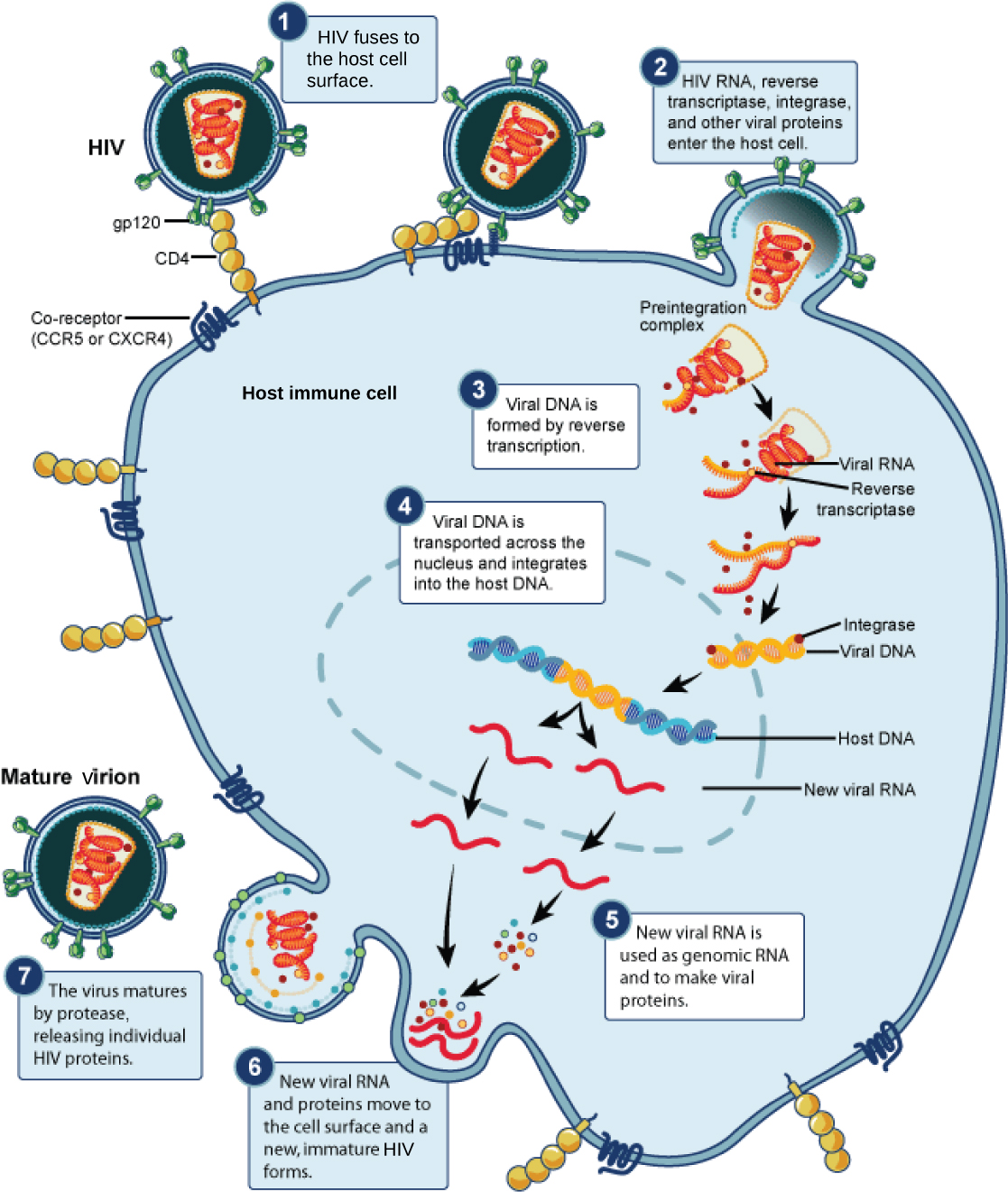


Figure 21.16図 21.16
Life cycle of HIV. HIV, an enveloped, icosahedral virus, attaches to the CD4 receptor of an immune cell and fuses with the cell membrane. Viral contents are released into the cell, where viral enzymes convert the single-stranded RNA genome into DNA and incorporate it into the host genome. (credit: NIAID, NIH)
HIVの生活環。HIVは、エンベロープをもつ正二十面体のウイルスで、免疫細胞のCD4受容体へ付着し、細胞膜と融合する。ウイルスの内容物が細胞内へ放出され、ウイルス酵素が一本鎖RNAゲノムをDNAへ変換して、宿主ゲノムへ組み込む。(クレジット:NIAID、NIH)
Unfortunately, when any of these drugs are used individually, the high mutation rate of the virus allows it to easily and rapidly develop resistance to the drug, limiting the drug’s effectiveness. The breakthrough in the treatment of HIV was the development of HAART, highly active anti-retroviral therapy, which involves a mixture of different drugs, sometimes called a drug “cocktail.” By attacking the virus at different stages of its replicative cycle, it is much more difficult for the virus to develop resistance to multiple drugs at the same time. Still, even with the use of combination HAART therapy, there is concern that, over time, the virus will develop resistance to this therapy. Thus, new anti-HIV drugs are constantly being developed with the hope of continuing the battle against this highly fatal virus.
英語のヒント
残念ながら、これらの薬を単独で使うと、ウイルスの高い変異率によって、薬への耐性が容易かつ急速に生じ、薬の効果が限られてしまう。HIV治療の突破口となったのは、HAART、すなわち高活性抗レトロウイルス療法の開発だった。これは異なる薬を組み合わせるもので、薬の「カクテル」と呼ばれることもある。複製サイクルの異なる段階でウイルスを攻撃すると、ウイルスが複数の薬への耐性を同時に獲得することは、はるかに難しくなる。それでも、HAARTによる併用療法を行っていても、時間とともにウイルスがこの治療への耐性を獲得する懸念はある。そのため、この極めて致死性の高いウイルスとの闘いを続けられるよう、新しい抗HIV薬の開発が絶えず行われている。