第21章ウイルス
21.4 Other Acellular Entities: Prions and Viroids21.4 ほかの無細胞性の存在:プリオンとウイロイド
Learning Objectives学習目標
By the end of this section, you will be able to do the following:
この節を終えると、次のことができるようになる。
- Describe prions and their basic propertiesプリオンとその基本的な性質を説明する。
- Define viroids and their targets of infectionウイロイドを定義し、その感染対象を示す。
Prions and viroids are pathogens (agents with the ability to cause disease) that have simpler structures than viruses but, in the case of prions, still can produce deadly diseases.
プリオンとウイロイドは、ウイルスより単純な構造をもつ病原体、すなわち病気を起こす能力をもつものである。それでも、プリオンの場合は、致死的な病気を引き起こしうる。
Prionsプリオン
Prions, so-called because they are proteinaceous, are infectious particles—smaller than viruses—that contain no nucleic acids (neither DNA nor RNA). Historically, the idea of an infectious agent that did not use nucleic acids was considered impossible, but pioneering work by Nobel Prize-winning biologist Stanley Prusiner has convinced the majority of biologists that such agents do indeed exist.
英語のヒント
プリオンは、タンパク質性であることからそう名づけられた、ウイルスより小さい感染性粒子であり、DNAもRNAも、核酸をまったく含まない。かつては、核酸を使わない感染性因子という考えはありえないとされていた。しかし、ノーベル賞を受賞した生物学者スタンリー・プルシナーの先駆的な研究により、そのような因子が確かに存在すると、大半の生物学者が納得するに至った。
Fatal neurodegenerative diseases, such as kuru in humans and bovine spongiform encephalopathy (BSE) in cattle (commonly known as “mad cow disease”) were shown to be transmitted by prions. The disease was spread by the consumption of meat, nervous tissue, or internal organs between members of the same species. Kuru, native to humans in Papua New Guinea, was spread from human to human via ritualistic cannibalism. BSE, originally detected in the United Kingdom, was spread between cattle by the practice of including cattle nervous tissue in feed for other cattle. Individuals with kuru and BSE show symptoms of loss of motor control and unusual behaviors, such as uncontrolled bursts of laughter with kuru, followed by death. Kuru was controlled by inducing the population to abandon its ritualistic cannibalism.
英語のヒント
ヒトのクールーや、ウシの牛海綿状脳症(BSE、一般には「狂牛病」として知られる)など、致死的な神経変性疾患は、プリオンによって伝播することが示された。この病気は、同種の個体同士で肉、神経組織、内臓を食べることによって広がった。パプアニューギニアの人々に見られたクールーは、儀礼的な食人を通じて人から人へ広がった。最初に英国で検出されたBSEは、ウシの神経組織をほかのウシの飼料に混ぜる慣行によって、ウシの間に広がった。クールーやBSEの個体には、運動制御の喪失や、クールーでの抑えられない突然の笑いなど、異常な行動の症状が現れ、その後死に至る。クールーは、人々が儀礼的な食人をやめるよう促すことによって、抑えられた。
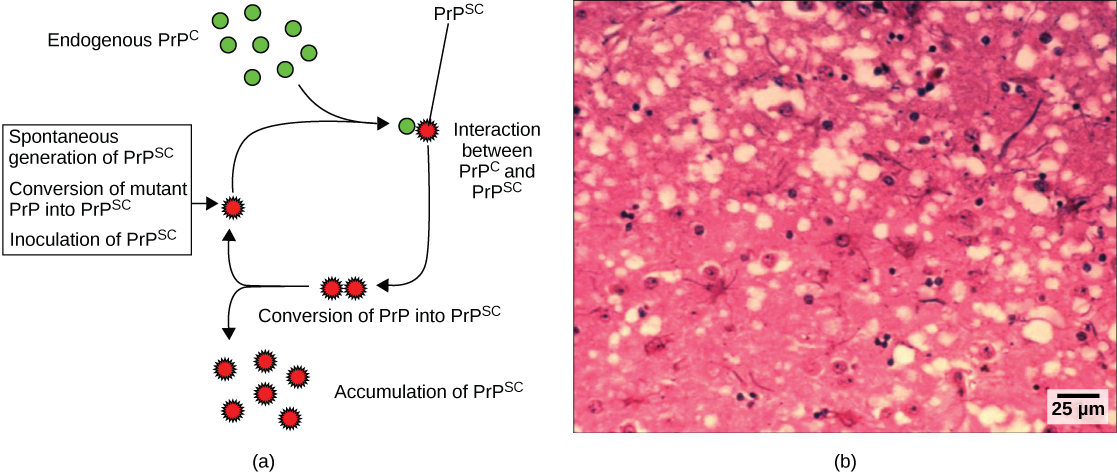
On the other hand, BSE was initially thought to only affect cattle. Cattle dying of the disease were shown to have developed lesions or “holes” in the brain, causing the brain tissue to resemble a sponge. Later on in the outbreak, however, it was shown that a similar encephalopathy in humans, known as variant Creutzfeldt-Jakob disease (CJD), could be acquired from eating beef from animals infected with BSE, sparking bans by various countries on the importation of British beef and causing considerable economic damage to the British beef industry (Figure 21.17). BSE still exists in various areas, and although a rare disease, individuals that acquire CJD are difficult to treat. The disease can be spread from human to human by blood, so many countries have banned blood donation from regions associated with BSE.
英語のヒント
一方、BSEは当初、ウシにだけ影響すると考えられていた。この病気で死ぬウシには、脳に病変や「穴」が生じ、脳組織がスポンジに似た状態になることが示された。しかし流行の後期には、変異型クロイツフェルト・ヤコブ病(CJD)として知られるヒトの類似の脳症が、BSEに感染した動物の牛肉を食べることによって生じうると分かった。これをきっかけに、さまざまな国が英国産牛肉の輸入を禁止し、英国の牛肉産業は大きな経済的損害を受けた(図21.17)。BSEは今もさまざまな地域に存在し、CJDはまれな病気だが、かかった人の治療は難しい。この病気は血液によって人から人へ伝わりうるため、多くの国では、BSEと関わる地域からの献血を禁止している。
The cause of spongiform encephalopathies, such as kuru and BSE, is an infectious structural variant of a normal cellular protein called PrP (prion protein). It is this variant that constitutes the prion particle. PrP exists in two forms, PrPc, the normal form of the protein, and PrPsc, the infectious form. Once introduced into the body, the PrPsc contained within the prion binds to PrPc and converts it to PrPsc. This leads to an exponential increase of the PrPsc protein, which aggregates. PrPsc is folded abnormally, and the resulting conformation (shape) is directly responsible for the lesions seen in the brains of infected cattle. Thus, although not without some detractors among scientists, the prion seems likely to be an entirely new form of infectious agent, the first one found whose transmission is not reliant upon genes made of DNA or RNA.
英語のヒント
クールーやBSEなどの海綿状脳症の原因は、PrP(プリオンタンパク質)と呼ばれる正常な細胞タンパク質の、感染性をもつ構造異型である。この異型こそが、プリオン粒子を構成する。PrPには、正常型のPrPcと、感染型のPrPscという二つの形がある。体内へ入ると、プリオンに含まれるPrPsc はPrPc へ結合し、それをPrPscへ変換する。これによりPrPscタンパク質が指数関数的に増え、凝集する。PrPsc は異常に折りたたまれており、その結果生じる立体構造、すなわち形が、感染したウシの脳で見られる病変の直接の原因となる。したがって、科学者の間に異論を唱える人がいないわけではないが、プリオンはまったく新しい形の感染性因子である可能性が高い。DNAやRNAからなる遺伝子に伝播を依存しないものとして、初めて見つかったのである。
OpenStax, Rice University; Biology 2e. (credit b: modification of work by Dr. Al Jenny, USDA APHIS; scale-bar data from Matt Russell) · CC BY 4.0 · Source出典

Figure 21.17図 21.17
Mad Cow Disease in humans. (a) Endogenous normal prion protein (PrPc) is converted into the disease-causing form (PrPsc) when it encounters this variant form of the protein. PrPsc may arise spontaneously in brain tissue, especially if a mutant form of the protein is present, or it may occur via the spread of misfolded prions consumed in food into brain tissue. (b) This prion-infected brain tissue, visualized using light microscopy, shows the vacuoles that give it a spongy texture, typical of transmissible spongiform encephalopathies. (credit b: modification of work by Dr. Al Jenny, USDA APHIS; scale-bar data from Matt Russell)
英語のヒント
ヒトにおける狂牛病。(a)体内の正常なプリオンタンパク質(PrPc)は、このタンパク質の異型に出会うと、病気を起こす形(PrPsc)へ変換される。PrPscは、特に変異型のタンパク質が存在するときには脳組織内で自然に生じることがある。また、食物とともに摂取した、異常に折りたたまれたプリオンが脳組織へ広がることでも生じうる。(b)光学顕微鏡で見たプリオン感染脳組織には、組織を海綿状にする空胞が見られる。これは伝達性海綿状脳症に典型的である。(クレジットb:Dr. Al Jenny、USDA APHISの作品を改変。スケールバーのデータ:Matt Russell)
Viroidsウイロイド
Viroids are plant pathogens: small, single-stranded, circular RNA particles that are much simpler than a virus. They do not have a capsid or outer envelope, but like viruses can reproduce only within a host cell. Viroids do not, however, manufacture any proteins, and they only produce a single, specific RNA molecule. Human diseases caused by viroids have yet to be identified.
英語のヒント
ウイロイドは植物の病原体であり、小さな一本鎖の環状RNA粒子で、ウイルスよりはるかに単純である。カプシドも外側のエンベロープもないが、ウイルスと同様に、宿主細胞内でしか増殖できない。しかしウイロイドは、タンパク質をまったく作らず、特定の1種類のRNA分子だけを作る。ウイロイドが起こすヒトの病気は、まだ見つかっていない。
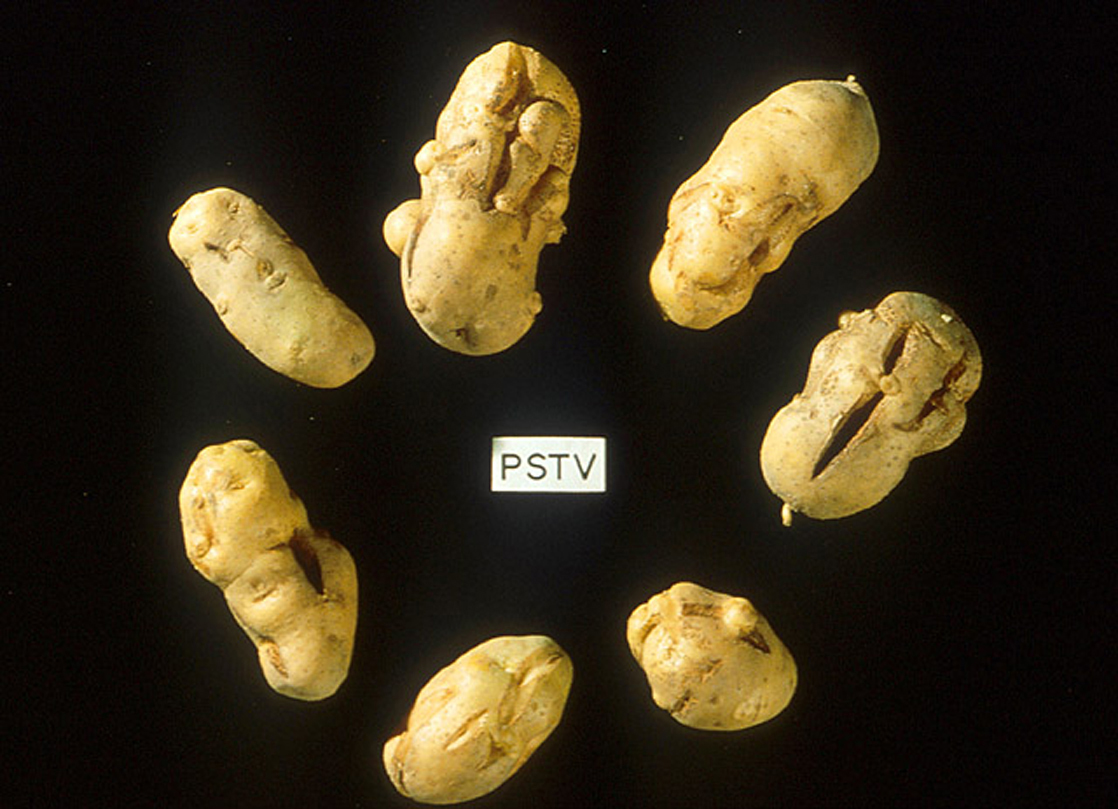
Viroids are known to infect plants (Figure 21.18) and are responsible for crop failures and the loss of millions of dollars in agricultural revenue each year. Some of the plants they infect include potatoes, cucumbers, tomatoes, chrysanthemums, avocados, and coconut palms.
英語のヒント
ウイロイドは植物に感染することが知られ(図21.18)、不作や、毎年何百万ドルもの農業収入の損失を引き起こしている。感染する植物には、ジャガイモ、キュウリ、トマト、キク、アボカド、ココヤシなどがある。
OpenStax, Rice University; Biology 2e. (credit: Pamela Roberts, University of Florida Institute of Food and Agricultural Sciences, USDA ARS) · CC BY 4.0 · Source出典

Figure 21.18図 21.18
These potatoes have been infected by the potato spindle tuber viroid (PSTV), which is typically spread when infected knives are used to cut healthy potatoes, which are then planted. (credit: Pamela Roberts, University of Florida Institute of Food and Agricultural Sciences, USDA ARS)
これらのジャガイモは、ジャガイモやせいもウイロイド(PSTV)に感染している。この病原体は通常、汚染されたナイフで健康なジャガイモを切り、それを植えるときに広がる。(クレジット:Pamela Roberts、University of Florida Institute of Food and Agricultural Sciences、USDA ARS)