第11章減数分裂と有性生殖
Introductionはじめに
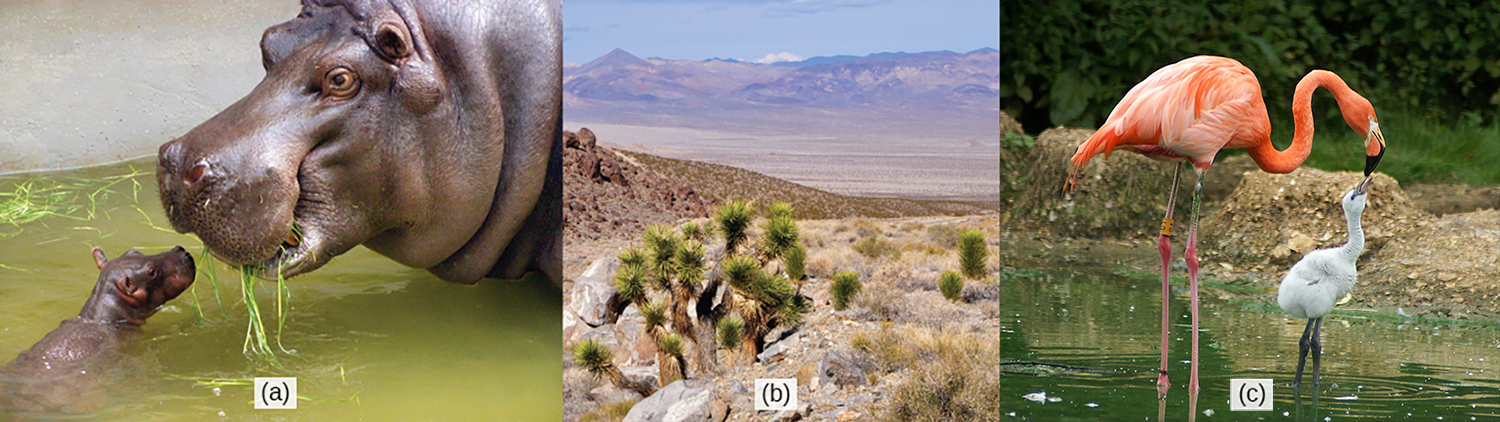
OpenStax, Rice University; Biology 2e. (credit a: modification of work by Frank Wouters; credit b: modification of work by Ken Cole, USGS; credit c: modification of work by Martin Pettitt) · CC BY 4.0 · Source出典

Figure 11.1図 11.1
Each of us, like the organisms shown above, begins life as a fertilized egg (zygote). After trillions of cell divisions, each of us develops into a complex, multicellular organism. (credit a: modification of work by Frank Wouters; credit b: modification of work by Ken Cole, USGS; credit c: modification of work by Martin Pettitt)
私たちは上の生物と同じく、受精卵(接合子)として一生を始める。何兆回もの細胞分裂の後、それぞれが複雑な多細胞生物へ発達する。(出典a:Frank Woutersの作品を改変、b:Ken Cole、USGSの作品を改変、c:Martin Pettittの作品を改変)
The ability to reproduce is a basic characteristic of all organisms: Hippopotamuses give birth to hippopotamus calves; Joshua trees produce seeds from which Joshua tree seedlings emerge; and adult flamingos lay eggs that hatch into flamingo chicks. However, unlike the organisms shown above, offspring may or may not resemble their parents. For example, in the case of most insects such as butterflies (with a complete metamorphosis), the larval forms rarely resemble the adult forms.
英語のヒント
生殖能力はすべての生物の基本的な特徴である。カバはカバの子を産み、ジョシュアツリーは種子を作り、そこから苗が育つ。成体のフラミンゴは卵を産み、そこからひながかえる。しかし、上の生物とは違い、子は親に似る場合も似ない場合もある。例えば、完全変態をするチョウなど大半の昆虫では、幼虫は成虫にほとんど似ていない。
Although many unicellular organisms and a few multicellular organisms can produce genetically identical clones of themselves through asexual reproduction, many single-celled organisms and most multicellular organisms reproduce regularly using another method—sexual reproduction. This highly evolved method involves the production by parents of two haploid cells and the fusion of two haploid cells to form a single, genetically recombined diploid cell—a genetically unique organism. In almost all sexually reproducing species, these two haploid cells differ in size, with the smaller cell called “male” and the larger one called “female." These haploid cells are produced by a type of cell division called meiosis. Sexual reproduction, involving both meiosis and fertilization, introduces variation into offspring that may account for the evolutionary success of sexual reproduction. The vast majority of eukaryotic organisms, both multicellular and unicellular, can or must employ some form of meiosis and fertilization to reproduce.
英語のヒント
多くの単細胞生物と少数の多細胞生物は、無性生殖によって自分と遺伝的に同一なクローンを作れる。一方、多くの単細胞生物と大半の多細胞生物は、有性生殖という別の方法を日常的に使う。この高度に進化した方法では、親が二つの半数体細胞を作り、その2細胞が融合して、遺伝的に組み換えられた1個の二倍体細胞、すなわち遺伝的に固有な生物となる。有性生殖を行うほぼすべての種で、二つの半数体細胞は大きさが異なり、小さい方が「雄」、大きい方が「雌」と呼ばれる。この半数体細胞は減数分裂という細胞分裂で作られる。減数分裂と受精の両方を含む有性生殖は、子に変異をもたらし、それが進化上の成功を説明するかもしれない。多細胞・単細胞を問わず、真核生物の圧倒的多数は、何らかの減数分裂と受精を使って生殖できるか、そうしなければならない。
In most plants and animals the zygote formed by fertilization, through thousands of rounds of mitotic cell division, will develop into an adult organism.
英語のヒント
大半の植物や動物では、受精によってできた接合子が何千回もの有糸分裂を経て、成体へと発達する。