第11章減数分裂と有性生殖
Metaphase I第一分裂中期
During metaphase I, the homologous chromosomes are arranged at the metaphase plate—roughly in the midline of the cell, with the kinetochores facing opposite poles. Each homologous pair is oriented randomly at the equator. For example, if the two homologous members of chromosome 1 are labeled a and b, then the chromosomes could line up a-b or b-a. This is important in determining the genes carried by a gamete, as each will only receive one of the two homologous chromosomes. (Recall that homologous chromosomes are not identical. They contain different versions of the same genes, and after recombination during crossing over, each gamete will have a unique genetic makeup that has never existed before.)
英語のヒント
第一分裂中期には、相同染色体が細胞中央付近の赤道板に並び、動原体は反対側の極を向く。各相同対の赤道面での向きは無作為である。例えば第1染色体の2本をaとbとすれば、a–bにもb–aにも並びうる。配偶子は2本の相同染色体の片方だけを受け取るので、この向きは運ばれる遺伝子を決めるうえで重要である。(相同染色体は同一ではない。同じ遺伝子の異なる型を持ち、乗換え時の組換えの後には、各配偶子はそれまで存在しなかった固有の遺伝的構成を持つ。)
The randomness in the alignment of recombined chromosomes at the metaphase plate, coupled with the crossing over events between nonsister chromatids, are responsible for much of the genetic variation in the offspring. To clarify this further, remember that the homologous chromosomes of a sexually reproducing organism are originally inherited as two separate sets, one from each parent. Using humans as an example, one set of 23 chromosomes is present in the egg cell, often called maternal chromosomes because the genetic contributor is often the mother. The other set of 23 chromosomes is contained in the sperm, and the genetic contributor is called a father who provides the paternal chromosomes. Every cell of the multicellular offspring has copies of the original two sets of homologous chromosomes. When the offspring human creates their own gametes through meiosis, the two sets of chromosomes will be rearranged. In prophase I of meiosis, the homologous chromosomes form the tetrads. In metaphase I, these pairs line up at the midway point between the two poles of the cell to form the metaphase plate. Because there is an equal chance that a microtubule fiber will encounter a maternally or paternally inherited chromosome, the arrangement of the tetrads at the metaphase plate is random. Thus, any maternally inherited chromosome may face either pole. Likewise, any paternally inherited chromosome may also face either pole. The orientation of each tetrad is independent of the orientation of the other 22 tetrads.
英語のヒント
組換え染色体が赤道板に並ぶ際の無作為性は、非姉妹染色分体間の乗換えとともに、子の遺伝的変異の多くを生む。これを明確にするため、有性生殖生物の相同染色体は、それぞれの親から1組ずつ、別々の2組として受け継がれることを思い出そう。ヒトでは、23本からなる1組が卵細胞にあり、遺伝情報の提供者は通常母親なので、母親由来の染色体と呼ばれることが多い。もう1組の23本は精子にあり、その提供者は父親と呼ばれ、父親由来の染色体を供給する。多細胞の子のすべての細胞は、元の2組の相同染色体のコピーを持つ。その子が減数分裂で自分の配偶子を作るとき、2組は並び替えられる。第一分裂前期に相同染色体が四分染色体を作り、中期に細胞の両極の中間に並んで赤道板を作る。微小管が母親由来の染色体に出会う確率と父親由来の染色体に出会う確率は等しいため、赤道板での四分染色体の配置は無作為になる。したがって、母親由来のどの染色体もどちらの極を向きうるし、父親由来も同様である。各四分染色体の向きは、他の22個の向きから独立している。
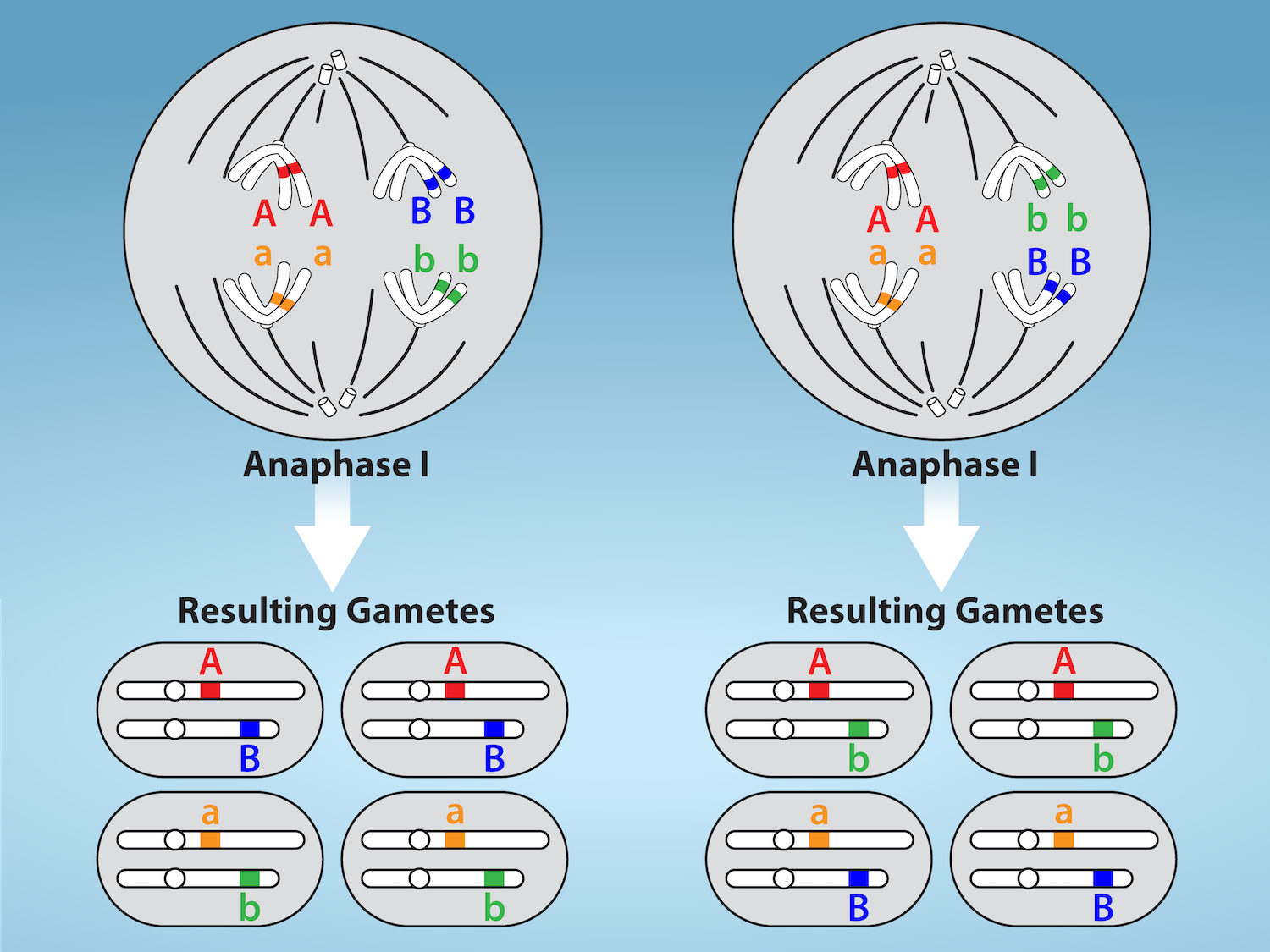
This event—the random (or independent) assortment of homologous chromosomes at the metaphase plate—is the second mechanism that introduces variation into the gametes or spores. In each cell that undergoes meiosis, the arrangement of the tetrads is different. The number of variations is dependent on the number of chromosomes making up a set. There are two possibilities for orientation at the metaphase plate; the possible number of alignments therefore equals 2n in a diploid cell, where n is the number of chromosomes per haploid set. Humans have 23 chromosome pairs, which results in over eight million (223) possible genetically-distinct gametes just from the random alignment of chromosomes at the metaphase plate. This number does not include the variability that was previously produced by crossing over between the nonsister chromatids. Given these two mechanisms, it is highly unlikely that any two haploid cells resulting from meiosis will have the same genetic composition (Figure 11.5).
英語のヒント
赤道板で相同染色体が無作為に、すなわち独立に振り分けられることは、配偶子や胞子に変異を導入する第二のしくみである。減数分裂する細胞ごとに、四分染色体の配置は異なる。変異の数は1組を構成する染色体数に依存する。赤道板での向きは2通りなので、二倍体細胞で可能な配列数は2nとなる。ここでnは半数体1組の染色体数である。ヒトは23対の染色体を持つので、赤道板での無作為な配列だけでも、遺伝的に異なる配偶子は800万通り以上(223)できる。この数には、それ以前に非姉妹染色分体間の乗換えで生じた変異は含まない。この二つのしくみを考えると、減数分裂で生じる二つの半数体細胞が同じ遺伝的構成を持つ可能性は極めて低い(図11.5)。
To summarize, meiosis I creates genetically diverse gametes in two ways. First, during prophase I, crossover events between the nonsister chromatids of each homologous pair of chromosomes generate recombinant chromatids with new combinations of maternal and paternal genes. Second, the random assortment of tetrads on the metaphase plate produces unique combinations of maternal and paternal chromosomes that will make their way into the gametes.
英語のヒント
まとめると、減数第一分裂は二つの方法で遺伝的に多様な配偶子を作る。第一に、前期の非姉妹染色分体間の乗換えにより、母親由来と父親由来の遺伝子を新しく組み合わせた組換え染色分体を作る。第二に、赤道板での四分染色体の無作為な振り分けが、配偶子へ入る母親由来と父親由来の染色体の固有の組み合わせを作る。
OpenStax, Rice University; Biology 2e. Credit: Rao, A.and Fletcher, S. Department of Biology, Texas A&M University. · CC BY 4.0 · Source出典

Figure 11.5図 11.5
Random, independent assortment during metaphase I is demonstrated by considering a cell with a set of two chromosomes (n = 2). There are two possible homologous chromosome arrangements at the equatorial plane in metaphase I, that are then separated during anaphase I. The total possible number of different gametes is 2n, where n equals the number of chromosomes in a set. In this example, there are four possible genetic combinations for the gametes. With n = 23 in human cells, there are over eight million possible combinations of paternal and maternal chromosomes. Credit: Rao, A.and Fletcher, S. Department of Biology, Texas A&M University.
第一分裂中期の無作為な独立の振り分けを、1組が2本の染色体(n=2)からなる細胞で示す。赤道面での相同染色体の配置は2通りあり、その後第一分裂後期に分離する。異なる配偶子の可能な総数は2nで、nは1組の染色体数である。この例の配偶子の遺伝的組み合わせは4通り。ヒト細胞のn=23では、母親由来と父親由来の染色体の組み合わせは800万通りを超える。出典:Rao, A.、Fletcher, S.、テキサスA&M大学生物学科。