第11章減数分裂と有性生殖
Comparing Meiosis and Mitosis減数分裂と有糸分裂の比較
Mitosis and meiosis are both forms of division of the nucleus in eukaryotic cells. They share some similarities, but also exhibit a number of distinct processes that lead to very different outcomes (Figure 11.8). Mitosis is a single nuclear division that results in two nuclei that are usually partitioned into two new cells. The nuclei resulting from a mitotic division are genetically identical to the original nucleus. They have the same number of sets of chromosomes: one set in the case of haploid cells and two sets in the case of diploid cells. In contrast, meiosis consists of two nuclear divisions resulting in four nuclei that are usually partitioned into four new, genetically distinct cells. The four nuclei produced during meiosis are not genetically identical, and they contain one chromosome set only. This is half the number of chromosome sets of the original cell, which is diploid.
英語のヒント
有糸分裂と減数分裂は、どちらも真核細胞の核分裂である。共通点もあるが、いくつもの異なる過程によって大きく異なる結果を生む(図11.8)。有糸分裂は1回の核分裂で二つの核を作り、通常はそれぞれが二つの新しい細胞に分けられる。有糸分裂でできた核は、元の核と遺伝的に同一である。染色体の組数も同じで、半数体細胞なら1組、二倍体細胞なら2組となる。これに対して減数分裂は2回の核分裂で四つの核を作り、通常は遺伝的に異なる四つの新しい細胞に分けられる。減数分裂でできた四つの核は遺伝的に同一ではなく、染色体は1組しか含まない。これは、二倍体である元の細胞の組数の半分である。
The main differences between mitosis and meiosis occur in meiosis I, which is a very different nuclear division than mitosis. In meiosis I, the homologous chromosome pairs physically meet and are bound together with the synaptonemal complex. Following this, the chromosomes develop chiasmata and undergo crossover between nonsister chromatids. In the end, the chromosomes line up along the metaphase plate as tetrads—with kinetochore fibers from opposite spindle poles attached to each kinetochore of a homolog to form a tetrad. All of these events occur only in meiosis I.
英語のヒント
有糸分裂と減数分裂の主な違いは第一分裂にあり、これは有糸分裂とは大きく異なる核分裂である。第一分裂では相同染色体の対が実際に接し、シナプトネマ複合体で結び付く。続いてキアズマができ、非姉妹染色分体の間で乗換えが起こる。最後に染色体は四分子として赤道板に並ぶ。この四分子では、紡錘体の反対側の極から伸びる動原体繊維が、相同染色体のそれぞれの動原体に付着している。これらはすべて減数第一分裂だけで起こる。
When the chiasmata resolve and the tetrad is broken up with the homologous chromosomes moving to one pole or another, the ploidy level—the number of sets of chromosomes in each future nucleus—has been reduced from two to one. For this reason, meiosis I is referred to as a reductional division. There is no such reduction in ploidy level during mitosis.
英語のヒント
キアズマが解消し、相同染色体がそれぞれ一方の極へ移動して四分子が分かれると、倍数性、つまりこれからできる各核の染色体の組数は2から1へ減る。このため減数第一分裂を還元分裂という。有糸分裂ではこのような倍数性の低下は起こらない。
Meiosis II is analogous to a mitotic division. In this case, the duplicated chromosomes (only one set of them) line up on the metaphase plate with divided kinetochores attached to kinetochore fibers from opposite poles. During anaphase II, as in mitotic anaphase, the kinetochores divide and one sister chromatid—now referred to as a chromosome—is pulled to one pole while the other sister chromatid is pulled to the other pole. If it were not for the fact that there had been crossover, the two products of each individual meiosis II division would be identical (as in mitosis). Instead, they are different because there has always been at least one crossover per chromosome. Meiosis II is not a reduction division because although there are fewer copies of the genome in the resulting cells, there is still one set of chromosomes, as there was at the end of meiosis I.
英語のヒント
減数第二分裂は有糸分裂に類似している。この場合、複製された染色体は1組だけで、それらが赤道板に並び、分かれた動原体には反対側の極からの動原体繊維が付着する。第二分裂後期には、有糸分裂後期と同様に動原体が分かれ、一方の姉妹染色分体(ここからは染色体と呼ぶ)が一方の極に、もう一方が反対側の極に引かれる。乗換えが起こっていたという事実がなければ、各第二分裂でできる二つの細胞は、有糸分裂の場合と同じく同一になるはずである。しかし実際には、各染色体で少なくとも1回の乗換えが必ず起こっているため、両者は異なる。第二分裂は還元分裂ではない。できた細胞ではゲノムのコピー数は減るが、第一分裂の終わりと同じく、染色体の組はなお1組だからである。
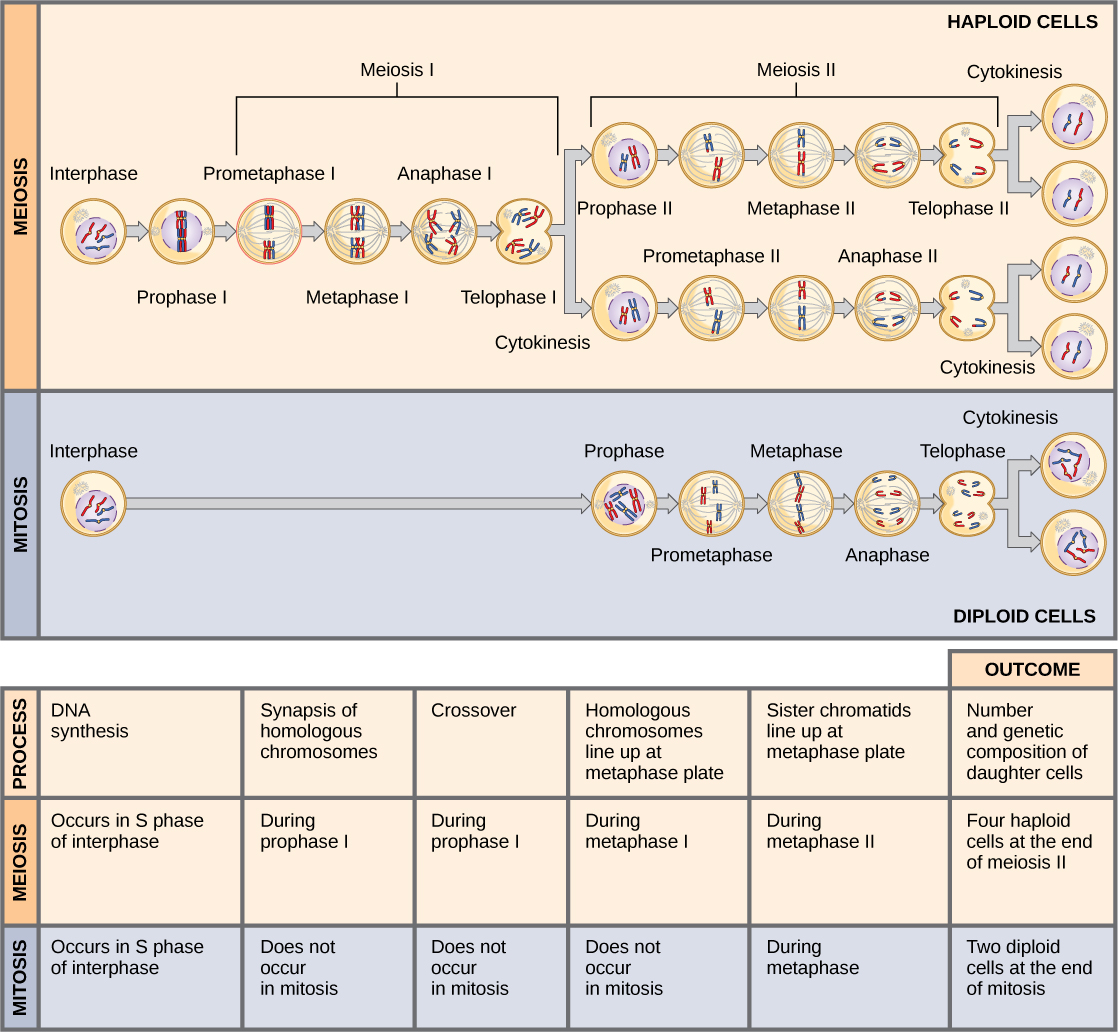

Figure 11.8図 11.8
Meiosis and mitosis are both preceded by one cycle of DNA replication; however, meiosis includes two nuclear divisions. The four daughter cells resulting from meiosis are haploid and genetically distinct. The daughter cells resulting from mitosis are diploid and identical to the parent cell.
減数分裂と有糸分裂は、どちらもその前に1回のDNA複製を行うが、減数分裂は2回の核分裂を含む。減数分裂でできる4個の娘細胞は半数体で、遺伝的に異なる。有糸分裂でできる娘細胞は二倍体で、親細胞と同一である。