第11章減数分裂と有性生殖
11.1 The Process of Meiosis11.1 減数分裂の過程
Learning Objectives学習目標
By the end of this section, you will be able to do the following:
この節を学ぶと、次のことができるようになる。
- Describe the behavior of chromosomes during meiosis, and the differences between the first and second meiotic divisions減数分裂中の染色体の動きと、第一分裂と第二分裂の違いを説明する。
- Describe the cellular events that take place during meiosis減数分裂中に起こる細胞の出来事を説明する。
- Explain the differences between meiosis and mitosis減数分裂と有糸分裂の違いを説明する。
- Explain the mechanisms within the meiotic process that produce genetic variation among the haploid gametes半数体の配偶子間に遺伝的変異を生む、減数分裂のしくみを説明する。
Sexual reproduction requires the union of two specialized cells, called gametes, each of which contains one set of chromosomes. When gametes unite, they form a zygote, or fertilized egg that contains two sets of chromosomes. (Note: Cells that contain one set of chromosomes are called haploid; cells containing two sets of chromosomes are called diploid.) If the reproductive cycle is to continue for any sexually reproducing species, then the diploid cell must somehow reduce its number of chromosome sets to produce haploid gametes; otherwise, the number of chromosome sets will double with every future round of fertilization. Therefore, sexual reproduction requires a nuclear division that reduces the number of chromosome sets by half.
英語のヒント
有性生殖には、染色体を1組ずつ持つ、配偶子という特殊化した二つの細胞の融合が必要である。配偶子が結合すると、染色体を2組持つ接合子、すなわち受精卵ができる。(注:染色体を1組持つ細胞を半数体、2組持つ細胞を二倍体という。)有性生殖する種が生殖周期を続けるには、二倍体細胞が何らかの方法で染色体の組数を減らし、半数体の配偶子を作らなければならない。そうしなければ、以後の受精のたびに組数が倍増してしまう。このため有性生殖には、染色体の組数を半分にする核分裂が必要である。
Most animals and plants and many unicellular organisms are diploid and therefore have two sets of chromosomes. In each somatic cell of the organism (all cells of a multicellular organism except the gametes or reproductive cells), the nucleus contains two copies of each chromosome, called homologous chromosomes. Homologous chromosomes are matched pairs containing the same genes in identical locations along their lengths. Diploid organisms inherit one copy of each homologous chromosome from each genetic contributor.
英語のヒント
大半の動物と植物、および多くの単細胞生物は二倍体であり、染色体を2組持つ。多細胞生物の配偶子・生殖細胞以外のすべての細胞である体細胞では、核に各染色体が2コピーずつあり、これを相同染色体という。相同染色体は対応する対であり、全長に沿った同じ位置に同じ遺伝子を持つ。二倍体生物は、遺伝情報を提供するそれぞれの親から、各相同染色体を1本ずつ受け継ぐ。
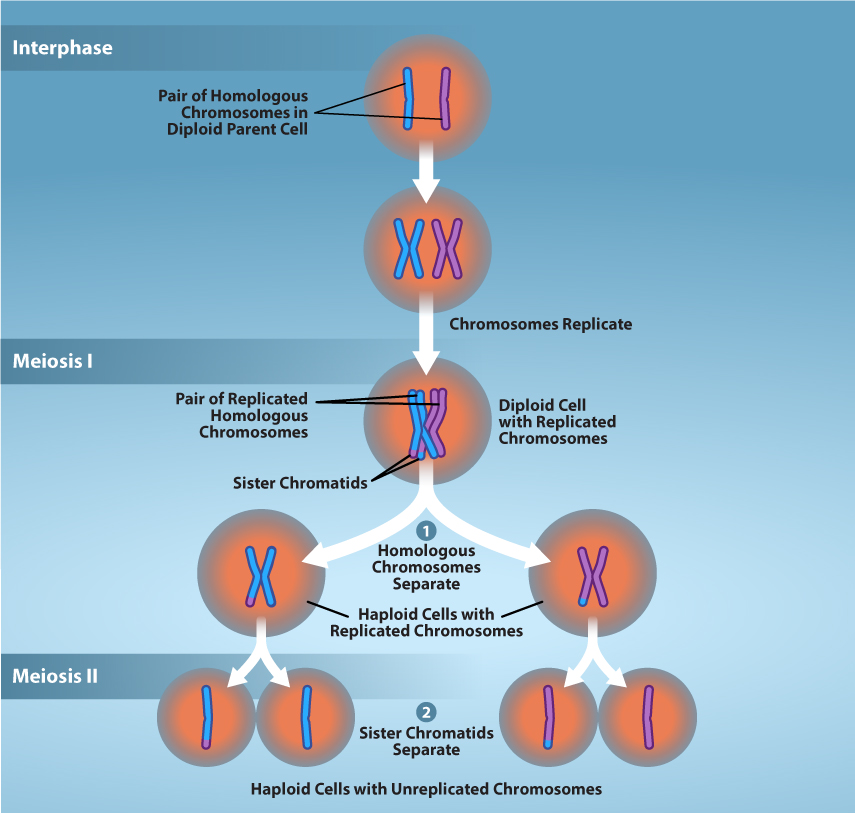
Meiosis is the nuclear division that forms haploid cells from diploid cells, and it employs many of the same cellular mechanisms as mitosis. However, as you have learned, mitosis produces daughter cells whose nuclei are genetically identical to the original parent nucleus. In mitosis, both the parent and the daughter nuclei are at the same “ploidy level”—diploid in the case of most multicellular animals. Plants use mitosis to grow as sporophytes, and to grow and produce eggs and sperm as gametophytes; so they use mitosis for both haploid and diploid cells (as well as for all other ploidies). In meiosis, the starting nucleus is always diploid and the daughter nuclei that result are haploid. To achieve this reduction in chromosome number, meiosis consists of one round of chromosome replication followed by two rounds of nuclear division. Because many events that occur during each of the division stages are analogous to the events of mitosis, the same stage names are assigned. However, because there are two rounds of division, the major process and the stages are designated with a “I” or a “II.” Thus, meiosis I is the first round of meiotic division and consists of prophase I, prometaphase I, and so on. Likewise, Meiosis II (during which the second round of meiotic division takes place) includes prophase II, prometaphase II, and so on.
英語のヒント
減数分裂は、二倍体細胞から半数体細胞を作る核分裂で、有糸分裂と同じ細胞のしくみを多く使う。しかし、既に学んだとおり、有糸分裂が作る娘細胞の核は、元の親細胞の核と遺伝的に同一である。有糸分裂では親核と娘核の倍数性は同じであり、大半の多細胞動物では二倍体である。植物は、有糸分裂によって胞子体として成長し、配偶体としても成長して卵と精子を作る。そのため、半数体と二倍体の両方、さらにその他の倍数性の細胞にも有糸分裂を使う。減数分裂では開始時の核は常に二倍体で、できる娘核は半数体である。この染色体数の減少を実現するため、1回の染色体複製の後に2回の核分裂が続く。各段階の多くの出来事は有糸分裂に似ているため、同じ段階名を使う。ただし分裂が2回あるので、過程と各段階にIまたはIIを付ける。減数第一分裂は第1回の分裂で、第一分裂前期、前中期などを含む。同様に、減数第二分裂は第2回の分裂で、第二分裂前期、前中期などを含む。
OpenStax, Rice University; Biology 2e. Credit: Rao, A., Tag, A, Fletcher, S., and Ryan, K. Department of Biology, Texas A&M University. · CC BY 4.0 · Source出典

Figure 11.2図 11.2
Overview of Meiosis. The production of gametes is a crucial process for sexually reproducing organisms. Meiosis is the mechanism used to reduce diploid cells to haploid gametes while introducing genetic diversity. Prior to meiosis, chromosomes are replicated in S-phase to ensure proper number of chromosomes in the resulting gametes. During meiosis, two successive rounds of division reduces the number of chromosomes (ploidy) of the cell by half. going from diploid cells to haploid gametes. Credit: Rao, A., Tag, A, Fletcher, S., and Ryan, K. Department of Biology, Texas A&M University.
減数分裂の概観。配偶子の生産は有性生殖生物に不可欠である。減数分裂は、遺伝的多様性を導入しながら、二倍体細胞から半数体配偶子を作るしくみである。分裂前のS期に染色体を複製し、できる配偶子の染色体数が適切になるようにする。連続する2回の分裂で染色体数、すなわち倍数性が半分になり、二倍体細胞から半数体配偶子となる。出典:Rao, A.、Tag, A.、Fletcher, S.、Ryan, K.、テキサスA&M大学生物学科。
Meiosis I減数第一分裂
Meiosis is preceded by an interphase consisting of G1, S, and G2 phases, which are nearly identical to the phases preceding mitosis. The G1 phase (the “first gap phase”) is focused on cell growth. During the S phase—the second phase of interphase—the cell copies or replicates the DNA of the chromosomes. Finally, in the G2 phase (the “second gap phase”) the cell undergoes the final preparations for meiosis.
英語のヒント
減数分裂の前には、G1期、S期、G2期からなる間期がある。これは有糸分裂前の各時期とほぼ同じである。G1期(第1のギャップ期)は細胞成長が中心となる。間期の第2段階であるS期では、染色体のDNAをコピー、すなわち複製する。最後にG2期(第2のギャップ期)で、減数分裂の最終準備を行う。
During DNA duplication in the S phase, each chromosome is replicated to produce two identical copies—sister chromatids that are held together at the centromere by cohesin proteins, which hold the chromatids together until anaphase II. (Note: these chromosome copies are called sister chromatids regardless of whether they are in a female gamete or a male gamete.)
英語のヒント
S期のDNA複製で各染色体が複製され、同一な二つのコピー、すなわち姉妹染色分体ができる。これらはセントロメアでコヒーシンによって結び付けられ、第二分裂後期まで結合を保つ。(注:雌の配偶子にあるか雄の配偶子にあるかに関係なく、これらのコピーを姉妹染色分体という。)