第11章減数分裂と有性生殖
Life Cycles of Sexually Reproducing Organisms有性生殖する生物の生活環
Fertilization and meiosis alternate in sexual life cycles. What happens between these two events depends on the organism’s “reproductive strategy.” The process of meiosis reduces the chromosome number by half. Fertilization, the joining of two haploid gametes, restores the diploid condition. Some organisms have a multicellular diploid stage that is most obvious and only produce haploid reproductive cells. Animals, including humans, have this type of life cycle. Other organisms, such as fungi, have a multicellular haploid stage that is most obvious. Plants and some algae have alternation of generations, in which they have multicellular diploid and haploid life stages that are apparent to different degrees depending on the group.
英語のヒント
有性生殖の生活環では、受精と減数分裂が交互に起こる。その間に何が起こるかは、生物の「繁殖戦略」によって決まる。減数分裂は染色体数を半減させる。二つの半数体配偶子が結合する受精は、二倍体の状態を回復させる。ある生物では多細胞の二倍体段階が最も目立ち、半数体で作るのは生殖細胞だけである。ヒトを含む動物の生活環はこの型である。菌類などほかの生物では、多細胞の半数体段階が最も目立つ。植物や一部の藻類は世代交代をし、多細胞の二倍体段階と半数体段階を持ち、その目立ち方は分類群によって異なる。
Nearly all animals employ a diploid-dominant life-cycle strategy in which the only haploid cells produced by the organism are the gametes. Early in the development of the embryo, specialized diploid cells, called germ cells, are produced within the gonads (such as the testes and ovaries). Germ cells are capable of mitosis to perpetuate the germ cell line and meiosis to produce haploid gametes. Once the haploid gametes are formed, they lose the ability to divide again. There is no multicellular haploid life stage. Fertilization occurs with the fusion of two gametes, usually from different individuals, restoring the diploid state (Figure 11.9).
英語のヒント
ほぼすべての動物は二倍体優勢の生活環を用い、作られる半数体細胞は配偶子だけである。胚発生の早期に、生殖細胞と呼ばれる特殊化した二倍体細胞が、精巣や卵巣などの生殖腺内にできる。生殖細胞は有糸分裂で生殖細胞系列を維持し、減数分裂で半数体配偶子を作ることができる。いったんできた半数体配偶子は、再び分裂する能力を失う。多細胞の半数体段階はない。通常は異なる個体に由来する二つの配偶子が融合して受精が起こり、二倍体の状態が回復する(図11.9)。
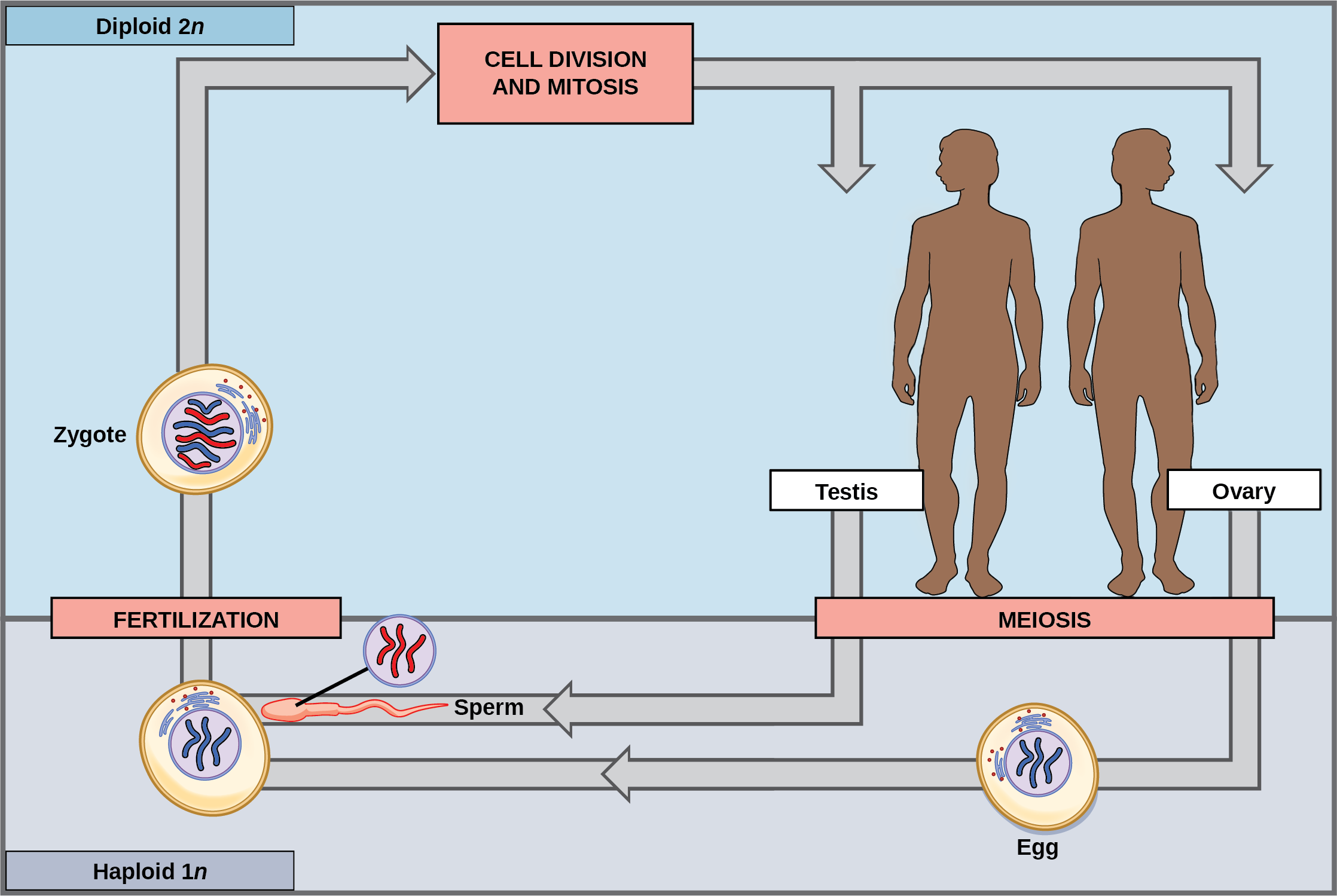

Figure 11.9図 11.9
In animals, sexually reproducing adults form haploid gametes, called egg and sperm, from diploid germ cells. Fusion of the two gametes gives rise to a fertilized egg cell, or zygote. The zygote will undergo multiple rounds of mitosis to produce a multicellular offspring. The germ cells are generated early in the development of the zygote.
動物では、有性生殖する成体が、二倍体の生殖細胞から卵と精子という半数体配偶子を作る。二つの配偶子の融合によって受精卵、すなわち接合子ができる。接合子は有糸分裂を何度も繰り返し、多細胞の子へと発生する。生殖細胞は接合子の発生の早期に作られる。
Most fungi and algae employ a life-cycle type in which the “body” of the organism—the ecologically important part of the life cycle—is haploid. The haploid cells that make up the tissues of the dominant multicellular stage are formed by mitosis. During sexual reproduction, specialized haploid cells from two individuals—designated the (+) and (−) mating types—join to form a diploid zygote. The zygote immediately undergoes meiosis to form four haploid cells called spores. Although these spores are haploid like the “parents,” they contain a new genetic combination from two parents. The spores can remain dormant for various time periods. Eventually, when conditions are favorable, the spores form multicellular haploid structures through many rounds of mitosis (Figure 11.10).
英語のヒント
多くの菌類と藻類では、生物の「体」、つまり生活環で生態学的に重要な部分が半数体である。優勢な多細胞段階の組織を構成する半数体細胞は、有糸分裂でできる。有性生殖の際には、(+)型と(−)型と呼ぶ二つの接合型の個体から生じた、特殊化した半数体細胞が融合し、二倍体の接合子を作る。接合子はすぐに減数分裂して、胞子と呼ばれる四つの半数体細胞を作る。これらの胞子は「親」と同じ半数体だが、両親に由来する新しい遺伝的組み合わせを含む。胞子はさまざまな期間、休眠状態にとどまれる。やがて条件がよくなると、有糸分裂を何度も繰り返して、多細胞の半数体構造を形成する(図11.10)。
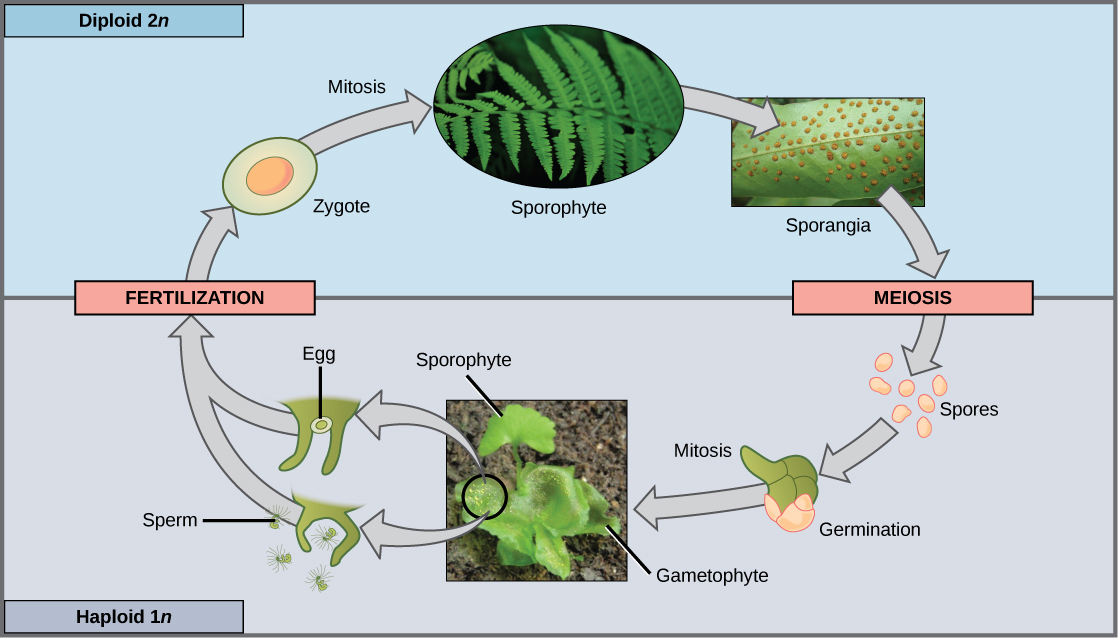
The third life-cycle type, employed by some algae and all plants, is a blend of the haploid-dominant and diploid-dominant extremes. Species with alternation of generations have both haploid and diploid multicellular organisms as part of their life cycle. The haploid multicellular plants are called gametophytes, because they produce gametes from specialized cells. Meiosis is not directly involved in the production of gametes in this case, because the organism that produces the gametes is already haploid. Fertilization between the gametes forms a diploid zygote. The zygote will undergo many rounds of mitosis and give rise to a diploid multicellular plant called a sporophyte. Specialized cells of the sporophyte will undergo meiosis and produce haploid spores. The spores will subsequently develop into the gametophytes (Figure 11.11).
英語のヒント
一部の藻類とすべての植物が用いる第三の生活環は、半数体優勢と二倍体優勢という両極端を組み合わせたものである。世代交代する種は、生活環の中に半数体と二倍体の両方の多細胞個体を持つ。半数体の多細胞植物は、特殊化した細胞から配偶子を作るため、配偶体と呼ばれる。この場合、配偶子を作る個体がすでに半数体なので、配偶子の形成に減数分裂は直接関わらない。配偶子どうしの受精によって二倍体の接合子ができる。接合子は何度も有糸分裂し、胞子体と呼ばれる二倍体の多細胞植物になる。胞子体の特殊化した細胞が減数分裂して半数体胞子を作る。胞子はその後、配偶体へと発生する(図11.11)。
OpenStax, Rice University; Biology 2e. (credit “fern”: modification of work by Cory Zanker; credit “sporangia”: modification of work by "Obsidian Soul"/Wikimedia Commons; credit “gametophyte and sporophyte”: modification of work by “Vlmastra”/Wikimedia Commons) · CC BY 4.0 · Source出典

Figure 11.11図 11.11
Plants have a life cycle that alternates between a multicellular haploid organism and a multicellular diploid organism. In some plants, such as ferns, both the haploid and diploid plant stages are free-living. The diploid plant is called a sporophyte because it produces haploid spores by meiosis. The spores develop into multicellular, haploid plants that are called gametophytes because they produce gametes. The gametes of two individuals will fuse to form a diploid zygote that becomes the sporophyte. (credit “fern”: modification of work by Cory Zanker; credit “sporangia”: modification of work by "Obsidian Soul"/Wikimedia Commons; credit “gametophyte and sporophyte”: modification of work by “Vlmastra”/Wikimedia Commons)
植物の生活環は、多細胞の半数体個体と多細胞の二倍体個体が交互に現れる。シダなどの一部の植物では、半数体と二倍体の両段階が独立して生活する。二倍体植物は減数分裂で半数体胞子を作るので胞子体と呼ぶ。胞子は多細胞の半数体植物へと発生し、これは配偶子を作るので配偶体と呼ぶ。二個体の配偶子が融合して二倍体の接合子を作り、それが胞子体になる。(「シダ」:Cory Zankerの作品を改変。「胞子嚢」:Obsidian Soul/Wikimedia Commonsの作品を改変。「配偶体と胞子体」:Vlmastra/Wikimedia Commonsの作品を改変)
Although all plants utilize some version of the alternation of generations, the relative size of the sporophyte and the gametophyte and the relationship between them vary greatly. In plants such as moss, the gametophyte organism is the free-living plant and the sporophyte is physically dependent on the gametophyte. In other plants, such as ferns, both the gametophyte and sporophyte plants are free-living; however, the sporophyte is much larger. In seed plants, such as magnolia trees and daisies, the gametophyte is composed of only a few cells and, in the case of the female gametophyte, is completely retained within the sporophyte.
英語のヒント
すべての植物は何らかの形で世代交代するが、胞子体と配偶体の相対的な大きさや関係は大きく異なる。コケなどでは配偶体が独立して生活する植物体で、胞子体は配偶体に物理的に依存している。シダなどでは両方が独立して生活するが、胞子体のほうがはるかに大きい。モクレンやヒナギクなどの種子植物では、配偶体は数個の細胞だけからなり、雌性配偶体は全体が胞子体の内部に保持される。
Sexual reproduction takes many forms in multicellular organisms. The fact that nearly every multicellular organism on Earth employs sexual reproduction is strong evidence for the benefits of producing offspring with unique gene combinations, though there are other possible benefits as well.
英語のヒント
多細胞生物の有性生殖には多くの形がある。地球上のほぼすべての多細胞生物が有性生殖を行うという事実は、ほかの利点の可能性もあるものの、固有の遺伝子の組み合わせを持つ子を作る利点の強い証拠である。