第15章遺伝子とタンパク質
Introductionはじめに
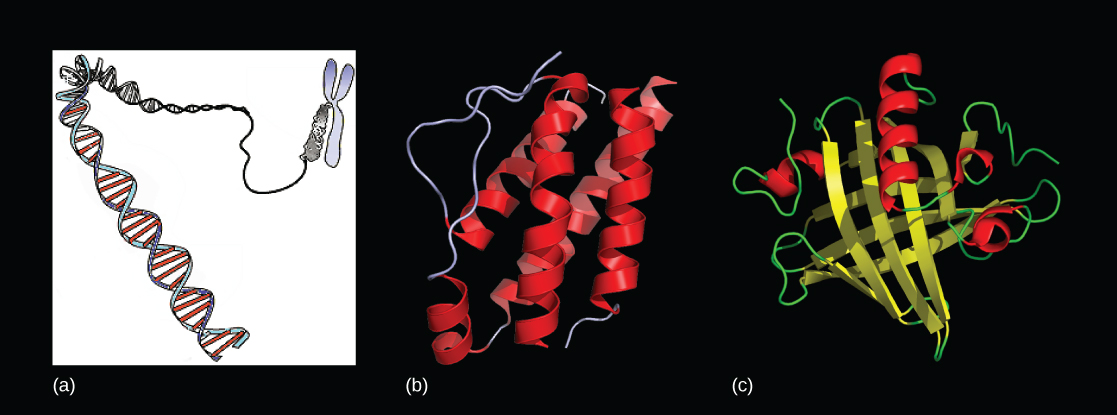
OpenStax, Rice University; Biology 2e. (credit “chromosome: National Human Genome Research Institute; credit “interleukin-2”: Ramin Herati/Created from PDB 1M47 and rendered with Pymol; credit “alpha-2u-globulin”: Darren Logan/rendered with AISMIG) · CC BY 4.0 · Source出典

Figure 15.1図 15.1
Genes, which are carried on (a) chromosomes, are linearly organized instructions for making the RNA and protein molecules that are necessary for all of the processes of life. The (b) interleukin-2 protein and (c) alpha-2u-globulin protein are just two examples of the array of different molecular structures that are encoded by genes. (credit “chromosome: National Human Genome Research Institute; credit “interleukin-2”: Ramin Herati/Created from PDB 1M47 and rendered with Pymol; credit “alpha-2u-globulin”: Darren Logan/rendered with AISMIG)
英語のヒント
(a)染色体上にある遺伝子は、生命のあらゆる過程に必要なRNA分子やタンパク質分子を作るための、直線状に並んだ指示である。(b)インターロイキン2タンパク質と(c)α2uグロブリンタンパク質は、遺伝子がコードする多様な分子構造の、わずか2つの例にすぎない。(「染色体」のクレジット:米国国立ヒトゲノム研究所。「インターロイキン2」のクレジット:Ramin Herati、PDB 1M47から作成しPymolで描画。「α2uグロブリン」のクレジット:Darren Logan、AISMIGで描画)
Since the rediscovery of Mendel’s work in 1900, the definition of the gene has progressed from an abstract unit of heredity to a tangible molecular entity capable of replication, expression, and mutation (Figure 15.1). Genes are composed of DNA and are linearly arranged on chromosomes. Genes specify the sequences of amino acids, which are the building blocks of proteins. In turn, proteins are responsible for orchestrating nearly every function of the cell. Both genes and the proteins they encode are absolutely essential to life as we know it.
英語のヒント
1900年にメンデルの研究が再発見されて以来、遺伝子の定義は、抽象的な遺伝の単位から、複製・発現・変異が可能な実体のある分子へと進展してきた(図15.1)。遺伝子はDNAからなり、染色体上に直線状に並んでいる。遺伝子は、タンパク質の構成単位であるアミノ酸の配列を指定する。そしてタンパク質は、細胞のほぼすべての機能を統括する。遺伝子と、それがコードするタンパク質は、どちらも私たちの知る生命に絶対に欠かせない。