第15章遺伝子とタンパク質
15.2 Prokaryotic Transcription15.2 原核生物の転写
Learning Objectives学習目標
By the end of this section, you will be able to do the following:
この節を学ぶと、次のことができるようになる。
- List the different steps in prokaryotic transcription原核生物の転写の各段階を挙げる。
- Discuss the role of promoters in prokaryotic transcription原核生物の転写におけるプロモーターの役割を論じる。
- Describe how and when transcription is terminated転写がいつ、どのように終結するかを説明する。
The prokaryotes, which include Bacteria and Archaea, are mostly single-celled organisms that, by definition, lack membrane-bound nuclei and other organelles. A bacterial chromosome is a closed circle that, unlike eukaryotic chromosomes, is not organized around histone proteins. The central region of the cell in which prokaryotic DNA resides is called the nucleoid region. In addition, prokaryotes often have abundant plasmids, which are shorter, circular DNA molecules that may only contain one or a few genes. Plasmids can be transferred independently of the bacterial chromosome during cell division and often carry traits such as those involved with antibiotic resistance.
英語のヒント
細菌と古細菌を含む原核生物は、ほとんどが単細胞生物である。定義上、膜に囲まれた核やその他の細胞小器官をもたない。細菌の染色体は閉じた環状で、真核生物の染色体とは異なり、ヒストンタンパク質に巻きついた構造をとらない。原核生物のDNAが存在する細胞の中央領域を、核様体領域と呼ぶ。また、原核生物は多くの場合、多数のプラスミドをもつ。プラスミドはより短い環状DNA分子で、1個または少数の遺伝子だけを含むことがある。プラスミドは、細胞分裂時に細菌の染色体とは独立に受け渡され、抗生物質耐性に関わるものなどの形質を担うことが多い。
Transcription in prokaryotes (and in eukaryotes) requires the DNA double helix to partially unwind in the region of mRNA synthesis. The region of unwinding is called a transcription bubble. Transcription always proceeds from the same DNA strand for each gene, which is called the template strand. The mRNA product is complementary to the template strand and is almost identical to the other DNA strand, called the nontemplate strand, or the coding strand. The only nucleotide difference is that in mRNA, all of the T nucleotides are replaced with U nucleotides (Figure 15.7). In an RNA double helix, A can bind U via two hydrogen bonds, just as in A–T pairing in a DNA double helix.
英語のヒント
原核生物でも真核生物でも、転写には、mRNAを合成する領域でDNA二重らせんが部分的にほどけることが必要である。ほどけた領域を転写バブルという。各遺伝子の転写は、常に同じ側のDNA鎖をもとに進み、この鎖を鋳型鎖という。mRNA産物は鋳型鎖に相補的であり、もう一方のDNA鎖とほぼ同一である。このもう一方の鎖を、非鋳型鎖またはコード鎖という。ヌクレオチドの唯一の違いは、mRNAではTがすべてUに置き換わっていることである(図15.7)。RNA二重らせんでは、DNA二重らせんのA–T対と同じように、Aが2本の水素結合を介してUと結合できる。
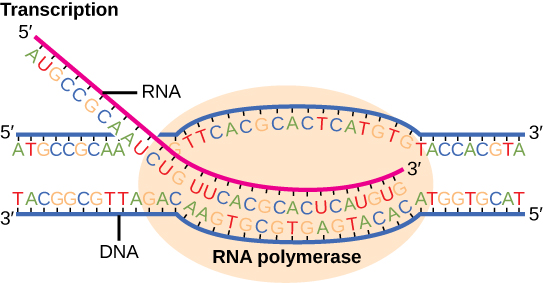

Figure 15.7図 15.7
Messenger RNA is a copy of protein-coding information in the coding strand of DNA, with the substitution of U in the RNA for T in the coding sequence. However, new RNA nucleotides base pair with the nucleotides of the template strand. RNA is synthesized in its 5'-3' direction, using the enzyme RNA polymerase. As the template is read, the DNA unwinds ahead of the polymerase and then rewinds behind it.
英語のヒント
メッセンジャーRNAは、DNAのコード鎖にあるタンパク質をコードする情報のコピーであり、コード配列のTがRNAではUに置き換わる。ただし、新たに加わるRNAヌクレオチドが塩基対を作る相手は、鋳型鎖のヌクレオチドである。RNAはRNAポリメラーゼを用いて5′から3′の方向に合成される。鋳型が読まれるにつれ、DNAはポリメラーゼの前方でほどけ、後方で再び巻き合う。
The nucleotide pair in the DNA double helix that corresponds to the site from which the first 5' mRNA nucleotide is transcribed is called the +1 site, or the initiation site. Nucleotides preceding the initiation site are denoted with a “-” and are designated upstream nucleotides. Conversely, nucleotides following the initiation site are denoted with “+” numbering and are called downstream nucleotides.
英語のヒント
mRNAの最初の5′ヌクレオチドが転写される位置に対応する、DNA二重らせんのヌクレオチド対を、+1部位または開始部位という。開始部位より前のヌクレオチドには「−」の番号を付け、上流のヌクレオチドと呼ぶ。反対に、開始部位より後のヌクレオチドには「+」の番号を付け、下流のヌクレオチドと呼ぶ。
Initiation of Transcription in Prokaryotes原核生物における転写の開始
Prokaryotes do not have membrane-enclosed nuclei. Therefore, the processes of transcription, translation, and mRNA degradation can all occur simultaneously. The intracellular level of a bacterial protein can quickly be amplified by multiple transcription and translation events that occur concurrently on the same DNA template. Prokaryotic genomes are very compact, and prokaryotic transcripts often cover more than one gene or cistron (a coding sequence for a single protein). Polycistronic mRNAs are then translated to produce more than one kind of protein.
英語のヒント
原核生物には、膜に囲まれた核がない。そのため、転写、翻訳、mRNA分解のすべてが同時に起こりうる。同じDNA鋳型上で複数の転写と翻訳が並行して起こることにより、細菌細胞内のタンパク質量は速やかに増幅できる。原核生物のゲノムは非常にコンパクトであり、転写産物は複数の遺伝子、すなわちシストロン(1つのタンパク質のコード配列)にまたがることが多い。その後、このポリシストロニックmRNAが翻訳され、複数種類のタンパク質が作られる。
Our discussion here will exemplify transcription by describing this process in Escherichia coli, a well-studied eubacterial species. Although some differences exist between transcription in E. coli and transcription in archaea, an understanding of E. coli transcription can be applied to virtually all bacterial species.
英語のヒント
ここでは、よく研究されている真正細菌の一種、大腸菌(Escherichia coli)における過程を説明し、転写の例とする。大腸菌と古細菌の転写にはいくつか違いがあるが、大腸菌の転写の理解は、ほぼすべての細菌種に適用できる。
Prokaryotic RNA Polymerase原核生物のRNAポリメラーゼ
Prokaryotes use the same RNA polymerase to transcribe all of their genes. In E. coli, the polymerase is composed of five polypeptide subunits, two of which are identical. Four of these subunits, denoted α, α, β, and β', comprise the polymerase core enzyme. These subunits assemble every time a gene is transcribed, and they disassemble once transcription is complete. Each subunit has a unique role; the two α-subunits are necessary to assemble the polymerase on the DNA; the β-subunit binds to the ribonucleoside triphosphate that will become part of the nascent mRNA molecule; and the β' subunit binds the DNA template strand. The fifth subunit, σ, is involved only in transcription initiation. It confers transcriptional specificity such that the polymerase begins to synthesize mRNA from an appropriate initiation site. Without σ, the core enzyme would transcribe from random sites and would produce mRNA molecules that specified protein gibberish. The polymerase comprised of all five subunits is called the holoenzyme.
英語のヒント
原核生物は、同じRNAポリメラーゼを使ってすべての遺伝子を転写する。大腸菌のポリメラーゼは5つのポリペプチドサブユニットからなり、そのうち2つは同一である。α、α、β、β′と表される4つのサブユニットが、ポリメラーゼのコア酵素を構成する。これらは遺伝子が転写されるたびに集合し、転写が終わると解離する。各サブユニットには固有の役割がある。2つのαサブユニットは、DNA上にポリメラーゼを組み立てるのに必要である。βサブユニットは、形成中のmRNA分子の一部となるリボヌクレオシド三リン酸に結合する。β′サブユニットはDNA鋳型鎖に結合する。5つ目のサブユニットσは、転写開始にだけ関与する。これは、ポリメラーゼが適切な開始部位からmRNA合成を始めるよう、転写に特異性を与える。σがなければ、コア酵素は無作為な位置から転写し、意味をなさないタンパク質を指定するmRNA分子を作ってしまう。5つのサブユニットをすべて含むポリメラーゼを、ホロ酵素という。