第15章遺伝子とタンパク質
15.5 Ribosomes and Protein Synthesis15.5 リボソームとタンパク質合成
Learning Objectives学習目標
By the end of this section, you will be able to do the following:
この節を学ぶと、次のことができるようになる。
- Describe the different steps in protein synthesisタンパク質合成の各段階を説明する。
- Discuss the role of ribosomes in protein synthesisタンパク質合成におけるリボソームの役割を論じる。
The synthesis of proteins consumes more of a cell’s energy than any other metabolic process. In turn, proteins account for more mass than any other component of living organisms (with the exception of water), and proteins perform virtually every function of a cell. The process of translation, or protein synthesis, involves the decoding of an mRNA message into a polypeptide product. Amino acids are covalently strung together by interlinking peptide bonds in lengths ranging from approximately 50 to more than 1000 amino acid residues. Each individual amino acid has an amino group (NH2) and a carboxyl (COOH) group. Polypeptides are formed when the amino group of one amino acid forms an amide (i.e., peptide) bond with the carboxyl group of another amino acid (Figure 15.15). This reaction is catalyzed by ribosomes and generates one water molecule.
英語のヒント
タンパク質合成は、ほかのどの代謝過程よりも多くの細胞のエネルギーを消費する。それに対応して、タンパク質は、水を除けば生物のどの構成成分よりも多くの質量を占め、細胞のほぼすべての機能を果たす。翻訳、すなわちタンパク質合成の過程では、mRNAの情報をポリペプチド産物へと解読する。アミノ酸はペプチド結合によって共有結合でつながれ、約50〜1,000個を超えるアミノ酸残基の長さになる。各アミノ酸には、アミノ基(NH2)とカルボキシ基(COOH)がある。あるアミノ酸のアミノ基が、別のアミノ酸のカルボキシ基とアミド結合、すなわちペプチド結合を作ると、ポリペプチドが形成される(図15.15)。この反応はリボソームによって触媒され、水分子を1個生じる。
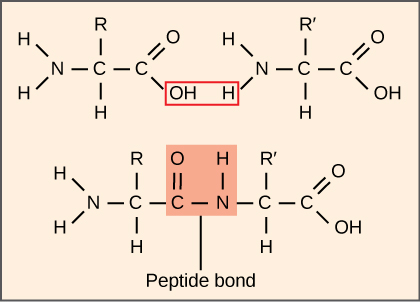

Figure 15.15図 15.15
A peptide bond links the carboxyl end of one amino acid with the amino end of another, producing one water molecule during the process. For simplicity in this image, only the functional groups involved in the peptide bond are shown. The R and R' designations refer to the rest of each amino acid structure.
英語のヒント
ペプチド結合は、あるアミノ酸のカルボキシ末端と、別のアミノ酸のアミノ末端をつなぎ、その過程で水分子を1個生じる。図を簡単にするため、ペプチド結合に関わる官能基だけを示している。RとR′は、各アミノ酸構造の残りの部分を表す。
The Protein Synthesis Machineryタンパク質合成装置
In addition to the mRNA template, many molecules and macromolecules contribute to the process of translation. The composition of each component may vary across species; for example, ribosomes may consist of different numbers of rRNAs and polypeptides depending on the organism. However, the general structures and functions of the protein synthesis machinery are comparable from bacteria to human cells. Translation requires the input of an mRNA template, ribosomes, tRNAs, and various enzymatic factors. (Note: A ribosome can be thought of as an enzyme whose amino acid binding sites are specified by mRNA.)
英語のヒント
翻訳の過程には、mRNA鋳型に加えて、多くの分子や高分子が関与する。各構成要素の組成は種によって異なることがある。たとえば、リボソームを構成するrRNAやポリペプチドの数は、生物によって違う。しかし、タンパク質合成装置の基本的な構造と機能は、細菌からヒトの細胞まで共通している。翻訳には、mRNA鋳型、リボソーム、tRNA、さまざまな酵素因子の供給が必要である。(注:リボソームは、アミノ酸結合部位がmRNAによって指定される酵素と考えることができる。)
Ribosomesリボソーム
Even before an mRNA is translated, a cell must invest energy to build each of its ribosomes. In E. coli, there are between 10,000 and 70,000 ribosomes present in each cell at any given time. A ribosome is a complex macromolecule composed of structural and catalytic rRNAs, and many distinct polypeptides. In eukaryotes, the nucleolus is completely specialized for the synthesis and assembly of rRNAs.
英語のヒント
mRNAが翻訳される前から、細胞は各リボソームを組み立てるためにエネルギーを投入しなければならない。大腸菌では、どの時点でも、各細胞に1万〜7万個のリボソームが存在する。リボソームは、構造や触媒作用を担うrRNAと、多数の異なるポリペプチドからなる複雑な高分子である。真核生物の核小体は、rRNAの合成と組立てに全面的に特化している。
Ribosomes exist in the cytoplasm of prokaryotes and in the cytoplasm and rough endoplasmic reticulum of eukaryotes. Mitochondria and chloroplasts also have their own ribosomes in the matrix and stroma, which look more similar to prokaryotic ribosomes (and have similar drug sensitivities) than the ribosomes just outside their outer membranes in the cytoplasm. Ribosomes dissociate into large and small subunits when they are not synthesizing proteins and reassociate during the initiation of translation. In E. coli, the small subunit is described as 30S, and the large subunit is 50S, for a total of 70S (recall that Svedberg units are not additive). Mammalian ribosomes have a small 40S subunit and a large 60S subunit, for a total of 80S. The small subunit is responsible for binding the mRNA template, whereas the large subunit sequentially binds tRNAs. Each mRNA molecule is simultaneously translated by many ribosomes, all synthesizing protein in the same direction: reading the mRNA from 5' to 3' and synthesizing the polypeptide from the N terminus to the C terminus. The complete mRNA/poly-ribosome structure is called a polysome.
英語のヒント
リボソームは、原核生物では細胞質に、真核生物では細胞質と粗面小胞体に存在する。ミトコンドリアと葉緑体も、それぞれマトリックスとストロマに独自のリボソームをもつ。これらは、外膜のすぐ外の細胞質にあるリボソームよりも、原核生物のリボソームに似ており、薬剤感受性も似ている。リボソームはタンパク質を合成していないとき、大サブユニットと小サブユニットに解離し、翻訳開始時に再び会合する。大腸菌では、小サブユニットが30S、大サブユニットが50Sで、全体は70Sである(スベドベリ単位は加算できないことを思い出そう)。哺乳類のリボソームは、40Sの小サブユニットと60Sの大サブユニットからなり、全体は80Sである。小サブユニットはmRNA鋳型との結合を担い、大サブユニットはtRNAを順に結合する。各mRNA分子は、多数のリボソームによって同時に翻訳される。どのリボソームも同じ方向にタンパク質を合成する。すなわち、mRNAを5′から3′へ読み、ポリペプチドをN末端からC末端へ合成する。mRNAと複数のリボソームからなる構造全体を、ポリソームという。
tRNAstRNA
The tRNAs are structural RNA molecules that were transcribed from genes by RNA polymerase III. Depending on the species, 40 to 60 types of tRNAs exist in the cytoplasm. Transfer RNAs serve as adaptor molecules. Each tRNA carries a specific amino acid and recognizes one or more of the mRNA codons that define the order of amino acids in a protein. Aminoacyl-tRNAs bind to the ribosome and add the corresponding amino acid to the polypeptide chain. Therefore, tRNAs are the molecules that actually “translate” the language of RNA into the language of proteins.
英語のヒント
tRNAは、RNAポリメラーゼIIIによって遺伝子から転写された構造RNA分子である。種によって異なるが、細胞質には40〜60種類のtRNAが存在する。転移RNAはアダプター分子として働く。各tRNAは特定のアミノ酸を運び、タンパク質中のアミノ酸の順序を定めるmRNAコドンのうち、1種類以上を認識する。アミノアシルtRNAはリボソームに結合し、対応するアミノ酸をポリペプチド鎖へ加える。したがって、実際にRNAの言語をタンパク質の言語へ「翻訳」する分子は、tRNAである。
Of the 64 possible mRNA codons—or triplet combinations of A, U, G, and C—three specify the termination of protein synthesis and 61 specify the addition of amino acids to the polypeptide chain. Of these 61, one codon (AUG) also encodes the initiation of translation. Each tRNA anticodon can base pair with one or more of the mRNA codons for its amino acid. For instance, if the sequence CUA occurred on an mRNA template in the proper reading frame, it would bind a leucine tRNA expressing the complementary sequence, GAU. The ability of some tRNAs to match more than one codon is what gives the genetic code its blocky structure.
英語のヒント
可能なmRNAコドン、つまりA、U、G、Cの3つ組の組み合わせは64種類ある。そのうち3種類はタンパク質合成の終結を、61種類はポリペプチド鎖へのアミノ酸の付加を指定する。この61種類のうち1つのコドン(AUG)は、翻訳の開始もコードする。各tRNAのアンチコドンは、そのアミノ酸に対応するmRNAコドンの1種類以上と塩基対を作れる。たとえば、mRNA鋳型の正しい読み枠にCUAという配列があれば、相補的なGAU配列をもつロイシンtRNAと結合する。一部のtRNAが複数のコドンに対応できることが、遺伝暗号をブロック状の構造にしている。
As the adaptor molecules of translation, it is surprising that tRNAs can fit so much specificity into such a small package. Consider that tRNAs need to interact with three factors: 1) they must be recognized by the correct aminoacyl synthetase (see below); 2) they must be recognized by ribosomes; and 3) they must bind to the correct sequence in mRNA.
英語のヒント
翻訳のアダプター分子として、tRNAがこれほど小さな構造に、これほど多くの特異性を収めていることは驚くべきことである。tRNAが次の3つの相手と相互作用しなければならないことを考えよう。1)正しいアミノアシル合成酵素に認識される(後述)。2)リボソームに認識される。3)mRNAの正しい配列に結合する。
OpenStax, Rice University; Biology 2e. Credit: Rao, A., Ryan, K. and Fletcher, S. Department of Biology, Texas A&M University. · CC BY 4.0 · Source出典

Figure 15.16図 15.16
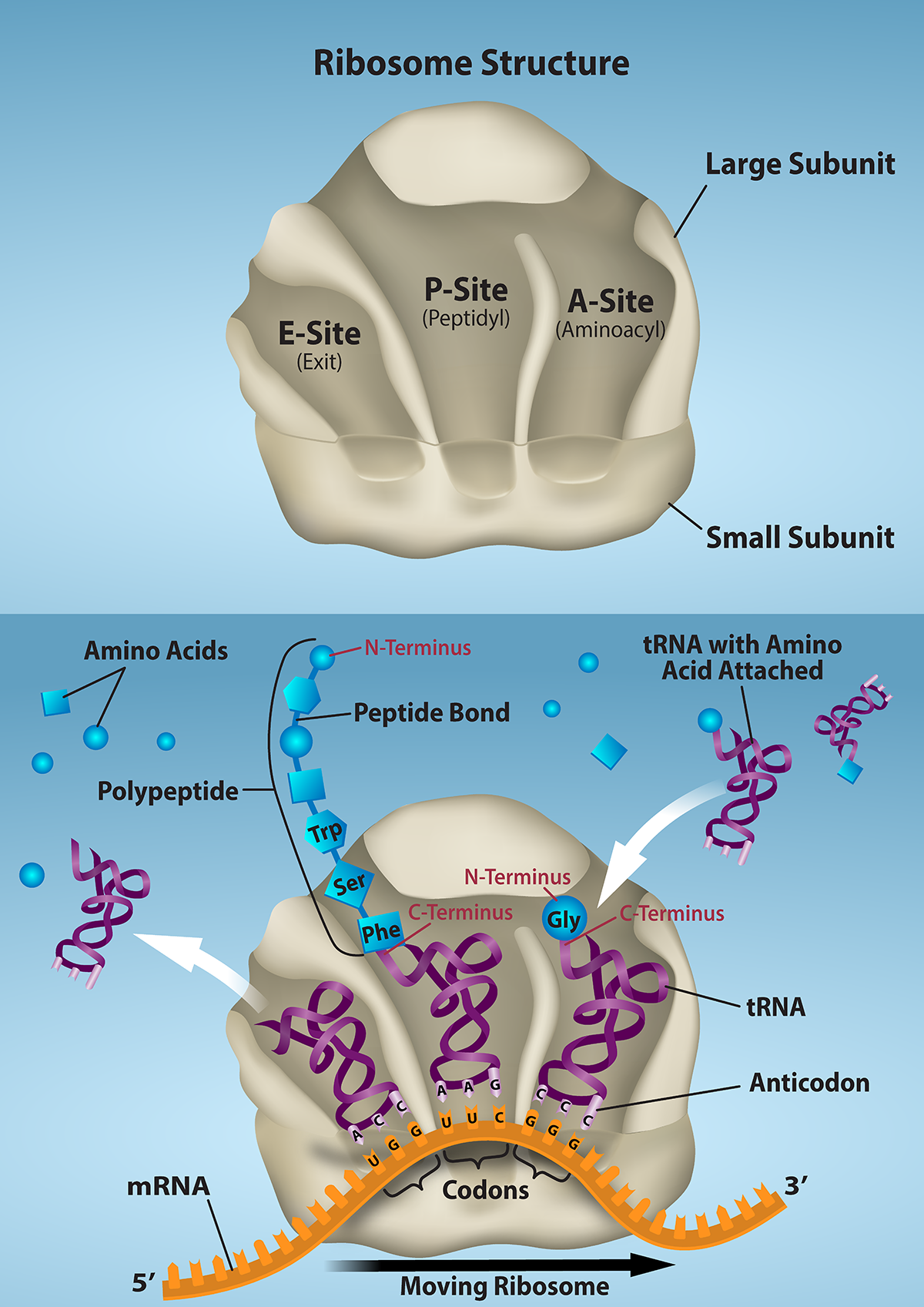
The ribosome and its function. The ribosome is responsible for translating the mRNA into protein. A. The ribosome consists of a large and small ribosomal subunit. Assembly of the subunits on the mRNA forms three tRNA binding sites. B. During translation, charged tRNAs enter the Acceptor site, and the anticodon on the tRNA base pairs with the codon in the mRNA. After the incoming amino acid forms a peptide bond with the growing polypeptide chain, the ribosome will move three nucleotides toward the 3’ end of the mRNA. This movement will transfer the tRNA with the growing polypeptide to the Peptidyl-tRNA binding site and allow the empty tRNA to exit at the Exit site. Credit: Rao, A., Ryan, K. and Fletcher, S. Department of Biology, Texas A&M University.
英語のヒント
リボソームとその働き。リボソームは、mRNAをタンパク質へ翻訳する。A:リボソームは、大サブユニットと小サブユニットからなる。mRNA上でサブユニットが組み立てられると、3つのtRNA結合部位ができる。B:翻訳中、アミノ酸を結合したtRNAが受容部位に入り、tRNAのアンチコドンがmRNAのコドンと塩基対を作る。入ってきたアミノ酸が伸長中のポリペプチド鎖とペプチド結合を作ると、リボソームはmRNAの3′末端へ向かって3ヌクレオチド移動する。この移動によって、伸長中のポリペプチドをもつtRNAがペプチジルtRNA結合部位へ移り、空のtRNAが出口部位から出られるようになる。クレジット:Rao, A., Ryan, K. and Fletcher, S.、テキサスA&M大学生物学科。