第15章遺伝子とタンパク質
5' Capping5′キャップの付加
While the pre-mRNA is still being synthesized, a 7-methylguanosine cap is added to the 5' end of the growing transcript by a phosphate linkage. This functional group protects the nascent mRNA from degradation. In addition, factors involved in protein synthesis recognize the cap to help initiate translation by ribosomes.
英語のヒント
pre-mRNAの合成がまだ続いている間に、伸長中の転写産物の5′末端へ、リン酸結合によって7-メチルグアノシンキャップが付加される。この官能基は、形成中のmRNAを分解から守る。さらに、タンパク質合成に関わる因子がこのキャップを認識し、リボソームによる翻訳の開始を助ける。
3' Poly-A Tail3′ポリAテール
Once elongation is complete, the pre-mRNA is cleaved by an endonuclease between an AAUAAA consensus sequence and a GU-rich sequence, leaving the AAUAAA sequence on the pre-mRNA. An enzyme called poly-A polymerase then adds a string of approximately 200 A residues, called the poly-A tail. This modification further protects the pre-mRNA from degradation and is also the binding site for a protein necessary for exporting the processed mRNA to the cytoplasm.
英語のヒント
伸長が完了すると、pre-mRNAは、AAUAAA共通配列とGUに富む配列との間でエンドヌクレアーゼによって切断される。AAUAAA配列はpre-mRNA側に残る。次に、ポリAポリメラーゼという酵素が、ポリAテールと呼ばれる約200個のA残基の連なりを付加する。この修飾は、pre-mRNAを分解からさらに保護する。また、加工済みのmRNAを細胞質へ運び出すために必要なタンパク質の結合部位にもなる。
Pre-mRNA Splicingpre-mRNAのスプライシング
Eukaryotic genes are composed of exons, which correspond to protein-coding sequences (ex-on signifies that they are expressed), and intervening sequences called introns (int-ron denotes their intervening role), which may be involved in gene regulation but are removed from the pre-mRNA during processing. Intron sequences in mRNA do not encode functional proteins.
英語のヒント
真核生物の遺伝子は、タンパク質コード配列に対応するエクソンと、その間に挟まるイントロンと呼ばれる配列からなる。ex-onのexは発現することを、int-ronのintは間に挟まる役割を表す。イントロンは遺伝子調節に関わることがあるが、加工中にpre-mRNAから取り除かれる。mRNA中のイントロン配列は、機能するタンパク質をコードしない。
The discovery of introns came as a surprise to researchers in the 1970s who expected that pre-mRNAs would specify protein sequences without further processing, as they had observed in prokaryotes. The genes of higher eukaryotes very often contain one or more introns. These regions may correspond to regulatory sequences; however, the biological significance of having many introns or having very long introns in a gene is unclear. It is possible that introns slow down gene expression because it takes longer to transcribe pre-mRNAs with lots of introns. Alternatively, introns may be nonfunctional sequence remnants left over from the fusion of ancient genes throughout the course of evolution. This is supported by the fact that separate exons often encode separate protein subunits or domains. For the most part, the sequences of introns can be mutated without ultimately affecting the protein product.
英語のヒント
1970年代、イントロンの発見は研究者を驚かせた。原核生物で観察したように、pre-mRNAは追加の加工なしにタンパク質配列を指定すると予想していたからである。高等真核生物の遺伝子には、1つ以上のイントロンが含まれることが非常に多い。これらの領域は調節配列に当たることがある。しかし、遺伝子内に多数のイントロンや、非常に長いイントロンがあることの生物学的な意味は、明らかではない。イントロンが多いpre-mRNAの転写には時間がかかるため、イントロンが遺伝子発現を遅くしている可能性もある。別の可能性として、イントロンは、進化の過程で古い遺伝子どうしが融合した後に残った、機能のない配列の名残かもしれない。異なるエクソンが、異なるタンパク質サブユニットやドメインをコードすることが多いという事実は、この考えを支持する。大部分の場合、イントロンの配列に変異が起きても、最終的なタンパク質産物には影響しない。
All of a pre-mRNA’s introns must be completely and precisely removed before protein synthesis. If the process errs by even a single nucleotide, the reading frame of the rejoined exons would shift, and the resulting protein would be dysfunctional. The process of removing introns and reconnecting exons is called splicing (Figure 15.13). Introns are removed and degraded while the pre-mRNA is still in the nucleus. Splicing occurs by a sequence-specific mechanism that ensures introns will be removed and exons rejoined with the accuracy and precision of a single nucleotide. Although the intron itself is noncoding, the beginning and end of each intron is marked with specific nucleotides: GU at the 5' end and AG at the 3' end of the intron. The splicing of pre-mRNAs is conducted by complexes of proteins and RNA molecules called spliceosomes.
英語のヒント
タンパク質合成の前に、pre-mRNAのイントロンはすべて、完全かつ正確に除去されなければならない。この過程にわずか1ヌクレオチドの誤りがあっても、つなぎ直されたエクソンの読み枠がずれ、できるタンパク質は機能不全となる。イントロンを取り除き、エクソンをつなぎ直す過程を、スプライシングという(図15.13)。イントロンは、pre-mRNAがまだ核内にあるうちに除去され、分解される。スプライシングは配列特異的な仕組みによって起こり、1ヌクレオチド単位の正確さと精密さで、イントロンの除去とエクソンの再結合を行う。イントロン自体はタンパク質をコードしないが、各イントロンの両端には、特定のヌクレオチドが目印としてある。5′末端にはGU、3′末端にはAGがある。pre-mRNAのスプライシングは、スプライソソームと呼ばれる、タンパク質とRNA分子の複合体によって行われる。
Note that more than 70 individual introns can be present, and each has to undergo the process of splicing—in addition to 5' capping and the addition of a poly-A tail—just to generate a single, translatable mRNA molecule.
英語のヒント
翻訳できるmRNA分子をたった1つ作るためだけでも、5′キャップとポリAテールの付加に加え、70個を超えるイントロンが存在し、その1つひとつをスプライシングする必要がある場合もあることに注目しよう。
Processing of tRNAs and rRNAstRNAとrRNAの加工
The tRNAs and rRNAs are structural molecules that have roles in protein synthesis; however, these RNAs are not themselves translated. Pre-rRNAs are transcribed, processed, and assembled into ribosomes in the nucleolus. Pre-tRNAs are transcribed and processed in the nucleus and then released into the cytoplasm where they are linked to free amino acids for protein synthesis.
英語のヒント
tRNAとrRNAはタンパク質合成で役割を果たす構造分子だが、これらのRNA自体が翻訳されることはない。pre-rRNAは核小体で転写され、加工され、リボソームへ組み立てられる。pre-tRNAは核内で転写と加工を受け、その後、細胞質へ放出される。そこでタンパク質合成のため、遊離アミノ酸と結びつく。
Most of the tRNAs and rRNAs in eukaryotes and prokaryotes are first transcribed as a long precursor molecule that spans multiple rRNAs or tRNAs. Enzymes then cleave the precursors into subunits corresponding to each structural RNA. Some of the bases of pre-rRNAs are methylated; that is, a –CH3 methyl functional group is added for stability. Pre-tRNA molecules also undergo methylation. As with pre-mRNAs, subunit excision occurs in eukaryotic pre-RNAs destined to become tRNAs or rRNAs.
英語のヒント
真核生物と原核生物のtRNAやrRNAの大部分は、まず、複数のrRNAまたはtRNAにまたがる長い前駆体分子として転写される。その後、酵素が前駆体を切断し、各構造RNAに対応するサブユニットに分ける。pre-rRNAの一部の塩基はメチル化される。つまり、安定化のために−CH3というメチル官能基が付加される。pre-tRNA分子もメチル化を受ける。pre-mRNAと同じく、tRNAやrRNAになる真核生物の前駆体RNAでも、サブユニットの切り出しが起こる。
Mature rRNAs make up approximately 50 percent of each ribosome. Some of a ribosome’s RNA molecules are purely structural, whereas others have catalytic or binding activities. Mature tRNAs take on a three-dimensional structure through local regions of base pairing stabilized by intramolecular hydrogen bonding. The tRNA folds to position the amino acid binding site at one end and the anticodon at the other end (Figure 15.14). The anticodon is a three-nucleotide sequence in a tRNA that interacts with an mRNA codon through complementary base pairing.
英語のヒント
成熟rRNAは、各リボソームのおよそ50%を構成する。リボソームのRNA分子には、純粋に構造を担うものと、触媒活性や結合活性をもつものがある。成熟tRNAは、分子内水素結合によって安定化された局所的な塩基対形成を通じて、立体構造をとる。tRNAは、一端にアミノ酸結合部位、もう一端にアンチコドンが来るように折りたたまれる(図15.14)。アンチコドンは、tRNA中の3ヌクレオチド配列で、相補的な塩基対形成を通じてmRNAのコドンと相互作用する。
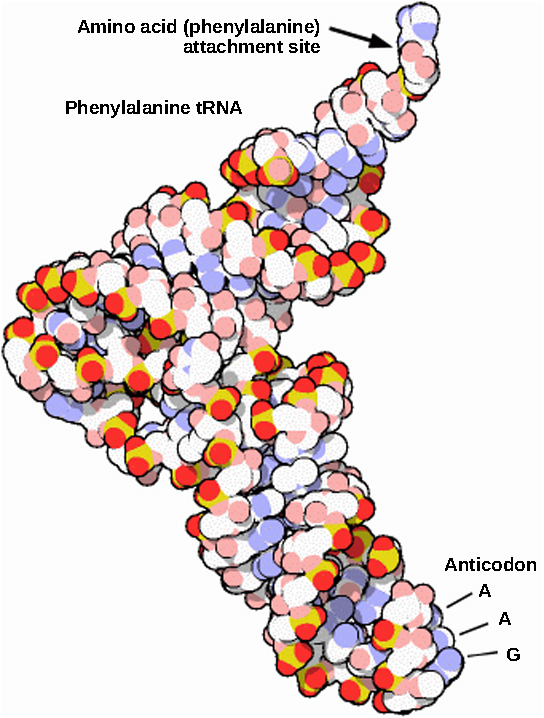

Figure 15.14図 15.14
This is a space-filling model of a tRNA molecule that adds the amino acid phenylalanine to a growing polypeptide chain. The anticodon AAG binds the Codon UUC on the mRNA. The amino acid phenylalanine is attached to the other end of the tRNA.
英語のヒント
伸長中のポリペプチド鎖にアミノ酸フェニルアラニンを加える、tRNA分子の空間充填模型。アンチコドンAAGは、mRNAのコドンUUCに結合する。アミノ酸フェニルアラニンは、tRNAのもう一方の端に付いている。