第15章遺伝子とタンパク質
Prokaryotic Promoters原核生物のプロモーター
A promoter is a DNA sequence onto which the transcription machinery, including RNA polymerase, binds and initiates transcription. In most cases, promoters exist upstream of the genes they regulate. The specific sequence of a promoter is very important because it determines whether the corresponding gene is transcribed all the time, some of the time, or infrequently. Although promoters vary among prokaryotic genomes, a few elements are evolutionarily conserved in many species. At the -10 and -35 regions upstream of the initiation site, there are two promoter consensus sequences, or regions that are similar across all promoters and across various bacterial species (Figure 15.8). The -10 sequence, called the -10 region, has the consensus sequence TATAAT. The -35 sequence has the consensus sequence TTGACA. These consensus sequences are recognized and bound by σ. Once this interaction is made, the subunits of the core enzyme bind to the site. The A–T-rich -10 region facilitates unwinding of the DNA template, and several phosphodiester bonds are made. The transcription initiation phase ends with the production of abortive transcripts, which are polymers of approximately 10 nucleotides that are made and released.
英語のヒント
プロモーターは、RNAポリメラーゼを含む転写装置が結合し、転写を開始するDNA配列である。多くの場合、プロモーターは調節対象の遺伝子の上流にある。プロモーターの具体的な配列は非常に重要である。その配列が、対応する遺伝子を常時転写するか、ときどき転写するか、まれにしか転写しないかを決めるからだ。プロモーターは原核生物のゲノムごとに異なるが、いくつかの要素は、多くの種で進化的に保存されている。開始部位より上流の−10領域と−35領域には、2つのプロモーター共通配列がある。これは、すべてのプロモーター間、またさまざまな細菌種間で似ている領域である(図15.8)。−10領域と呼ばれる−10配列の共通配列はTATAAT、−35配列の共通配列はTTGACAである。これらの共通配列をσが認識して結合する。この相互作用が起こると、コア酵素のサブユニットがその部位に結合する。A–Tに富む−10領域によってDNA鋳型がほどけやすくなり、いくつかのホスホジエステル結合が作られる。転写開始段階は、合成されては放出される約10ヌクレオチドの重合体、すなわち不稔転写産物が作られて終わる。
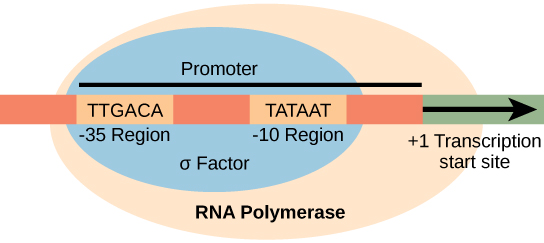
Figure 15.8図 15.8
The σ subunit of prokaryotic RNA polymerase recognizes consensus sequences found in the promoter region upstream of the transcription start site. The σ subunit dissociates from the polymerase after transcription has been initiated.
英語のヒント
原核生物のRNAポリメラーゼのσサブユニットは、転写開始部位より上流のプロモーター領域にある共通配列を認識する。転写が開始されると、σサブユニットはポリメラーゼから解離する。
Elongation and Termination in Prokaryotes原核生物における伸長と終結
The transcription elongation phase begins with the release of the σ subunit from the polymerase. The dissociation of σ allows the core enzyme to proceed along the DNA template, synthesizing mRNA in the 5' to 3' direction at a rate of approximately 40 nucleotides per second. As elongation proceeds, the DNA is continuously unwound ahead of the core enzyme and rewound behind it. The base pairing between DNA and RNA is not stable enough to maintain the stability of the mRNA synthesis components. Instead, the RNA polymerase acts as a stable linker between the DNA template and the nascent RNA strands to ensure that elongation is not interrupted prematurely.
英語のヒント
転写の伸長段階は、σサブユニットがポリメラーゼから離れることで始まる。σが解離すると、コア酵素はDNA鋳型に沿って進み、5′から3′の方向へ、1秒あたり約40ヌクレオチドの速さでmRNAを合成する。伸長が進む間、DNAはコア酵素の前方で絶えずほどけ、後方で再び巻き合う。DNAとRNAの塩基対形成だけでは、mRNA合成に関わる構成要素の安定性を保つには不十分である。その代わり、RNAポリメラーゼがDNA鋳型と形成中のRNA鎖との間の安定した連結役となり、伸長が途中で中断されないようにする。
Prokaryotic Termination Signals原核生物の終結シグナル
Once a gene is transcribed, the prokaryotic polymerase needs to be instructed to dissociate from the DNA template and liberate the newly made mRNA. Depending on the gene being transcribed, there are two kinds of termination signals. One is protein-based and the other is RNA-based. Rho-dependent termination is controlled by the rho (ρ) protein, which tracks along behind the polymerase on the growing mRNA chain. Near the end of the gene, the polymerase encounters a run of G nucleotides on the DNA template and it stalls. As a result, the rho protein collides with the polymerase. The interaction with rho releases the mRNA from the transcription bubble.
英語のヒント
遺伝子の転写が済むと、原核生物のポリメラーゼには、DNA鋳型から解離し、新しくできたmRNAを放出するよう指示が必要になる。転写する遺伝子に応じて、終結シグナルには2種類ある。一方はタンパク質、もう一方はRNAによるものである。ρ依存的終結は、ロー(ρ)タンパク質によって制御される。このタンパク質は、伸長中のmRNA鎖上を、ポリメラーゼの後ろを追って進む。遺伝子の終わり近くで、ポリメラーゼはDNA鋳型上のGヌクレオチドの連続に出会い、停止する。その結果、ρタンパク質がポリメラーゼに衝突する。ρとの相互作用によって、mRNAが転写バブルから放出される。
Rho-independent termination is controlled by specific sequences in the DNA template strand. As the polymerase nears the end of the gene being transcribed, it encounters a region rich in C–G nucleotides. The mRNA folds back on itself, and the complementary C–G nucleotides bind together. The result is a stable hairpin that causes the polymerase to stall as soon as it begins to transcribe a region rich in A–T nucleotides. The complementary U–A region of the mRNA transcript forms only a weak interaction with the template DNA. This, coupled with the stalled polymerase, induces enough instability for the core enzyme to break away and liberate the new mRNA transcript.
英語のヒント
ρ非依存的終結は、DNA鋳型鎖の特定の配列によって制御される。ポリメラーゼが転写中の遺伝子の終わりに近づくと、C–Gヌクレオチドに富む領域に出会う。mRNAは折り返して自分自身に重なり、相補的なC–Gヌクレオチドどうしが結合する。その結果、安定したヘアピンができ、ポリメラーゼがA–Tヌクレオチドに富む領域の転写を始めると、すぐに停止させる。mRNA転写産物の相補的なU–A領域は、鋳型DNAと弱い相互作用しか形成しない。これとポリメラーゼの停止が重なり、コア酵素が離れて新しいmRNA転写産物を放出するほど、不安定になる。
Upon termination, the process of transcription is complete. By the time termination occurs, the prokaryotic transcript would already have been used to begin synthesis of numerous copies of the encoded protein because these processes can occur concurrently. The unification of transcription, translation, and even mRNA degradation is possible because all of these processes occur in the same 5' to 3' direction, and because there is no membranous compartmentalization in the prokaryotic cell (Figure 15.9). In contrast, the presence of a nucleus in eukaryotic cells precludes simultaneous transcription and translation.
英語のヒント
終結によって、転写の過程は完了する。原核生物では、終結が起こるころには、転写産物を使って、コードされているタンパク質の多数のコピーの合成がすでに始まっている。これらの過程が並行して起こりうるからである。転写、翻訳、さらにmRNAの分解まで一体として進められるのは、これらがすべて同じ5′から3′の方向に進むことと、原核細胞には膜による区画化がないためである(図15.9)。これに対し、真核細胞では核があるため、転写と翻訳を同時に行うことはできない。
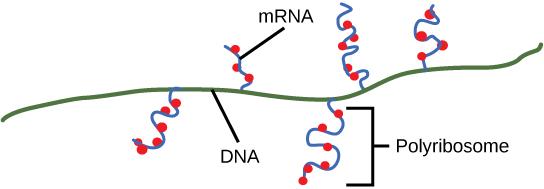


Figure 15.9図 15.9
Multiple polymerases can transcribe a single bacterial gene while numerous ribosomes concurrently translate the mRNA transcripts into polypeptides. In this way, a specific protein can rapidly reach a high concentration in the bacterial cell.
複数のポリメラーゼが1つの細菌遺伝子を転写すると同時に、多数のリボソームがmRNA転写産物をポリペプチドへ翻訳できる。こうして、細菌細胞内で特定のタンパク質の濃度を速やかに高めることができる。