第28章無脊椎動物
Introductionはじめに
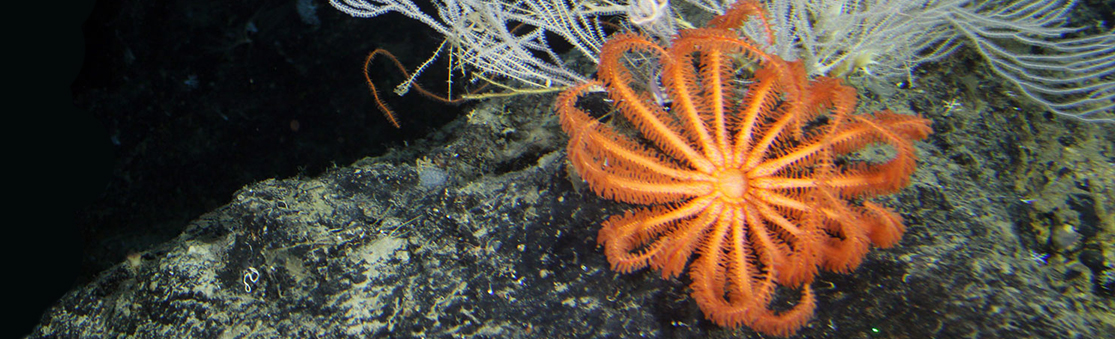
OpenStax, Rice University; Biology 2e. (credit: NOAA’s National Ocean Service) · CC BY 4.0 · Source出典

Figure 28.1図 28.1
Nearly 97 percent of animal species are invertebrates, including this sea star (Novodinia antillensis) (credit: NOAA’s National Ocean Service)
動物種のほぼ97%は無脊椎動物であり、このヒトデ(Novodinia antillensis)もその一つである。(提供:NOAAのNational Ocean Service)
A brief look at any magazine pertaining to our natural world, such as National Geographic, would show a rich variety of vertebrates, especially mammals and birds. To most people, these are the animals that attract our attention. Concentrating on vertebrates, however, gives us a rather biased and limited view of animal diversity, because it ignores nearly 97 percent of the animal kingdom—the invertebrates—animals that lack a cranium and a defined vertebral column or spine.
英語のヒント
『ナショナル ジオグラフィック』など自然界を扱う雑誌を少し眺めれば、多種多様な脊椎動物、特に哺乳類や鳥類が目に入るだろう。多くの人にとって、関心を引く動物とはこうした動物である。しかし、脊椎動物に注目するだけでは、動物の多様性についてかなり偏った、限られた見方になってしまう。動物界のほぼ97%を占める無脊椎動物、すなわち頭蓋と明確な脊柱(背骨)をもたない動物が、そこから抜け落ちるからである。
The invertebrate animal phyla exhibit an enormous variety of cells and tissues adapted for specific purposes, and frequently these tissues are unique to their phyla. These specializations show the range of cellular differentiation possible within the clade Opisthokonta, which has both unicellular and multicellular members. Cellular and structural specializations include cuticles for protection, spines and tiny harpoons for defense, toothy structures for feeding, and wings for flight. An exoskeleton may be adapted for movement or for the attachment of muscles as in the clams and insects. Secretory cells can produce venom, mucus, or digestive enzymes. The body plans of some phyla, such as those of the mollusks, annelids, arthropods, and echinoderms, have been modified and adapted throughout evolution to produce thousands of different forms. Perhaps you will find it amazing that an enormous number of both aquatic and terrestrial invertebrates—perhaps millions of species—have not yet been scientifically classified. As a result, the phylogenetic relationships among the invertebrates are constantly being updated as new information is collected about the organisms of each phylum.
英語のヒント
無脊椎動物の各門には、特定の目的に適応したきわめて多様な細胞や組織が見られ、その門に固有の組織もしばしばある。こうした特殊化は、単細胞生物と多細胞生物の両方を含むオピストコンタというクレードで、細胞の分化がどれほど多様に起こりうるかを示している。細胞や構造の特殊化には、保護のためのクチクラ、防御のための棘や小さな銛、摂食のための歯状構造、飛翔のための翅などがある。二枚貝や昆虫のように、外骨格が運動や筋肉の付着に適応することもある。分泌細胞は、毒、粘液、消化酵素を産生できる。軟体動物、環形動物、節足動物、棘皮動物などの門では、進化の過程を通じて体制が改変され、適応し、何千もの異なる形が生まれてきた。水生・陸生の無脊椎動物の膨大な数、おそらく数百万種が、まだ科学的に分類されていないと知れば、驚くかもしれない。このため、各門の生物について新しい情報が集まるにつれ、無脊椎動物間の系統関係は絶えず更新されている。