第28章無脊椎動物
Class Anthozoa花虫綱
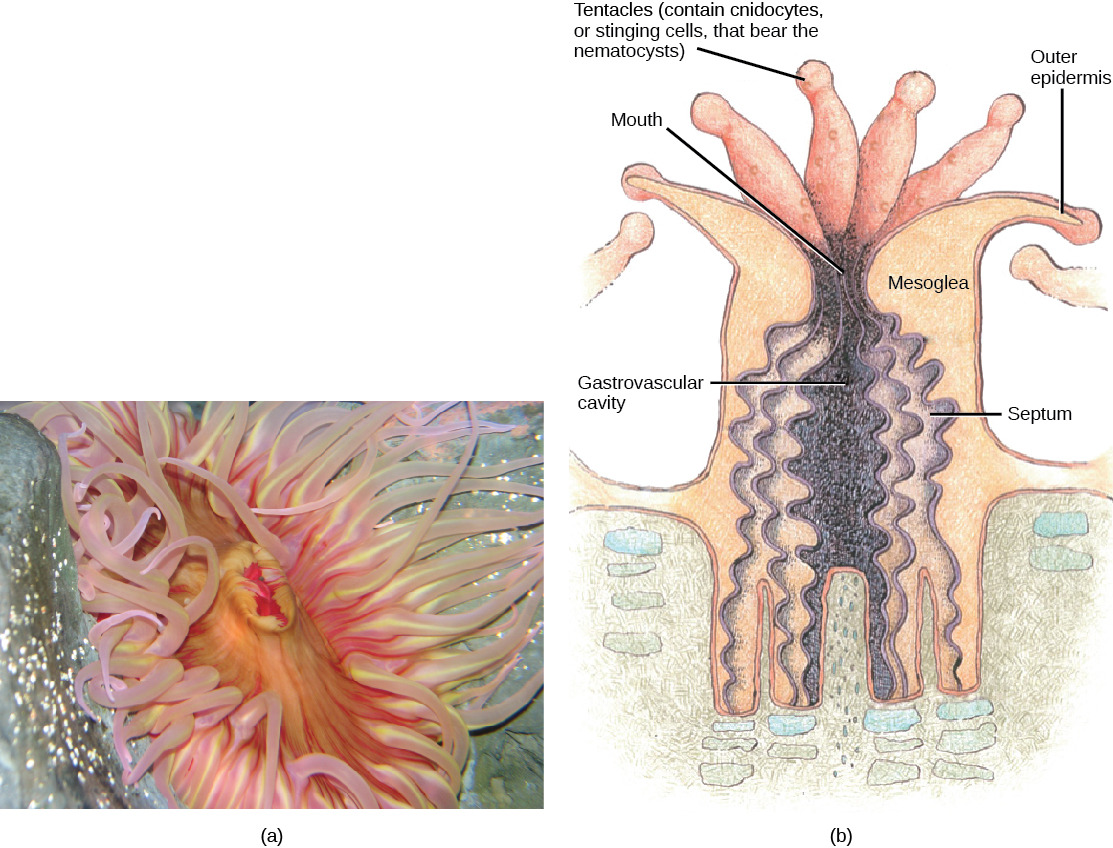
The class Anthozoa ("flower animals") includes sea anemones (Figure 28.8), sea pens, and corals, with an estimated number of 6,100 described species. Sea anemones are usually brightly colored and can attain a size of 1.8 to 10 cm in diameter. Individual animals are cylindrical in shape and are attached directly to a substrate.
英語のヒント
花虫綱(「花の動物」の意)には、イソギンチャク(図28.8)、ウミエラ、サンゴが含まれ、記載種は推定6,100種である。イソギンチャクは通常鮮やかな色をしており、直径は1.8〜10 cmに達する。各個体は円筒形で、基質に直接付着している。
OpenStax, Rice University; Biology 2e. (credit a: modification of work by "Dancing With Ghosts"/Flickr; credit b: modification of work by NOAA) · CC BY 4.0 · Source出典

Figure 28.8図 28.8
Sea anemone. The sea anemone is shown (a) photographed and (b) in a diagram illustrating its morphology. (credit a: modification of work by "Dancing With Ghosts"/Flickr; credit b: modification of work by NOAA)
イソギンチャク。(a)写真と(b)形態を示す模式図。(a:「Dancing With Ghosts」/Flickrの作品を改変。b:NOAAの作品を改変)
The mouth of a sea anemone is surrounded by tentacles that bear cnidocytes. The slit-like mouth opening and flattened pharynx are lined with ectoderm. This structure of the pharynx makes anemones bilaterally symmetrical. A ciliated groove called a siphonoglyph is found on two opposite sides of the pharynx and directs water into it. The pharynx is the muscular part of the digestive system that serves to ingest as well as egest food, and may extend for up to two-thirds the length of the body before opening into the gastrovascular cavity. This cavity is divided into several chambers by longitudinal septa called mesenteries. Each mesentery consists of a fold of gastrodermal tissue with a layer of mesoglea between the sheets of gastrodermis. Mesenteries do not divide the gastrovascular cavity completely, and the smaller cavities coalesce at the pharyngeal opening. The adaptive benefit of the mesenteries appears to be an increase in surface area for absorption of nutrients and gas exchange, as well as additional mechanical support for the body of the anemone.
英語のヒント
イソギンチャクの口は、刺細胞を備えた触手で囲まれている。裂け目のような口の開口部と、平たい咽頭の内面は外胚葉に覆われる。この咽頭の構造によって、イソギンチャクは左右相称となる。咽頭の向かい合う二つの側には、繊毛のある管溝と呼ばれる溝があり、水を咽頭へ導く。咽頭は、食物の取り込みと排出を担う消化系の筋肉質の部分であり、体長の3分の2まで伸びてから胃水管腔へ開くことがある。この腔は、隔膜と呼ばれる縦走する隔壁によって、複数の部屋に分けられている。各隔膜は胃皮組織の折れ込みでできており、胃皮の二枚の層の間に中膠の層がある。隔膜は胃水管腔を完全には分割せず、小さな腔は咽頭の開口部で合流する。隔膜の適応上の利点は、栄養吸収とガス交換のための表面積を増やすとともに、イソギンチャクの体に機械的な支持を加えることにあると考えられる。
Sea anemones feed on small fish and shrimp, usually by immobilizing their prey with nematocysts. Some sea anemones establish a mutualistic relationship with hermit crabs when the crab seizes and attaches them to their shell. In this relationship, the anemone gets food particles from prey caught by the crab, and the crab is protected from the predators by the stinging cells of the anemone. Some species of anemone fish, or clownfish, are also able to live with sea anemones because they build up an acquired immunity to the toxins contained within the nematocysts and also secrete a protective mucus that prevents them from being stung.
英語のヒント
イソギンチャクは小魚やエビを食べ、通常は刺胞で獲物の動きを止める。一部のイソギンチャクは、ヤドカリにつかまれて殻に付けられることで、ヤドカリとの相利共生関係を築く。この関係では、イソギンチャクはヤドカリが捕らえた獲物から食物粒子を得て、ヤドカリはイソギンチャクの刺細胞によって捕食者から守られる。一部のクマノミの種もイソギンチャクと共に暮らせる。刺胞内の毒素に対する獲得免疫を発達させるうえ、刺されるのを防ぐ保護用の粘液を分泌するためである。
The structure of coral polyps is similar to that of anemones, although the individual polyps are usually smaller and part of a colony, some of which are massive and the size of small buildings. Coral polyps feed on smaller planktonic organisms, including algae, bacteria, and invertebrate larvae. Some anthozoans have symbiotic associations with dinoflagellate algae called zooxanthellae. The mutually beneficial relationship between zooxanthellae and modern corals—which provides the algae with shelter—gives coral reefs their colors and supplies both organisms with nutrients. This complex mutualistic association began more than 210 million years ago, according to a new study by an international team of scientists. That this symbiotic relationship arose during a time of massive worldwide coral-reef expansion suggests that the interconnection of algae and coral is crucial for the health of coral reefs, which provide habitat for roughly one-fourth of all marine life. Reefs are threatened by a trend in ocean warming that has caused corals to expel their zooxanthellae algae and turn white, a process called coral bleaching.
英語のヒント
サンゴのポリプの構造はイソギンチャクに似ている。ただし個々のポリプは通常より小さく、群体の一部である。群体の中には、小さな建物ほどの巨大なものもある。サンゴのポリプは、藻類、細菌、無脊椎動物の幼生など、小型のプランクトンを食べる。一部の花虫類は、褐虫藻と呼ばれる渦鞭毛藻と共生する。褐虫藻と現生サンゴの相互に有益な関係は、藻類にすみかを与え、サンゴ礁に色をもたらし、双方に栄養を供給する。国際的な科学者チームの新しい研究によると、この複雑な相利共生は2億1,000万年以上前に始まった。この共生関係が、世界中でサンゴ礁が大きく拡大した時期に生じたことは、藻類とサンゴの結びつきが、全海洋生物のおよそ4分の1に生息地を提供するサンゴ礁の健全性にとって不可欠であることを示唆する。海の温暖化傾向によりサンゴが褐虫藻を排出して白くなる、サンゴの白化と呼ばれる現象が起こり、サンゴ礁が脅かされている。
Anthozoans remain polypoid (note that this term is easily confused with "polyploid") throughout their lives and can reproduce asexually by budding or fragmentation, or sexually by producing gametes. Male or female gametes produced by a polyp fuse to give rise to a free-swimming planula larva. The larva settles on a suitable substratum and develops into a sessile polyp.
英語のヒント
花虫類は一生を通じてポリプ型のままである。なお、polypoid(ポリプ型)は polyploid(倍数体)と混同しやすい語である。出芽や分裂によって無性的に、または配偶子をつくって有性的に繁殖できる。ポリプがつくった雄性配偶子と雌性配偶子が融合すると、自由に泳ぐプラヌラ幼生が生じる。幼生は適した基質に定着し、固着性のポリプへ発生する。
Class Scyphozoa鉢虫綱
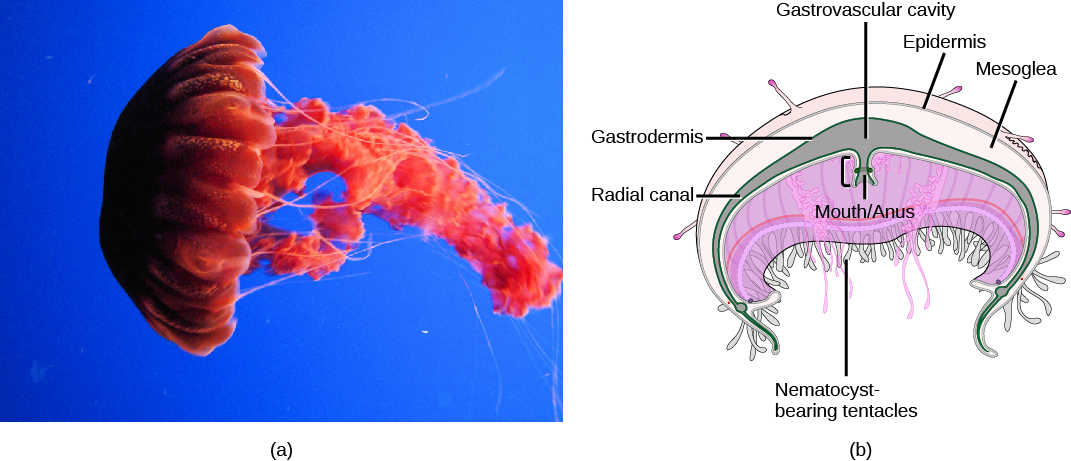
Class Scyphozoa ("cup animals") includes only marine jellies, with about 200 known species. The medusa is the prominent stage in the life cycle, although there is a polyp stage in the life cycle of most species. Most jellies range from 2 to 40 cm in length but the largest scyphozoan species, Cyanea capillata, can reach a size of two meters in diameter. Scyphozoans display a characteristic bell-like morphology (Figure 28.9).
英語のヒント
鉢虫綱(「杯の動物」の意)には海産のクラゲだけが含まれ、約200種が知られている。生活環ではメデューサの段階が目立つが、多くの種にはポリプの段階もある。ほとんどのクラゲは長さ2〜40 cmだが、最大の鉢虫類であるキタユウレイクラゲ(Cyanea capillata)は、直径2 mに達することがある。鉢虫類は特徴的な鐘状の形態を示す(図28.9)。
OpenStax, Rice University; Biology 2e. (credit a: modification of work by "Jimg944"/Flickr; credit b: modification of work by Mariana Ruiz Villareal) · CC BY 4.0 · Source出典

Figure 28.9図 28.9
A sea jelly. A jelly is shown (a) photographed and (b) in a diagram illustrating its morphology. (credit a: modification of work by "Jimg944"/Flickr; credit b: modification of work by Mariana Ruiz Villareal)
海のクラゲ。(a)写真と(b)形態を示す模式図。(a:「Jimg944」/Flickrの作品を改変。b:Mariana Ruiz Villarealの作品を改変)
In the sea jelly, a mouth opening is present on the underside of the animal, surrounded by hollow tentacles bearing nematocysts. Scyphozoans live most of their life cycle as free-swimming, solitary carnivores. The mouth leads to the gastrovascular cavity, which may be sectioned into four interconnected sacs, called diverticuli. In some species, the digestive system may branch further into radial canals. Like the septa in anthozoans, the branched gastrovascular cells serve two functions: to increase the surface area for nutrient absorption and diffusion, and to support the body of the animal.
英語のヒント
海のクラゲでは、体の下面に口が開き、その周囲を、刺胞を備えた中空の触手が囲む。鉢虫類は、生活環の大部分を自由に泳ぐ単独性の肉食動物として過ごす。口は胃水管腔へ通じ、この腔は憩室と呼ばれる、互いにつながった四つの袋に分かれることがある。一部の種では、消化系がさらに放射水管へ枝分かれする。花虫類の隔壁と同じく、枝分かれした胃水管の細胞は二つの機能を果たす。栄養吸収と拡散のための表面積を増やすことと、体を支えることである。
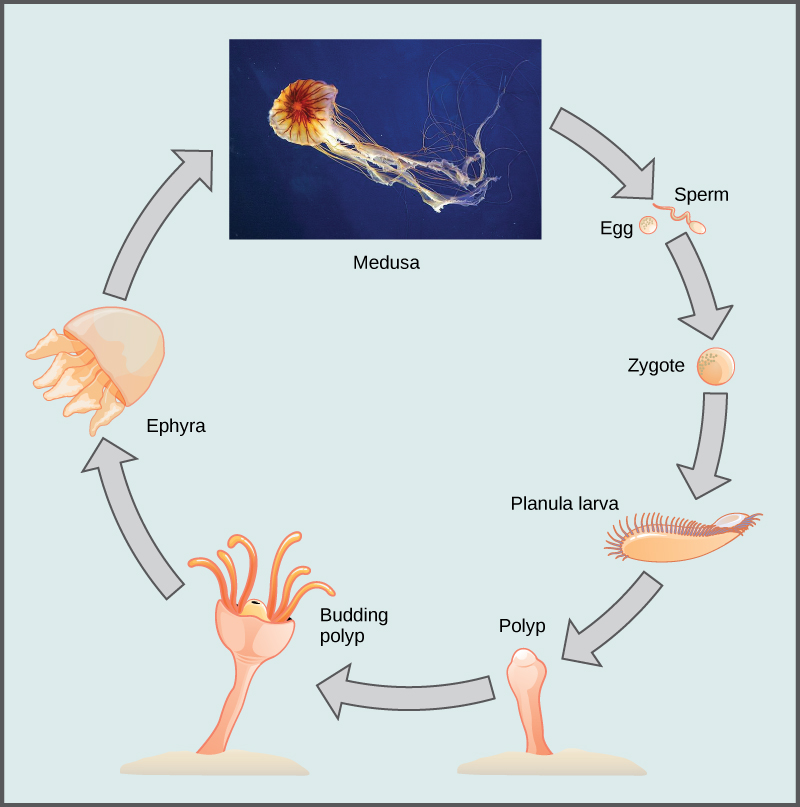
In scyphozoans, nerve cells are organized in a nerve net that extends over the entire body, with a nerve ring around the edge of the bell. Clusters of sensory organs called rhopalia may be present in pockets in the edge of the bell. Jellies have a ring of muscles lining the dome of the body, which provides the contractile force required to swim through water, as well as to draw in food from the water as they swim. Scyphozoans have separate sexes. The gonads are formed from the gastrodermis and gametes are expelled through the mouth. Planula larvae are formed by external fertilization; they settle on a substratum in a polypoid form. These polyps may bud to form additional polyps or begin immediately to produce medusa buds. In a few species, the planula larva may develop directly into the medusa. The life cycle (Figure 28.10) of most scyphozoans includes both sexual medusoid and asexual polypoid body forms.
英語のヒント
鉢虫類では、神経細胞は体全体に広がる神経網を構成し、傘の縁には神経環がある。傘の縁のくぼみには、感覚体と呼ばれる感覚器官の集まりがあることもある。クラゲのドーム状の体の内面には環状の筋肉があり、水中を泳ぐとともに、遊泳中に水から食物を引き込むのに必要な収縮力を生み出す。鉢虫類は雌雄異体である。生殖腺は胃皮から形成され、配偶子は口から放出される。体外受精によってプラヌラ幼生が生じ、基質に定着してポリプ型になる。ポリプは出芽してさらにポリプをつくるか、すぐにメデューサの芽をつくり始める。少数の種では、プラヌラ幼生が直接メデューサに発生することもある。多くの鉢虫類の生活環(図28.10)には、有性的なメデューサ型と無性的なポリプ型の両方が含まれる。
OpenStax, Rice University; Biology 2e. (credit "medusa": modification of work by Francesco Crippa) · CC BY 4.0 · Source出典

Figure 28.10図 28.10
Scyphozoan life cycle. The lifecycle of most jellyfish includes two stages: the medusa stage and the polyp stage. The polyp reproduces asexually by budding, and the medusa reproduces sexually. (credit "medusa": modification of work by Francesco Crippa)
鉢虫類の生活環。多くのクラゲの生活環には、メデューサ期とポリプ期の二つの段階がある。ポリプは出芽によって無性的に繁殖し、メデューサは有性的に繁殖する。(「メデューサ」:Francesco Crippaの作品を改変)