第28章無脊椎動物
Subphylum Chelicerata鋏角亜門
This subphylum includes animals such as horseshoe crabs, sea spiders, spiders, mites, ticks, scorpions, whip scorpions, and harvestmen. Chelicerates are predominantly terrestrial, although some freshwater and marine species also exist. An estimated 77,000 species of chelicerates can be found in almost all terrestrial habitats.
英語のヒント
この亜門には、カブトガニ、ウミグモ、クモ、ダニ、マダニ、サソリ、サソリモドキ、ザトウムシなどが含まれる。鋏角類の大部分は陸生だが、淡水産や海産の種もいる。推定7万7,000種の鋏角類が、ほぼあらゆる陸上の生息地で見られる。
The body of chelicerates is divided into two tagmata: prosoma and opisthosoma, which are basically the equivalents of a cephalothorax (usually smaller) and an abdomen (usually larger). A distinct “head” tagma is not usually discernible. The phylum derives its name from the first pair of appendages: the chelicerae (Figure 28.38), which serve as specialized clawlike or fanglike mouthparts. We should note here that chelicerae are actually modified legs, but they are not the exact serial equivalent of mandibles, which are the modified leglike chewing mouthparts of insects and crustaceans: The chelicerae are borne on the first segment making up the prosoma, whereas the mandibles are embryonically on the fourth segment of the mandibulate head. The chelicerates have secondarily lost their antennae and hence do not have them. Some of the functions of the antennae (such as touch) are now performed by the second pair of appendages— the pedipalps, which may also be used for general sensing the environment as well as the manipulation of food. In some species, such as sea spiders, an additional pair of derived leg appendages, called ovigers, is present between the chelicerae and pedipalps. Ovigers are used for grooming and by males to carry eggs. In spiders, the chelicerae are often modified and terminate in fangs that inject venom into their prey before feeding (Figure 28.39).
英語のヒント
鋏角類の体は、前体と後体という二つの合体節に分かれる。基本的には、それぞれ通常小さい頭胸部と、通常大きい腹部に相当する。明瞭な「頭部」という合体節は、普通は識別できない。名前は、最初の一対の付属肢である鋏角(図28.38)に由来する。鋏角は、爪状または牙状に特殊化した口器として働く。鋏角は実際には脚が変化したものだが、昆虫や甲殻類の脚状の咀嚼口器である大顎と、体節の並びの上で厳密に対応するわけではない。鋏角は前体を構成する第1体節にあるのに対し、大顎は発生上、大顎をもつ動物の頭部の第4体節にある。鋏角類は触角を二次的に失っており、現在はもたない。触覚など、触角の機能の一部は、第二の一対の付属肢である触肢が担う。触肢は、環境の一般的な感知や食物の操作にも使われる。ウミグモなど一部の種では、鋏角と触肢の間に、抱卵肢という脚に由来する一対の付属肢がさらにある。抱卵肢は身づくろいに使われ、雄では卵を運ぶためにも使われる。クモでは鋏角がしばしば改変され、先端が牙となり、摂食前に獲物へ毒を注入する(図28.39)。
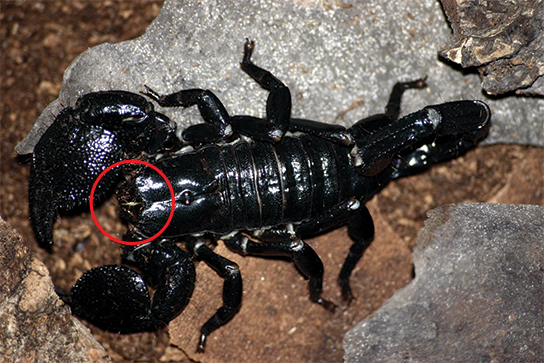
Figure 28.38図 28.38
Chelicerae (circled) are well developed in the scorpion. (credit: Kevin Walsh)
サソリでは鋏角(円内)がよく発達している。(提供:Kevin Walsh)
Most chelicerates ingest food using a preoral cavity formed by the chelicerae and pedipalps. Some chelicerates may secrete digestive enzymes to pre-digest food before ingesting it. Parasitic chelicerates like ticks and mites have evolved blood-sucking apparatuses. Members of this subphylum have an open circulatory system with a heart that pumps blood into the hemocoel. Aquatic species, like horseshoe crabs, have gills, whereas terrestrial species have either tracheae or book lungs for gaseous exchange. Chelicerate hemolymph contains hemocyanin a copper-containing oxygen transport protein.
英語のヒント
多くの鋏角類は、鋏角と触肢がつくる口前腔を使って食物を取り込む。一部は消化酵素を分泌し、取り込む前に食物を予備消化することがある。マダニやダニのような寄生性の鋏角類は、吸血装置を進化させた。この亜門は開放血管系をもち、心臓が血体腔へ血液を送り出す。カブトガニのような水生種は鰓をもち、陸生種は気管または書肺でガス交換する。鋏角類の血リンパには、銅を含む酸素運搬タンパク質であるヘモシアニンが含まれる。
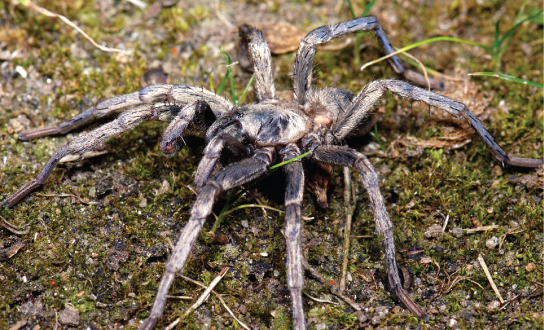


Figure 28.39図 28.39
Spider. The trapdoor spider, like all spiders, is a member of the subphylum Chelicerata. (credit: Marshal Hedin)
クモ。トタテグモは、すべてのクモと同様、鋏角亜門の動物である。(提供:Marshal Hedin)
The nervous system in chelicerates consists of a brain and two ventral nerve cords. Chelicerates are dioecious, meaning that the sexes are separate. These animals use external fertilization as well as internal fertilization strategies for reproduction, depending upon the species and its habitat. Parental care for the young ranges from absolutely none to relatively prolonged care.
英語のヒント
鋏角類の神経系は、脳と2本の腹側神経索からなる。鋏角類は雌雄異体、すなわち雄と雌が別個体である。種や生息地によって、体外受精と体内受精の両方の生殖戦略が使われる。親による子の世話は、まったくないものから、比較的長期間続くものまでさまざまである。
Subphylum Myriapoda多足亜門
Subphylum Myriapoda comprises arthropods with numerous legs. Although the name is misleading, suggesting that thousands of legs are present in these invertebrates, the number of legs typically varies from 10 to 750. This subphylum includes 16,000 species; the most commonly found examples are millipedes and centipedes. Virtually all myriapods are terrestrial animals and prefer a humid environment. Ancient myriapods (or myriapod-like arthropods) from the Silurian to the Devonian grew up to 10 feet in length (three meters). Unfortunately, they are all extinct!
英語のヒント
多足亜門は、多数の脚をもつ節足動物からなる。名前から何千本もの脚があると誤解されやすいが、通常の脚数は10〜750本である。この亜門には1万6,000種が含まれ、最もよく見られる例はヤスデとムカデである。ほぼすべてが陸生で、湿った環境を好む。シルル紀からデボン紀の古代の多足類、または多足類に似た節足動物は、最大10フィート(3 m)にまで成長した。残念ながら、これらはすべて絶滅している。
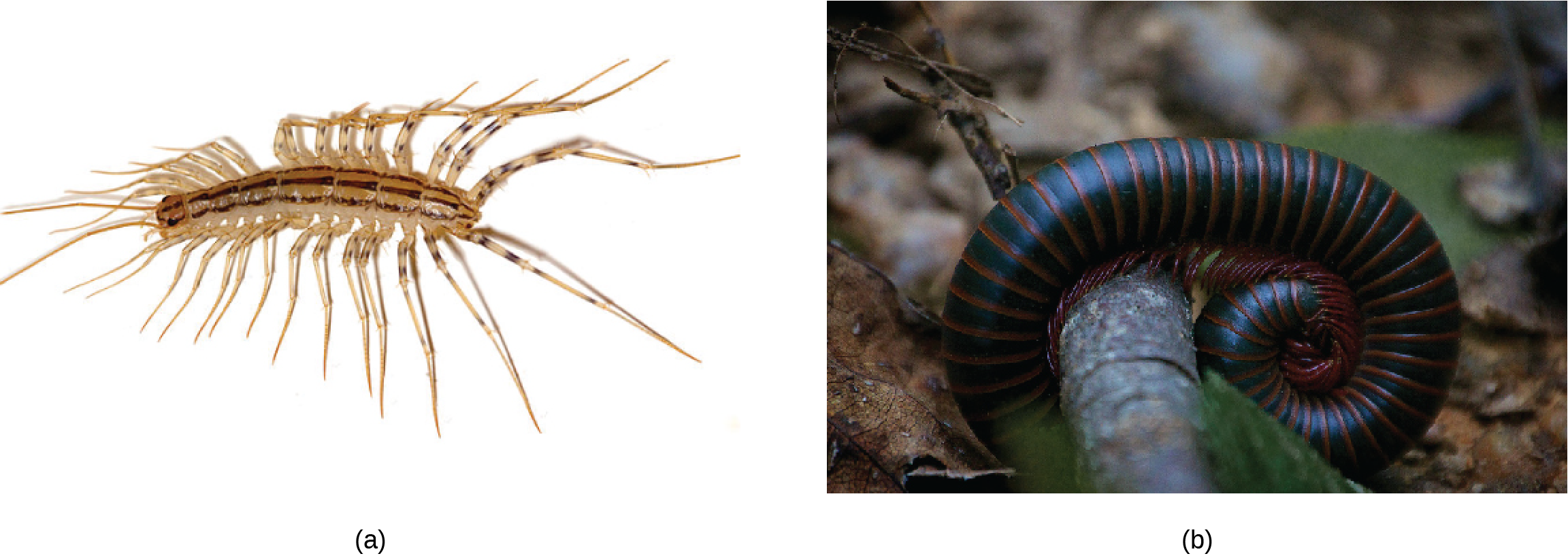
Myriapods are typically found in moist soils, decaying biological material, and leaf litter. Subphylum Myriapoda is divided into four classes: Chilopoda, Symphyla, Diplopoda, and Pauropoda. Centipedes like Scutigera coleoptrata (Figure 28.40) are classified as chilopods. These animals bear one pair of legs per segment, mandibles as mouthparts, and are somewhat dorsoventrally flattened. All centipedes are predators, and the legs in the first segment are modified to form forcipules (poison claws) that deliver poison to prey. Symphyla are similar to centipedes, but lack the poison claws and are vegetarian. Millipedes bear two pairs of legs per diplosegment—a feature that results from the embryonic fusion of adjacent pairs of body segments. These arthropods are usually rounder in cross-section than centipedes, and are herbivores or detritivores. Millipedes have two pairs of legs per segment, positioned under the body, as compared to centipedes, who have one pair per segment, positioned laterally to the body (Figure 28.40b). Millipedes feed on decomposing plant material, while centipedes are predatory and eat insects that they kill with their venom. The Pauropods are similar to millipedes, but have fewer segments.
英語のヒント
多足類は通常、湿った土壌、腐敗する生物由来物質、落ち葉の中に見られる。多足亜門は、唇脚綱、結合綱、倍脚綱、少脚綱の四つに分けられる。Scutigera coleoptrata(図28.40)のようなゲジを含むムカデ類は、唇脚類に分類される。各体節に一対の脚をもち、口器は大顎で、体はやや背腹方向に扁平である。すべてのムカデ類は捕食者で、第1体節の脚が顎肢(毒爪)へ変化し、獲物に毒を注入する。結合類はムカデに似るが、毒爪がなく、植物食性である。ヤスデは、二重体節ごとに二対の脚をもつ。これは胚発生中に、隣り合う体節の対が融合した結果である。断面はムカデより丸いことが多く、植物食性または腐食性である。ヤスデの二対の脚は体の下にあるのに対し、ムカデの一対の脚は体の側方にある(図28.40b)。ヤスデは分解中の植物を食べ、捕食性のムカデは毒で殺した昆虫を食べる。少脚類はヤスデに似るが、体節数が少ない。
OpenStax, Rice University; Biology 2e. (credit a: modification of work by Bruce Marlin; credit b: modification of work by Cory Zanker) · CC BY 4.0 · Source出典

Figure 28.40図 28.40
Myriapods. The centipede Scutigera coleoptrata (a) has up to 15 pairs of legs. The North American millipede Narceus americanus (b) bears many legs, although not a thousand, as its name might suggest. (credit a: modification of work by Bruce Marlin; credit b: modification of work by Cory Zanker)
多足類。ゲジ Scutigera coleoptrata(a)は最大15対の脚をもつ。北米のヤスデ Narceus americanus(b)も多数の脚をもつが、英名が連想させるような千本ではない。(a:Bruce Marlinの作品を改変。b:Cory Zankerの作品を改変)