第28章無脊椎動物
Classification of Phylum Annelida環形動物門の分類
Phylum Annelida contains the class Polychaeta (the polychaetes) and the class Oligochaeta (the earthworms, leeches, and their relatives). The earthworms and the leeches form a monophyletic clade within the polychaetes, which are therefore paraphyletic as a group.
環形動物門には、多毛綱(多毛類)と貧毛綱(ミミズ、ヒル、その近縁群)が含まれる。ミミズとヒルは、多毛類の中で一つの単系統クレードを形成するため、多毛類という群は側系統となる。
There are more than 22,000 different species of annelids, and more than half of these are marine polychaetes ("many bristles"). In the polychaetes, bristles are arranged in clusters on their parapodia—fleshy, flat, paired appendages that protrude from each segment. Many polychaetes use their parapodia to crawl along the sea floor, but others are adapted for swimming or floating. Some are sessile, living in tubes. Some polychaetes live near hydrothermal vents. These deepwater tubeworms have no digestive tract, but have a symbiotic relationship with bacteria living in their bodies.
英語のヒント
環形動物には2万2,000種を超える種があり、その半数以上は海産の多毛類(「多くの剛毛」の意)である。多毛類の剛毛は、各体節から対になって突き出す、肉質で平たい付属肢である疣足に、束状に並ぶ。多くの多毛類は疣足を使って海底をはい進むが、遊泳や浮遊に適応したものもいる。管の中で固着生活するものや、熱水噴出孔の近くで暮らすものもいる。こうした深海の管棲虫には消化管がないが、体内に住む細菌と共生関係をもつ。
Earthworms are the most abundant members of the class Oligochaeta ("few bristles"), distinguished by the presence of a permanent clitellum as well as the small number of reduced chaetae on each segment. (Recall that oligochaetes do not have parapodia.) The oligochaete subclass Hirudinea, includes leeches such as the medicinal leech, Hirudo medicinalis, which is effective at increasing blood circulation and breaking up blood clots, and thus can be used to treat some circulatory disorders and cardiovascular diseases. Their use goes back thousands of years. These animals produce a seasonal clitellum, unlike the permanent clitellum of other oligochaetes. A significant difference between leeches and other annelids is the lack of setae and the development of suckers at the anterior and posterior ends, which are used to attach to the host animal. Additionally, in leeches, the segmentation of the body wall may not correspond to the internal segmentation of the coelomic cavity. This adaptation possibly helps the leeches to elongate when they ingest copious quantities of blood from host vertebrates, a condition in which they are said to be “engorged.” The subclass Brachiobdella includes tiny leechlike worms that attach themselves to the gills or body surface of crayfish.
英語のヒント
ミミズは貧毛綱(「少ない剛毛」の意)で最も数が多い動物であり、恒常的な環帯と、各体節にある少数の縮小した剛毛を特徴とする。貧毛類には疣足がないことを思い出そう。貧毛類のヒル亜綱には、医療用ヒル Hirudo medicinalis などが含まれる。このヒルは血液循環を増やし、血栓を分解するのに有効なため、一部の循環障害や心血管疾患の治療に使える。その利用は数千年前にさかのぼる。ほかの貧毛類の恒常的な環帯とは異なり、ヒルは季節的な環帯をつくる。ヒルとほかの環形動物の重要な違いは、剛毛がなく、前端と後端に宿主へ付着するための吸盤が発達することである。また、ヒルでは体壁の分節が、体腔内部の分節と一致しないことがある。この適応は、宿主の脊椎動物から大量の血液を取り込んで「飽血」状態になる際に、体を伸ばすのに役立つ可能性がある。エビヤドリミミズ亜綱には、ザリガニの鰓や体表に付着する、小さなヒル状の虫が含まれる。
OpenStax, Rice University; Biology 2e. (credit a: modification of work by S. Shepherd; credit b: modification of work by “Sarah G...”/Flickr; credit c: modification of work by Chris Gotschalk, NOAA) · CC BY 4.0 · Source出典

Figure 28.31図 28.31
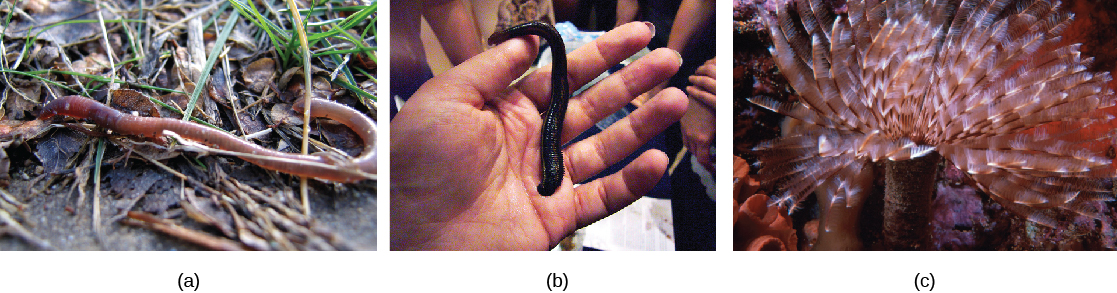
Annelid groups. The (a) earthworm, (b) leech, and (c) featherduster are all annelids. The earthworm and leech are oligochaetes, while the featherduster worm is a tube-dwelling filter-feeding polychaete. (credit a: modification of work by S. Shepherd; credit b: modification of work by “Sarah G...”/Flickr; credit c: modification of work by Chris Gotschalk, NOAA)
環形動物の群。(a)ミミズ、(b)ヒル、(c)ケヤリムシは、すべて環形動物である。ミミズとヒルは貧毛類であり、ケヤリムシは管に住むろ過摂食性の多毛類である。(a:S. Shepherd、b:「Sarah G...」/Flickr、c:Chris Gotschalk、NOAAの各作品を改変)
Section Summary節のまとめ
Phylum Mollusca is a large, group of protostome schizocoelous invertebrates that occupy marine, freshwater, and terrestrial habitats. Mollusks can be divided into seven classes, each of which exhibits variations on the basic molluscan body plan. Two defining features are the mantle, which secretes a protective calcareous shell in many species, and the radula, a rasping feeding organ found in most classes. Some mollusks have evolved a reduced shell, and others have no radula. The mantle also covers the body and forms a mantle cavity, which is quite distinct from the coelomic cavity—typically reduced to the area surrounding the heart, kidneys, and intestine. In aquatic mollusks, respiration is facilitated by gills (ctenidia) in the mantle cavity. In terrestrial mollusks, the mantle cavity itself serves as an organ of gas exchange. Mollusks also have a muscular foot, which is modified in various ways for locomotion or food capture. Most mollusks have separate sexes. Early development in aquatic species occurs via one or more larval stages, including a trochophore larva, that precedes a veliger larva in some groups.
英語のヒント
軟体動物門は、海、淡水、陸上に生息する、前口動物で裂体腔性の無脊椎動物の大きな群である。軟体動物は七つの綱に分けられ、それぞれ基本的な体制の変形を示す。特徴的な二つの構造は、多くの種で保護用の石灰質の殻を分泌する外套膜と、多くの綱にある、やすり状の摂食器官である歯舌である。一部では殻が縮小するように進化し、歯舌がないものもいる。外套膜は体を覆い、外套腔をつくる。外套腔は、通常、心臓、腎臓、腸の周囲まで縮小している体腔とは明確に異なる。水生軟体動物では、外套腔内の鰓(櫛鰓)が呼吸を助ける。陸生軟体動物では、外套腔そのものがガス交換器官となる。軟体動物は筋肉質の足ももち、移動や食物捕獲のためにさまざまに改変されている。多くは雌雄異体である。水生種の初期発生は、トロコフォア幼生を含む一つ以上の幼生期を経る。一部の群では、トロコフォアの後にベリジャー幼生が続く。
Phylum Annelida includes vermiform, segmented animals. Segmentation is metameric (i.e., each segment is partitioned internally as well as externally, with various structures repeated in each segment). These animals have well-developed neuronal, circulatory, and digestive systems. The two major groups of annelids are the polychaetes, which have parapodia with multiple bristles, and oligochaetes, which have no parapodia and fewer bristles or no bristles. Oligochaetes, which include earthworms and leeches, have a specialized band of segments known as a clitellum, which secretes a cocoon and protects gametes during reproduction. The leeches do not have full internal segmentation. Reproductive strategies include separate sexes, hermaphroditism, and serial hermaphroditism. Polychaetes typically have trochophore larvae, while the oligochaetes develop more directly.
環形動物門には、虫状で体節をもつ動物が含まれる。体節制は同規的であり、各体節は外側だけでなく内部も区切られ、さまざまな構造が各体節で繰り返される。神経系、循環系、消化系はよく発達する。主要な二群は、多数の剛毛を備えた疣足をもつ多毛類と、疣足がなく、剛毛が少ないか、まったくない貧毛類である。ミミズとヒルを含む貧毛類には、環帯という特殊化した体節の帯があり、繭を分泌して、生殖時に配偶子を保護する。ヒルには、完全な内部の分節がない。生殖戦略には、雌雄異体、雌雄同体、性転換する雌雄同体がある。多毛類は通常トロコフォア幼生をもち、貧毛類はより直接的に発生する。