第19章集団の進化
Introductionはじめに
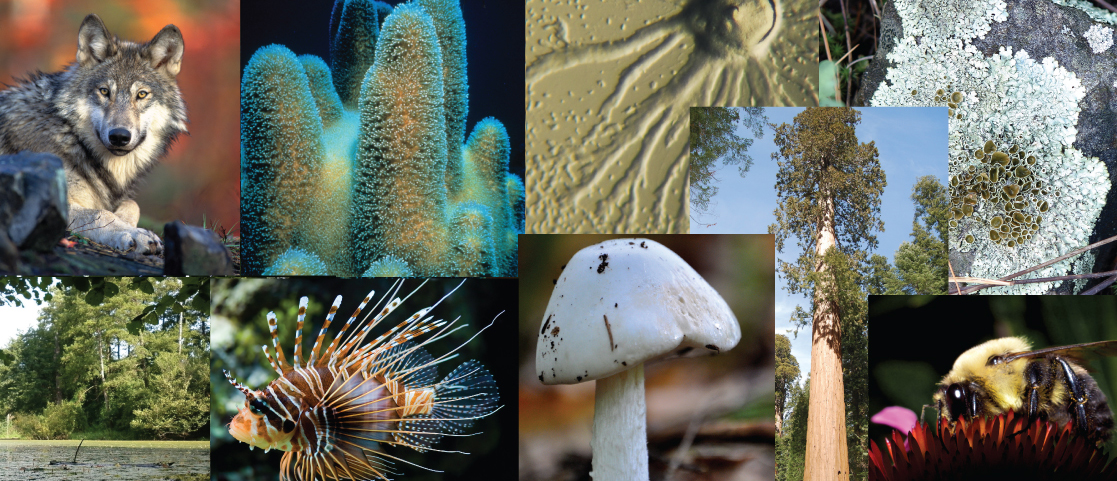
OpenStax, Rice University; Biology 2e. (credit "wolf": modification of work by Gary Kramer; credit "coral": modification of work by William Harrigan, NOAA; credit "river": modification of work by Vojtěch Dostál; credit "fish" modification of work by Christian Mehlführer; credit "mushroom": modification of work by Cory Zanker; credit "tree": modification of work by Joseph Kranak; credit "bee": modification of work by Cory Zanker) · CC BY 4.0 · Source出典

Figure 19.1図 19.1
Living things may be single-celled or complex, multicellular organisms. They may be plants, animals, fungi, bacteria, or archaea. This diversity results from evolution. (credit "wolf": modification of work by Gary Kramer; credit "coral": modification of work by William Harrigan, NOAA; credit "river": modification of work by Vojtěch Dostál; credit "fish" modification of work by Christian Mehlführer; credit "mushroom": modification of work by Cory Zanker; credit "tree": modification of work by Joseph Kranak; credit "bee": modification of work by Cory Zanker)
生物には単細胞のものも、複雑な多細胞のものもある。植物、動物、菌類、細菌、あるいは古細菌である場合もある。この多様性は進化の結果である。(「オオカミ」:Gary Kramerの作品を改変。「サンゴ」:William Harrigan、NOAAの作品を改変。「川」:Vojtěch Dostálの作品を改変。「魚」:Christian Mehlführerの作品を改変。「キノコ」:Cory Zankerの作品を改変。「樹木」:Joseph Kranakの作品を改変。「ハチ」:Cory Zankerの作品を改変。)
All life on Earth is related. Evolutionary theory states that humans, beetles, plants, and bacteria all share a common ancestor, but that billions of years of evolution have shaped each of these organisms into the forms we see today. Scientists consider evolution a key concept to understanding life. Natural selection acts to promote traits and behaviors that increase an organism’s chances of survival and reproduction, while eliminating those traits and behaviors that are detrimental to the organism. However, natural selection can only, as its name implies, select—it cannot create. We can attribute novel traits and behaviors to another evolutionary force—mutation. Mutation and other sources of variation among individuals, as well as the evolutionary forces that act upon them, alter populations and species. This combination of processes has led to the world of life we see today.
英語のヒント
地球上のすべての生命は互いに関連している。進化論によれば、ヒト、甲虫、植物、細菌はすべて共通祖先をもつが、数十億年にわたる進化によって、それぞれが今日見られる姿に形作られた。科学者は、進化を生命の理解に欠かせない概念と考えている。自然選択は、生物が生存し繁殖する可能性を高める形質や行動を促進し、その生物に有害な形質や行動を取り除く方向に働く。しかし自然選択は、その名が示すとおり、選ぶことしかできず、新たに作り出すことはできない。新しい形質や行動を生み出すのは、別の進化の力である変異である。変異やその他の個体間変異の源、そしてそれらに作用する進化の力が、個体群や種を変化させる。このような過程の組み合わせが、今日見られる生物の世界をもたらした。