第19章集団の進化
19.2 Population Genetics19.2 集団遺伝学
Learning Objectives学習目標
By the end of this section, you will be able to do the following:
この節を終えると、次のことができるようになる。
- Describe the different types of variation in a population個体群に見られるさまざまな種類の変異を説明する。
- Explain why natural selection can only act upon heritable variation自然選択が遺伝する変異にしか作用できない理由を説明する。
- Describe genetic drift and the bottleneck effect遺伝的浮動とボトルネック効果を説明する。
- Explain how each evolutionary force can influence a population's allele frequenciesそれぞれの進化の力が、個体群の対立遺伝子頻度にどう影響しうるか説明する。
A population's individuals often display different phenotypes, or express different alleles of a particular gene, which scientists refer to as polymorphisms. We call populations with two or more variations of particular characteristics polymorphic. A number of factors, including the population’s genetic structure and the environment (Figure 19.3) influence population variation, the distribution of phenotypes among individuals. Understanding phenotypic variation sources in a population is important for determining how a population will evolve in response to different evolutionary pressures.
英語のヒント
個体群の個体は、しばしば異なる表現型を示す、または特定の遺伝子の異なる対立遺伝子を発現する。これを科学者は多型と呼ぶ。特定の特徴について2つ以上の変異型をもつ個体群は、多型的であるという。個体群の遺伝構造や環境を含む多くの要因(図19.3)が、個体群の変異、すなわち個体間の表現型の分布に影響する。個体群内の表現型変異の源を理解することは、さまざまな進化圧に応じて個体群がどう進化するかを判断するうえで重要である。
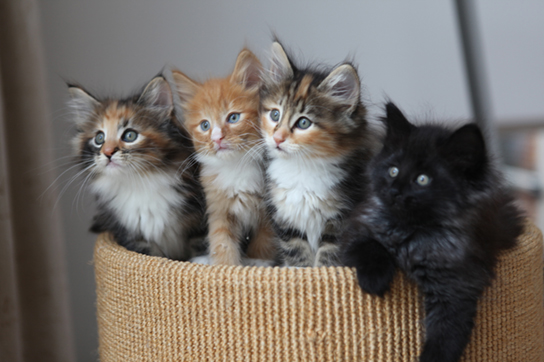
Figure 19.3図 19.3
The distribution of phenotypes in this litter of kittens illustrates population variation. (credit: Pieter Lanser)
英語のヒント
一腹の子猫たちの表現型の分布は、個体群の変異を示している。(クレジット:Pieter Lanser)
Genetic variability遺伝的変異性
Natural selection and some of the other evolutionary forces can only act on heritable traits, namely an organism’s genetic code. Because alleles are passed from parent to offspring, those that confer beneficial traits or behaviors may be selected, while deleterious alleles may not. Acquired traits, for the most part, are not heritable. For example, if an athlete works out in the gym every day, building up muscle strength, the athlete’s offspring will not necessarily grow up to be a body builder. If there is a genetic basis for the ability to run fast, on the other hand, a parent may pass this to a child.
英語のヒント
自然選択やその他の進化の力の一部は、遺伝する形質、すなわち生物の遺伝暗号にしか作用できない。対立遺伝子は親から子へ伝わるため、有益な形質や行動をもたらすものは選択されうるが、有害な対立遺伝子は選択されないことがある。獲得形質は、ほとんどの場合、遺伝しない。たとえば、運動選手が毎日ジムで鍛えて筋力を高めても、その子が必ずしもボディビルダーに育つわけではない。一方、速く走る能力に遺伝的な基盤があれば、親がその能力を子へ伝えることはありうる。
Heritability is the fraction of phenotype variation that we can attribute to genetic differences, or genetic variability, among individuals in a population. The greater the heritability of a population’s phenotypic variation, the more susceptible it is to the evolutionary forces that act on heritable variation.
英語のヒント
遺伝率とは、表現型の変異のうち、個体群内の個体間の遺伝的な違い、すなわち遺伝的変異性に帰することのできる割合である。個体群の表現型変異の遺伝率が高いほど、その変異は、遺伝する変異に作用する進化の力の影響を受けやすい。
We call the diversity of alleles and genotypes within a population genetic variability. When scientists are involved in the breeding of a species, such as with animals in zoos and nature preserves, they try to increase a population’s genetic variability to preserve as much of the phenotypic diversity as possible. This also helps reduce associated risks of inbreeding, the mating of closely related individuals, which can have the undesirable effect of bringing together deleterious recessive mutations that can cause abnormalities and susceptibility to disease. For example, a disease that is caused by a rare, recessive allele might exist in a population, but it will only manifest itself when an individual carries two copies of the allele. Because the allele is rare in a normal, healthy population with unrestricted habitat, the chance that two carriers will mate is low, and even then, only 25 percent of their offspring will inherit the disease allele from both parents. While it is likely to happen at some point, it will not happen frequently enough for natural selection to be able to swiftly eliminate the allele from the population, and as a result, the allele maintains itself at low levels in the gene pool. However, if a family of carriers begins to interbreed with each other, this will dramatically increase the likelihood of two carriers mating and eventually producing diseased offspring, a phenomenon that scientists call inbreeding depression.
英語のヒント
個体群内の対立遺伝子と遺伝子型の多様性を、遺伝的変異性と呼ぶ。科学者が種の繁殖に関わる場合、たとえば動物園や自然保護区の動物を繁殖させる場合には、表現型の多様性をできるだけ多く保つために、個体群の遺伝的変異性を高めようとする。これは近親交配、すなわち近縁個体どうしの交配に伴う危険を減らすことにも役立つ。近親交配では、異常や病気へのかかりやすさをもたらす有害な劣性変異が組み合わさるという、望ましくない影響が生じうる。たとえば、まれな劣性対立遺伝子によって起こる病気が個体群内に存在していても、その病気は個体が対立遺伝子を2コピーもつ場合にだけ現れる。生息場所が制限されていない通常の健全な個体群では、その対立遺伝子はまれなので、2個体の保因者が交配する可能性は低い。交配したとしても、両親から病気の対立遺伝子を受け継ぐ子は25%だけである。こうしたことはいずれ起こりうるが、自然選択が対立遺伝子を個体群からすぐに取り除けるほど頻繁には起こらない。その結果、その対立遺伝子は遺伝子プールに低い頻度で残る。しかし、保因者からなる家系で互いの交配が始まると、2個体の保因者が交配し、最終的に病気の子を生む可能性が大きく高まる。この現象を、科学者は近交弱勢と呼ぶ。
Changes in allele frequencies that we identify in a population can shed light on how it is evolving. In addition to natural selection, there are other evolutionary forces that could be in play: genetic drift, gene flow, mutation, nonrandom mating, and environmental variation.
英語のヒント
個体群で確認された対立遺伝子頻度の変化は、その個体群がどのように進化しているかを明らかにする手がかりとなる。自然選択のほかにも、遺伝的浮動、遺伝子流動、変異、非ランダム交配、環境の変動といった進化の力が働いている可能性がある。
Genetic Drift遺伝的浮動
The theory of natural selection stems from the observation that some individuals in a population are more likely to survive longer and have more offspring than others; thus, they will pass on more of their genes to the next generation. A big, powerful male gorilla, for example, is much more likely than a smaller, weaker one to become the population’s silverback, the pack’s leader who mates far more than the other males of the group. The pack leader will father more offspring, who share half of his genes, and are likely to also grow bigger and stronger like their father. Over time, the genes for bigger size will increase in frequency in the population, and the population will, as a result, grow larger on average. That is, this would occur if this particular selection pressure, or driving selective force, were the only one acting on the population. In other examples, better camouflage or a stronger resistance to drought might pose a selection pressure.
英語のヒント
自然選択の理論は、個体群の一部の個体が他より長く生き、多くの子を残しやすいため、その遺伝子を次世代へより多く伝えるという観察に由来する。たとえば、大きく力強い雄のゴリラは、小さく弱い雄に比べて、群れのシルバーバックになる可能性がはるかに高い。シルバーバックは群れのリーダーで、他の雄よりはるかに多く交尾する。リーダーはより多くの子の父となる。子は父の遺伝子の半分を共有し、父と同じように大きく強く育つ可能性が高い。時間とともに、大きな体に関わる遺伝子の頻度が個体群内で増え、その結果、個体群の平均的な体の大きさも増す。ただし、これはこの特定の選択圧、すなわち選択を推し進める力だけが個体群に作用している場合の話である。別の例では、より優れた擬態や、より強い耐乾性が選択圧となる場合もある。
Another way a population’s allele and genotype frequencies can change is genetic drift (Figure 19.4), which is simply the effect of chance. By chance, some individuals will have more offspring than others—not due to an advantage conferred by some genetically-encoded trait, but just because one male happened to be in the right place at the right time (when the receptive female walked by) or because the other one happened to be in the wrong place at the wrong time (when a fox was hunting).
英語のヒント
個体群の対立遺伝子頻度や遺伝子型頻度が変わるもう1つの仕組みは、遺伝的浮動である(図19.4)。これは単に偶然の影響である。ある個体が他より多くの子を残すのは、遺伝子にコードされた形質が有利だからではなく、たまたまそうなっただけということがある。ある雄は適切なときに適切な場所にいて、交尾を受け入れる雌が通りかかったのかもしれない。別の雄は、不適切なときに不適切な場所にいて、キツネが狩りをしていたのかもしれない。
Small populations are more susceptible to the forces of genetic drift. Large populations, alternatively, are buffered against the effects of chance. If one individual of a population of 10 individuals happens to die at a young age before it leaves any offspring to the next generation, all of its genes—1/10 of the population’s gene pool—will be suddenly lost. In a population of 100, that’s only 1 percent of the overall gene pool; therefore, it is much less impactful on the population’s genetic structure.
英語のヒント
小さな個体群は、遺伝的浮動の力の影響を受けやすい。一方、大きな個体群では、偶然の影響が緩和される。10個体からなる個体群で1個体が次世代に子を残す前に若くして死ぬと、その個体の遺伝子のすべて、すなわち個体群の遺伝子プールの10分の1が突然失われる。100個体の個体群なら、これは遺伝子プール全体のわずか1%なので、個体群の遺伝構造への影響ははるかに小さい。
Natural events, such as an earthquake disaster that kills—at random—a large portion of the population, can magnify genetic drift. Known as the bottleneck effect, it results in suddenly wiping out a large portion of the gene pool (Figure 19.5). At once, the survivors' genetic structure becomes the entire population's genetic structure, which may be very different from the pre-disaster population.
英語のヒント
地震災害が個体群の大部分を無作為に殺す場合など、自然の出来事は遺伝的浮動を増幅させることがある。これはボトルネック効果と呼ばれ、遺伝子プールの大部分が突然失われる結果をもたらす(図19.5)。生き残った個体の遺伝構造が、直ちに個体群全体の遺伝構造となるため、災害前の個体群とは大きく異なることがある。
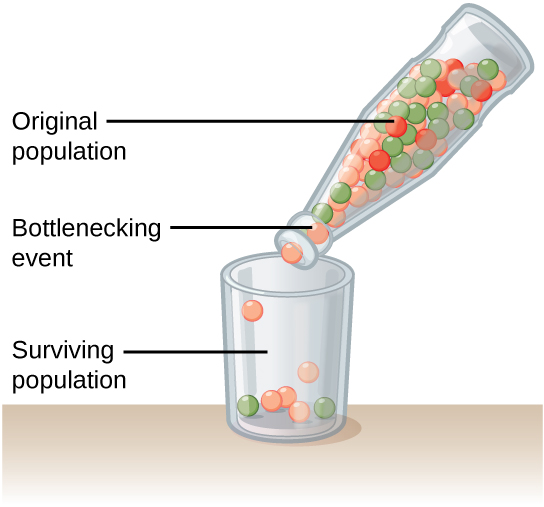


Figure 19.5図 19.5
A chance event or catastrophe can reduce the genetic variability within a population.
英語のヒント
偶然の出来事や大災害は、個体群内の遺伝的変異性を低下させうる。
Another scenario in which populations might experience a strong influence of genetic drift is if some portion of the population leaves to start a new population in a new location or if a physical barrier divides a population. In this situation, those individuals are an unlikely representation of the entire population, which results in the founder effect. The founder effect occurs when the genetic structure changes to match that of the new population’s founding fathers and mothers. Researchers believe that the founder effect was a key factor in the genetic history of the Afrikaner population of Dutch settlers in South Africa, as evidenced by mutations that are common in Afrikaners but rare in most other populations. This is probably because a higher-than-normal proportion of the founding colonists carried these mutations. As a result, the population expresses unusually high incidences of Huntington’s disease (HD) and Fanconi anemia (FA), a genetic disorder known to cause blood marrow and congenital abnormalities—even cancer. A. J. Tipping et al., “Molecular and Genealogical Evidence for a Founder Effect in Fanconi Anemia Families of the Afrikaner Population of South Africa,” PNAS 98, no. 10 (2001): 5734-5739, doi: 10.1073/pnas.091402398.
英語のヒント
個体群が遺伝的浮動の強い影響を受けうる別の状況は、一部の個体が新しい場所へ移って新たな個体群を作る場合や、物理的障壁が個体群を分割する場合である。その場合、それらの個体が個体群全体を代表しているとは限らず、創始者効果が生じる。創始者効果は、遺伝構造が、新しい個体群の創始者となった父親と母親たちの遺伝構造に一致するよう変わるときに起こる。研究者は、南アフリカに入植したオランダ人に由来するアフリカーナー集団の遺伝的歴史で、創始者効果が重要な要因だったと考えている。その証拠は、他の大半の集団ではまれな変異が、アフリカーナーではよく見られることである。最初の入植者にこうした変異をもつ人が、通常より高い割合で含まれていたためだろう。その結果、この集団ではハンチントン病(HD)とファンコニ貧血(FA)の発生率が異常に高い。FAは骨髄や先天性の異常、さらにはがんをも引き起こすことで知られる遺伝性疾患である。A. J. Tipping et al., “Molecular and Genealogical Evidence for a Founder Effect in Fanconi Anemia Families of the Afrikaner Population of South Africa,” PNAS 98, no. 10(2001): 5734–5739, doi: 10.1073/pnas.091402398.