第19章集団の進化
Frequency-Dependent Selection頻度依存選択
Another type of selection, frequency-dependent selection, favors phenotypes that are either common (positive frequency-dependent selection) or rare (negative frequency-dependent selection). We can observe an interesting example of this type of selection in a unique group of Pacific Northwest lizards. Male common side-blotched lizards come in three throat-color patterns: orange, blue, and yellow. Each of these forms has a different reproductive strategy: orange males are the strongest and can fight other males for access to their females. Blue males are medium-sized and form strong pair bonds with their mates. Yellow males (Figure 19.9) are the smallest, and look a bit like females, which allows them to sneak copulations. Like a game of rock-paper-scissors, orange beats blue, blue beats yellow, and yellow beats orange in the competition for females. That is, the big, strong orange males can fight off the blue males to mate with the blue’s pair-bonded females, the blue males are successful at guarding their mates against yellow sneaker males, and the yellow males can sneak copulations from the potential mates of the large, polygynous orange males.
英語のヒント
別の選択の型である頻度依存選択では、よく見られる表現型(正の頻度依存選択)またはまれな表現型(負の頻度依存選択)が有利になる。その興味深い例は、北米の太平洋岸北西部に暮らす独特なトカゲの集団で見られる。ワキモンユタトカゲの雄の喉の色には、オレンジ、青、黄の3つの型がある。各型は異なる繁殖戦略をもつ。オレンジの雄は最も強く、他の雄と争ってその雌への接近を獲得できる。青い雄は中くらいの大きさで、相手の雌と強いつがいの絆を作る。黄色い雄(図19.9)は最も小さく、雌に少し似ているため、ひそかに交尾できる。雌をめぐる競争では、じゃんけんのように、オレンジは青に、青は黄に、黄はオレンジに勝つ。つまり、大きく強いオレンジの雄は、青い雄を追い払い、そのつがい相手の雌と交尾できる。青い雄は、忍び込む黄色い雄から相手をうまく守ることができる。黄色い雄は、大きく一夫多妻のオレンジの雄が相手にしうる雌と、ひそかに交尾できる。
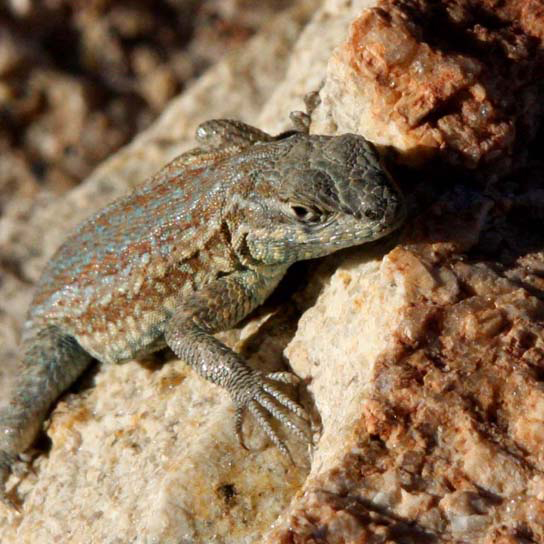

Figure 19.9図 19.9
A yellow-throated side-blotched lizard is smaller than either the blue-throated or orange-throated males and appears a bit like the females of the species, allowing it to sneak copulations. (credit: “tinyfroglet”/Flickr)
喉が黄色いワキモンユタトカゲの雄は、青やオレンジの喉をもつ雄より小さく、同種の雌に少し似ているため、ひそかに交尾できる。(クレジット:“tinyfroglet”/Flickr)
In this scenario, natural selection favors orange males when blue males dominate the population. Blue males will thrive when the population is mostly yellow males, and yellow males will be selected for when orange males are the most populous. As a result, populations of side-blotched lizards cycle in the distribution of these phenotypes—in one generation, orange might predominate, and then yellow males will begin to rise in frequency. Once yellow males comprise a majority of the population, blue males will be selected. Finally, when blue males become common, orange males once again will be favored. As indicated above, if the selection is against the common, favoring the rare, so in the case of the lizard there is negative frequency-dependent selection.
英語のヒント
この状況では、個体群で青い雄が優勢なとき、自然選択はオレンジの雄を有利にする。大半が黄色い雄なら青い雄が栄え、オレンジの雄が最も多いときは黄色い雄が有利に選択される。その結果、ワキモンユタトカゲの個体群では、これらの表現型の分布が循環する。ある世代ではオレンジが優勢でも、次には黄色い雄の頻度が増え始める。黄色い雄が多数を占めるようになると、青い雄が選択される。最後に、青い雄が多くなると、オレンジの雄が再び有利になる。上で示したように、このトカゲでは、よくある型に不利、まれな型に有利な選択が働くので、負の頻度依存選択となる。
Negative frequency-dependent selection serves to increase the population’s genetic variability by selecting for rare phenotypes; whereas, positive frequency-dependent selection usually decreases genetic variability by selecting for common phenotypes.
英語のヒント
負の頻度依存選択は、まれな表現型を有利にすることで、個体群の遺伝的変異性を高める。それに対して正の頻度依存選択は、よくある表現型を有利にすることで、通常、遺伝的変異性を低下させる。
Sexual Selection性選択
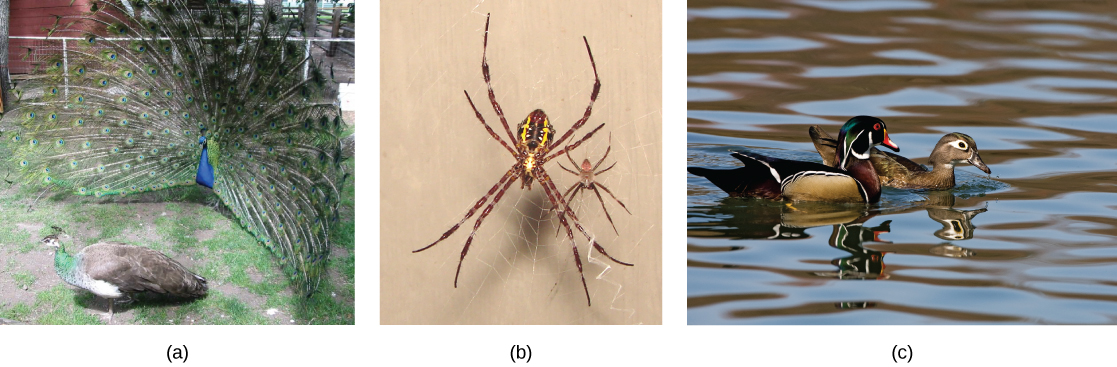
Males and females of certain species are often quite different from one another in ways beyond the reproductive organs. Males are often larger, for example, and display many elaborate colors and adornments, like the peacock’s tail, while females tend to be smaller and duller in decoration. We call such differences sexual dimorphisms (Figure 19.10), which arise in many populations, particularly animal populations, where there is more variability in the male's reproductive success than that of the females. That is, some males—often the bigger, stronger, or more decorated males—obtain the vast majority of the total matings, while others receive none. This can occur because the males are better at fighting off other males, or because females will choose to mate with the bigger or more decorated males. In either case, this variation in reproductive success generates a strong selection pressure among males to obtain those matings, resulting in the evolution of bigger body size and elaborate ornaments to attract the females’ attention. Females, however, tend to achieve a handful of selected matings; therefore, they are more likely to select more desirable males.
英語のヒント
ある種の雄と雌は、生殖器官以外の点でも大きく異なることが多い。たとえば雄は大きいことが多く、クジャクの尾羽のような、凝った色彩や装飾を多く示す。一方、雌は小さく、装飾も地味な傾向がある。こうした違いを性的二型と呼ぶ(図19.10)。多くの個体群、とくに動物の個体群で、雄の繁殖成功のばらつきが雌より大きい場合に生じる。つまり一部の雄、とくに大きい、強い、あるいは装飾の豊かな雄が、交尾の大部分を得る一方、まったく交尾できない雄もいる。これは、他の雄を撃退する能力が高いため、あるいは雌が大きく装飾豊かな雄を選ぶために起こりうる。いずれの場合も、繁殖成功のばらつきが、交尾を獲得するための強い選択圧を雄の間に生む。その結果、雌の注意を引くために、より大きな体や凝った装飾が進化する。これに対し、雌は選び抜いた少数の交尾を行う傾向があり、より望ましい雄を選びやすい。
Sexual dimorphism varies widely among species, and some species are even sex-role reversed. In such cases, females tend to have a greater variability in their reproductive success than males and are correspondingly selected for the bigger body size and elaborate traits usually characteristic of males.
英語のヒント
性的二型は種によって大きく異なり、性の役割が逆転している種もある。その場合、雌の繁殖成功のばらつきは雄より大きい傾向があり、それに応じて、通常は雄に特徴的な大きな体や凝った形質が雌で有利に選択される。
OpenStax, Rice University; Biology 2e. (credit “spiders”: modification of work by “Sanba38”/Wikimedia Commons; credit “duck”: modification of work by Kevin Cole) · CC BY 4.0 · Source出典

Figure 19.10図 19.10
Sexual dimorphism in (a) peacocks and peahens, (b) Argiope appensa spiders (the female spider is the large one), and in (c) wood ducks. (credit “spiders”: modification of work by “Sanba38”/Wikimedia Commons; credit “duck”: modification of work by Kevin Cole)
(a)クジャクの雄と雌、(b)Argiope appensaのクモ(大きいほうが雌)、(c)アメリカオシドリに見られる性的二型。(「クモ」:“Sanba38”/Wikimedia Commonsの作品を改変。「カモ」:Kevin Coleの作品を改変。)
We call the selection pressures on males and females to obtain matings sexual selection. It can result in developing secondary sexual characteristics that do not benefit the individual’s likelihood of survival but help to maximize its reproductive success. Sexual selection can be so strong that it selects traits that are actually detrimental to the individual’s survival. Think, once again, about the peacock’s tail. While it is beautiful and the male with the largest, most colorful tail is more likely to win the female, it is not the most practical appendage. In addition to greater visibility to predators, it makes the males slower in their attempted escapes. There is some evidence that this risk is why females like the big tails in the first place. The speculation is that large tails carry risk, and only the best males survive that risk: the bigger the tail, the more fit the male. We call this the handicap principle.
英語のヒント
交尾を獲得するために雄と雌にかかる選択圧を、性選択と呼ぶ。これは、個体の生存可能性を高めはしないが、繁殖成功を最大化する助けになる第二次性徴の発達をもたらしうる。性選択は非常に強く、生存に実際には有害な形質さえ選ぶことがある。もう一度、クジャクの尾羽を考えよう。尾羽は美しく、最も大きく色鮮やかな尾羽の雄は雌を獲得しやすいが、実用的な付属器官とはいえない。捕食者に目立つだけでなく、逃げようとするときの動きも遅くする。この危険こそが、そもそも雌が大きな尾羽を好む理由だという証拠もある。大きな尾羽には危険が伴い、それを乗り越えて生き残れるのは最良の雄だけなので、尾羽が大きいほど雄の適応度が高い、という推測である。これをハンディキャップ原理と呼ぶ。
The good genes hypothesis states that males develop these impressive ornaments to show off their efficient metabolism or their ability to fight disease. Females then choose males with the most impressive traits because it signals their genetic superiority, which they will then pass on to their offspring. Although one may argue that females should not be picky because it will likely reduce their number of offspring, if better males father more fit offspring, it may be beneficial. Fewer, healthier offspring may increase the chances of survival more than many, weaker offspring.
英語のヒント
優良遺伝子仮説では、雄は効率のよい代謝や病気に抵抗する能力を示すために、こうした印象的な装飾を発達させると考える。雌は、最も印象的な形質をもつ雄を選ぶ。その形質が遺伝的な優秀さを示し、その優秀さが子へ伝わるからである。雌がえり好みすれば子の数が減る可能性が高いため、えり好みすべきでないという議論もありうる。しかし、よりよい雄が適応度の高い子の父となるなら、選ぶことは有益かもしれない。弱い子を多数残すより、健康な子を少数残すほうが、生存の可能性を高めるかもしれないのである。
In both the handicap principle and the good genes hypothesis, the trait is an honest signal of the males’ quality, thus giving females a way to find the fittest mates— males that will pass the best genes to their offspring.
英語のヒント
ハンディキャップ原理でも優良遺伝子仮説でも、その形質は雄の質を正直に示す信号である。そのため雌は、最も適応度の高い相手、つまり最良の遺伝子を子へ伝える雄を見つけられる。