第19章集団の進化
Gene Flow遺伝子流動
Another important evolutionary force is gene flow: the flow of alleles in and out of a population due to the migration of individuals or gametes (Figure 19.6). While some populations are fairly stable, others experience more flux. Many plants, for example, send their pollen far and wide, by wind or by bird, to pollinate other populations of the same species some distance away. Even a population that may initially appear to be stable, such as a pride of lions, can experience its fair share of immigration and emigration as developing males leave their mothers to seek out a new pride with genetically unrelated females. This variable flow of individuals in and out of the group not only changes the population's gene structure, but it can also introduce new genetic variation to populations in different geological locations and habitats.
英語のヒント
もう1つの重要な進化の力は、遺伝子流動である。これは個体や配偶子の移動によって、対立遺伝子が個体群へ入ったり、個体群から出たりすることである(図19.6)。かなり安定した個体群もあれば、より大きな流入・流出を経験する個体群もある。たとえば多くの植物は、風や鳥を利用して花粉を広く遠くへ送り、離れた場所にある同種の別の個体群を受粉させる。ライオンの群れのように、最初は安定して見える個体群でも、相当な移入と移出が起こりうる。成長した雄が母親のもとを離れ、遺伝的に近縁でない雌のいる新しい群れを探すためである。このように個体がさまざまに出入りすることは、個体群の遺伝構造を変えるだけでなく、異なる地理的位置や生息場所にある個体群へ、新しい遺伝的変異を導入することもある。
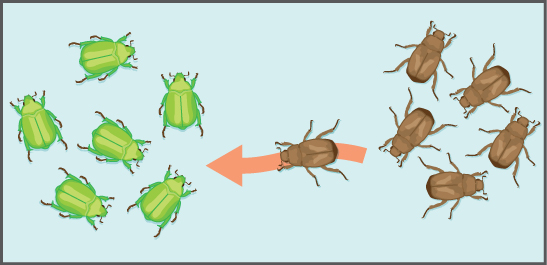

Figure 19.6図 19.6
Gene flow can occur when an individual travels from one geographic location to another.
個体がある地理的な場所から別の場所へ移動すると、遺伝子流動が起こりうる。
Mutation変異
Mutations are changes to an organism’s DNA and are an important driver of diversity in populations. Species evolve because of mutations accumulating over time. The appearance of new mutations is the most common way to introduce novel genotypic and phenotypic variability. Some mutations are unfavorable or harmful and are quickly eliminated from the population by natural selection. Others are beneficial and will spread through the population. Whether or not a mutation is beneficial or harmful is determined by whether it helps an organism survive to sexual maturity and reproduce. Some mutations do not do anything and can linger, unaffected by natural selection, in the genome. Some can have a dramatic effect on a gene and the resulting phenotype.
英語のヒント
変異は生物のDNAの変化であり、個体群の多様性を生む重要な原動力である。時間とともに変異が蓄積することで、種は進化する。新しい変異の出現は、遺伝子型や表現型の新たな変異性を導入する最も一般的な方法である。不利または有害な変異もあり、それらは自然選択によって個体群から速やかに除かれる。有益な変異は個体群内に広まる。変異が有益か有害かは、生物が性成熟まで生き残り、繁殖するのを助けるかどうかで決まる。何の作用ももたらさず、自然選択の影響を受けないままゲノム内に残る変異もある。一方、遺伝子や、そこから生じる表現型に劇的な影響を与える変異もある。
Nonrandom Mating非ランダム交配
If individuals nonrandomly mate with their peers, the result can be a changing population. There are many reasons nonrandom mating occurs. One reason is simple mate choice. For example, female peahens may prefer peacocks with bigger, brighter tails. Natural selection picks traits that lead to more mating selections for an individual. One common form of mate choice, called assortative mating, is an individual’s preference to mate with partners who are phenotypically similar to themselves.
英語のヒント
個体が仲間と無作為にではなく交配すれば、その結果、個体群が変化することがある。非ランダム交配が起こる理由は多い。1つは、単純に相手を選ぶことである。たとえば雌のクジャクは、より大きく鮮やかな尾羽をもつ雄を好むかもしれない。自然選択は、個体が交配相手としてより多く選ばれることにつながる形質を選ぶ。相手選びの一般的な形の1つに同類交配があり、これは、個体が表現型の似た相手との交配を好むことである。
Another cause of nonrandom mating is physical location. This is especially true in large populations spread over vast geographic distances where not all individuals will have equal access to one another. Some might be miles apart through woods or over rough terrain, while others might live immediately nearby.
英語のヒント
非ランダム交配の別の原因は、物理的な位置である。これは、とくに広大な地理的範囲に分布する大きな個体群に当てはまる。そうした個体群では、すべての個体が互いに等しく接触できるわけではない。森林や険しい地形を挟んで何マイルも離れている個体もいれば、すぐ近くに住む個体もいる。
Environmental Variation環境変動
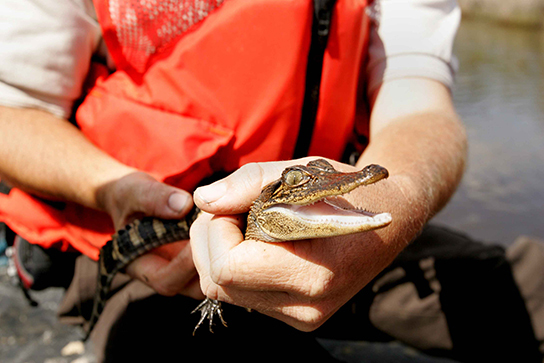
Genes are not the only players involved in determining population variation. Other factors, such as the environment (Figure 19.7) also influence phenotypes. A beachgoer is likely to have darker skin than a city dweller, for example, due to regular exposure to the sun, an environmental factor. For some species, the environment determines some major characteristics, such as sex. For example, some turtles and other reptiles have temperature-dependent sex determination (TSD). TSD means that individuals develop into males if their eggs are incubated within a certain temperature range, or females at a different temperature range. Because these phenotypic differences are due to environmental variation instead of genetic differences, they cannot be inherited and do not lead to evolution. However, environmental variation can affect evolution through natural selection favoring different alleles and shaping different phenotypes in different environments.
英語のヒント
個体群の変異を決める要因は、遺伝子だけではない。環境などの他の要因も表現型に影響する(図19.7)。たとえば、海辺によく行く人は都市に暮らす人より肌の色が濃い可能性が高い。日光という環境要因に頻繁にさらされるためである。一部の種では、環境が性などの主要な特徴を決める。たとえば、カメの一部や他の爬虫類には、温度依存性決定(TSD)がある。TSDでは、卵がある温度範囲で保たれると雄へ、別の温度範囲では雌へと発生する。こうした表現型の違いは、遺伝的な違いではなく環境の違いによるため、遺伝せず、進化をもたらさない。しかし環境変動は、環境ごとに異なる対立遺伝子を有利にし、異なる表現型を形作る自然選択を通して、進化に影響しうる。
OpenStax, Rice University; Biology 2e. (credit: Steve Hillebrand, USFWS) Embedded rights notice: Hillebrand Steve, U.S. Fish and Wildlife Service · CC BY 4.0 · Source出典

Figure 19.7図 19.7
The temperature at which the eggs are incubated determine the American alligator's (Alligator mississippiensis) sex. Eggs incubated at 30°C produce females, and eggs incubated at 33°C produce males. (credit: Steve Hillebrand, USFWS)
卵が保たれる温度によって、アメリカアリゲーター(Alligator mississippiensis)の性が決まる。30℃で保たれた卵からは雌、33℃で保たれた卵からは雄が生まれる。(クレジット:Steve Hillebrand、USFWS)
Geographic separation between populations can lead to differences in the phenotypic variation between those populations. We see such geographical variation between most populations and it can be significant. We can observe one type of geographic variation, a cline, as given species' populations vary gradually across an ecological gradient. Species of warm-blooded animals, for example, tend to have larger bodies in the cooler climates closer to the earth’s poles, allowing them to better conserve heat. This is a latitudinal cline. Alternatively, flowering plants tend to bloom at different times depending on where they are along a mountain slope. This is an altitudinal cline.
英語のヒント
個体群間の地理的な隔離は、それらの個体群の表現型変異に違いをもたらしうる。こうした地理的変異は大半の個体群の間で見られ、大きなものになることもある。地理的変異の一種であるクラインは、ある種の個体群が生態的勾配に沿って徐々に変わる場合に見られる。たとえば恒温動物は、地球の極に近い寒冷な気候では体が大きくなる傾向があり、これによって熱をよりよく保持できる。これは緯度的クラインである。一方、顕花植物は山の斜面のどの位置にあるかに応じて、異なる時期に開花する傾向がある。これは標高的クラインである。
If there is gene flow between the populations, the individuals will likely show gradual differences in phenotype along the cline. Restricted gene flow, alternatively can lead to abrupt differences, even speciation.
英語のヒント
個体群間に遺伝子流動があれば、個体の表現型はクラインに沿って徐々に異なるようになる可能性が高い。一方、遺伝子流動が制限されると、急激な違いが生じ、種分化に至ることさえある。