第22章原核生物:細菌と古細菌
Introductionはじめに
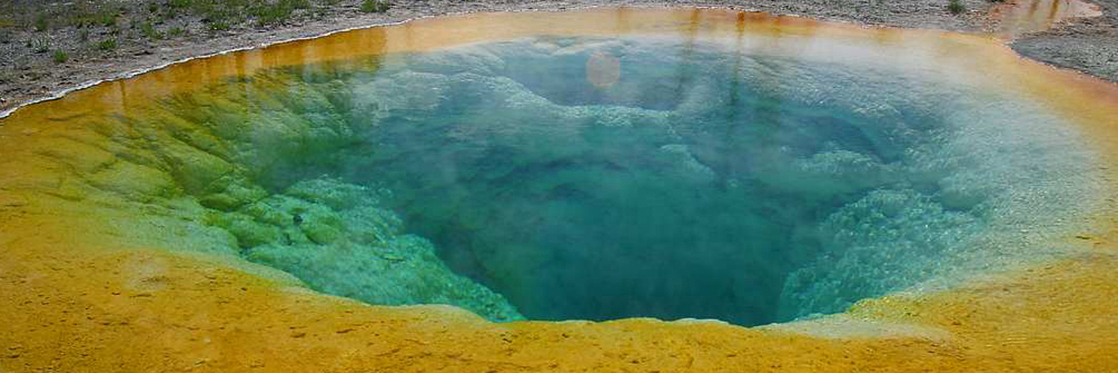
OpenStax, Rice University; Biology 2e. (credit: modification of work by Jon Sullivan) · CC BY 4.0 · Source出典

Figure 22.1図 22.1
Certain prokaryotes can live in extreme environments such as the Morning Glory pool, a hot spring in Yellowstone National Park. The spring’s vivid blue color is from the prokaryotes that thrive in its very hot waters. (credit: modification of work by Jon Sullivan)
英語のヒント
一部の原核生物は、イエローストーン国立公園の温泉、モーニング・グローリー・プールのような極限環境でも生息できる。この温泉の鮮やかな青色は、非常に熱い湯の中で繁栄する原核生物による。(クレジット:Jon Sullivanの作品を改変)
In the recent past, scientists grouped living things into six kingdoms—animalia, plantae, fungi, protista, archea, and bacteria—based on several criteria, such as the absence or presence of a nucleus and other membrane-bound organelles, the absence or presence of cell walls, multicellularity, and so on. In the late 20th century, the pioneering work of Carl Woese and others compared sequences of small-subunit ribosomal RNA (SSU rRNA), which resulted in a more fundamental way to group organisms on Earth. Based on differences in the structure of cell membranes and in rRNA, Woese and his colleagues proposed that all life on Earth evolved along three lineages, called domains. The domain Bacteria comprises all organisms in the kingdom Bacteria, the domain Archaea comprises the rest of the prokaryotes, and the domain Eukarya comprises all eukaryotes—including organisms in the kingdoms Animalia, Plantae, Fungi, and Protista.
英語のヒント
少し前まで科学者は、生物を動物界、植物界、菌界、原生生物界、古細菌界、細菌界の六つの界に分類していた。核やほかの膜で囲まれた細胞小器官の有無、細胞壁の有無、多細胞性など、いくつかの基準に基づいた分類である。20世紀後半、カール・ウーズらの先駆的な研究では、リボソーム小サブユニットRNA(SSU rRNA)の配列が比較され、地球上の生物を分類する、より根本的な方法が生まれた。ウーズらは、細胞膜構造とrRNAの違いに基づき、地球上のすべての生命は、ドメインと呼ばれる三つの系統に沿って進化したと提案した。細菌ドメインは細菌界の全生物を含み、古細菌ドメインは残りの原核生物を含む。真核生物ドメインは、動物界、植物界、菌界、原生生物界の生物を含む、すべての真核生物からなる。
Two of the three domains—Bacteria and Archaea—are prokaryotic. Prokaryotes were the first inhabitants on Earth, appearing 3.5 to 3.8 billion years ago. These organisms are abundant and ubiquitous; that is, they are present everywhere. In addition to inhabiting moderate environments, they are found in extreme conditions: from boiling springs to permanently frozen environments in Antarctica; from salty environments like the Dead Sea to environments under tremendous pressure, such as the depths of the ocean; and from areas without oxygen, such as a waste management plant, to radioactively contaminated regions, such as Chernobyl. Prokaryotes reside in the human digestive system and on the skin, are responsible for certain illnesses, and serve an important role in the preparation of many foods.
英語のヒント
三つのドメインのうち、細菌と古細菌の二つは原核生物である。原核生物は地球最初の住人で、35億〜38億年前に現れた。これらの生物は数が多く、遍在する。つまり、至るところに存在する。穏やかな環境に生息するだけでなく、極端な条件下にも見られる。沸騰する温泉から南極の永久に凍った環境、死海のような塩分の多い環境から深海のような莫大な圧力のかかる環境、廃棄物処理施設のような無酸素の場所からチェルノブイリのような放射能汚染地域まで、さまざまである。原核生物はヒトの消化器系の中や皮膚上にも住み、一部の病気を起こす一方、多くの食品を作る際にも重要な役割を果たす。