第22章原核生物:細菌と古細菌
Prokaryotes in the Dead Sea死海の原核生物
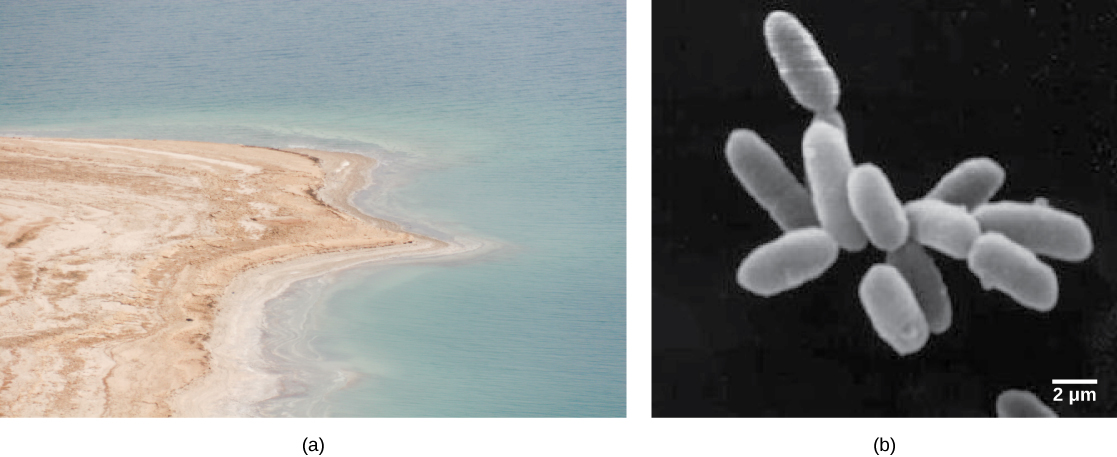
One example of a very harsh environment is the Dead Sea, a hypersaline basin that is located between Jordan and Israel. Hypersaline environments are essentially concentrated seawater. In the Dead Sea, the sodium concentration is 10 times higher than that of seawater, and the water contains high levels of magnesium (about 40 times higher than in seawater) that would be toxic to most living things. Iron, calcium, and magnesium, elements that form divalent ions (Fe2+, Ca2+, and Mg2+), produce what is commonly referred to as “hard” water. Taken together, the high concentration of divalent cations, the acidic pH (6.0), and the intense solar radiation flux make the Dead Sea a unique, and uniquely hostile, ecosystem Bodaker, I, Itai, S, Suzuki, MT, Feingersch, R, Rosenberg, M, Maguire, ME, Shimshon, B, and others. Comparative community genomics in the Dead Sea: An increasingly extreme environment. The ISME Journal 4 (2010): 399–407, doi:10.1038/ismej.2009.141. published online 24 December 2009. (Figure 22.6).
英語のヒント
非常に厳しい環境の例が、ヨルダンとイスラエルの間にある高塩分の水域、死海である。高塩分環境は、本質的には濃縮された海水である。死海のナトリウム濃度は海水の10倍で、水には、大半の生物にとって有毒となる高濃度のマグネシウムも含まれる。その濃度は海水の約40倍である。鉄、カルシウム、マグネシウムは二価イオン(Fe2+、Ca2+、Mg2+)を作る元素で、一般に「硬水」と呼ばれる水を生む。二価陽イオンの高濃度、酸性のpH(6.0)、強い太陽放射の流束が合わさり、死海を独特で、とりわけ生息困難な生態系にしている。Bodaker, I、Itai, S、Suzuki, MT、Feingersch, R、Rosenberg, M、Maguire, ME、Shimshon, Bほか。「死海の群集ゲノム比較:ますます極端になる環境」。The ISME Journal 4(2010):399–407、doi:10.1038/ismej.2009.141。2009年12月24日オンライン公開。(図22.6)
What sort of prokaryotes do we find in the Dead Sea? The extremely salt-tolerant bacterial mats include Halobacterium, Haloferax volcanii (which is found in other locations, not only the Dead Sea), Halorubrum sodomense, and Halobaculum gomorrense, and the archaean Haloarcula marismortui, among others.
死海には、どのような原核生物がいるのだろうか。非常に塩に強い細菌マットには、Halobacterium、Haloferax volcanii(死海だけでなく、ほかの場所にも見られる)、Halorubrum sodomense、Halobaculum gomorrense、そして古細菌Haloarcula marismortuiなどが含まれる。
OpenStax, Rice University; Biology 2e. (credit a: Julien Menichini; credit b: NASA; scale-bar data from Matt Russell) · CC BY 4.0 · Source出典
Figure 22.6図 22.6
Halophilic prokaryotes. (a) The Dead Sea is hypersaline. Nevertheless, salt-tolerant bacteria thrive in this sea. (b) These halobacteria cells can form salt-tolerant bacterial mats. (credit a: Julien Menichini; credit b: NASA; scale-bar data from Matt Russell)
好塩性の原核生物。(a)死海は高塩分である。それにもかかわらず、塩に強い細菌が、この海で繁栄している。(b)これらのハロバクテリアの細胞は、塩に強い細菌マットを作ることができる。(クレジットa:Julien Menichini。クレジットb:NASA。スケールバーのデータ:Matt Russell)
Unculturable Prokaryotes and the Viable-but-Non-Culturable State培養できない原核生物と、生きているが培養できない状態
The process of culturing bacteria is complex and is one of the greatest discoveries of modern science. German physician Robert Koch is credited with discovering the techniques for pure culture, including staining and using growth media. Microbiologists typically grow prokaryotes in the laboratory using an appropriate culture medium containing all the nutrients needed by the target organism. The medium can be liquid, broth, or solid. After an incubation time at the right temperature, there should be evidence of microbial growth (Figure 22.7). Koch's assistant Julius Petri invented the Petri dish, whose use persists in today’s laboratories. Koch worked primarily with the Mycobacterium tuberculosis bacterium that causes tuberculosis and developed guidelines, called Koch's postulates, to identify the organisms responsible for specific diseases. Koch's postulates continue to be widely used in the medical community. Koch’s postulates include that an organism can be identified as the cause of disease when it is present in all infected samples and absent in all healthy samples, and it is able to reproduce the infection after being cultured multiple times. Today, cultures remain a primary diagnostic tool in medicine and other areas of molecular biology.
英語のヒント
細菌を培養する過程は複雑で、近代科学の最大の発見の一つである。ドイツの医師ロベルト・コッホは、染色や培地の利用を含む純粋培養技術を発見した功績で知られる。微生物学者は通常、対象の生物が必要とする栄養分をすべて含んだ適切な培地を使い、実験室で原核生物を増やす。培地には液体やブロス、固体がある。適切な温度で一定時間培養すると、微生物の増殖の証拠が見られるはずである(図22.7)。コッホの助手ユリウス・ペトリは、現在の実験室でも使われるペトリ皿を発明した。コッホは主に、結核を起こす結核菌Mycobacterium tuberculosisを研究し、特定の病気の原因となる生物を特定するため、コッホの原則と呼ばれる指針を作った。コッホの原則は、今も医学界で広く使われる。そこには、ある生物がすべての感染試料に存在し、すべての健康な試料には存在せず、何度も培養した後にも感染を再現できる場合、その生物を病気の原因と認められる、という内容が含まれる。今日も、培養は医学や分子生物学のほかの分野における、主要な診断手段である。
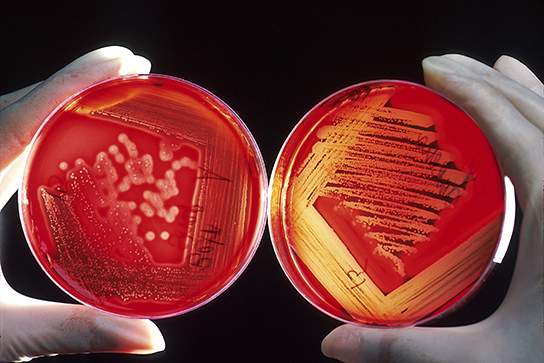


Figure 22.7図 22.7
Bacteria growing on blood agar plates. In these agar plates, the growth medium is supplemented with red blood cells. Blood agar becomes transparent in the presence of hemolytic Streptococcus, which destroys red blood cells and is used to diagnose Streptococcus infections. The plate on the left is inoculated with non-hemolytic Staphylococcus (large white colonies), and the plate on the right is inoculated with hemolytic Streptococcus (tiny clear colonies). If you look closely at the right plate, you can see that the agar surrounding the bacteria has turned clear. (credit: Bill Branson, NCI)
英語のヒント
血液寒天平板上で増殖する細菌。これらの寒天平板では、培地に赤血球を加えている。血液寒天は、赤血球を破壊する溶血性のStreptococcusが存在すると透明になり、Streptococcus感染の診断に使われる。左の平板には、非溶血性のStaphylococcus(大きな白い集落)、右の平板には、溶血性のStreptococcus(小さな透明な集落)を接種している。右の平板をよく見ると、細菌の周囲の寒天が透明になっていることが分かる。(クレジット:Bill Branson、NCI)
Koch's postulates can be fully applied only to organisms that can be isolated and cultured. Some prokaryotes, however, cannot grow in a laboratory setting. In fact, over 99 percent of bacteria and archaea are unculturable. For the most part, this is due to a lack of knowledge as to what to feed these organisms and how to grow them; they may have special requirements for growth that remain unknown to scientists, such as needing specific micronutrients, pH, temperature, pressure, co-factors, or co-metabolites. Some bacteria cannot be cultured because they are obligate intracellular parasites and cannot be grown outside a host cell.
英語のヒント
コッホの原則を完全に適用できるのは、分離して培養できる生物に限られる。しかし、一部の原核生物は、実験室の条件では増殖できない。実際、細菌と古細菌の99%以上は培養できない。その大部分は、これらの生物に何を与え、どう育てればよいかという知識がないためである。成長には、特定の微量栄養素、pH、温度、圧力、補因子、共代謝物など、科学者にまだ分かっていない特別な条件が必要なのかもしれない。一部の細菌は、偏性細胞内寄生体であり、宿主細胞の外では増やせないため、培養できない。
In other cases, culturable organisms become unculturable under stressful conditions, even though the same organism could be cultured previously. Those organisms that cannot be cultured but are not dead are in a viable-but-non-culturable (VBNC) state. The VBNC state occurs when prokaryotes respond to environmental stressors by entering a dormant state that allows their survival. The criteria for entering into the VBNC state are not completely understood. In a process called resuscitation, the prokaryote can go back to “normal” life when environmental conditions improve.
英語のヒント
別の場合には、それまで培養できた生物が、ストレス条件下で培養できなくなることもある。培養できないが死んではいない生物は、生存しているが培養できない状態、すなわちVBNC状態にある。VBNC状態は、原核生物が環境ストレスに応答し、生存を可能にする休眠状態へ入るときに生じる。この状態へ入る条件は、完全には理解されていない。蘇生と呼ばれる過程で、環境条件が改善すると、原核生物は「通常の」生活へ戻ることができる。
Is the VBNC state an unusual way of living for prokaryotes? In fact, most of the prokaryotes living in the soil or in oceanic waters are non-culturable. It has been said that only a small fraction, perhaps one percent, of prokaryotes can be cultured under laboratory conditions. If these organisms are non-culturable, then how is it known whether they are present and alive? Microbiologists use molecular techniques, such as the polymerase chain reaction (PCR), to amplify selected portions of DNA of prokaryotes, e.g., 16S rRNA genes, demonstrating their existence. (Recall that PCR can make billions of copies of a DNA segment in a process called amplification.)
英語のヒント
VBNC状態は、原核生物にとって珍しい生き方なのだろうか。実際には、土壌や海水中に住む原核生物の大部分は、培養できない。実験室の条件で培養できるのは、原核生物のごく一部、おそらく1%だけだといわれる。培養できないなら、その生物が存在し、生きているかどうかは、どうすれば分かるのだろうか。微生物学者は、ポリメラーゼ連鎖反応(PCR)などの分子技術を使い、たとえば16S rRNA遺伝子のような、原核生物DNAの選んだ部分を増幅して、その存在を示す。PCRは、増幅と呼ばれる過程で、DNAの一部分を何十億コピーも作れることを思い出してほしい。