第22章原核生物:細菌と古細菌
22.1 Prokaryotic Diversity22.1 原核生物の多様性
Learning Objectives学習目標
By the end of this section, you will be able to do the following:
この節を終えると、次のことができるようになる。
- Describe the evolutionary history of prokaryotes原核生物の進化の歴史を説明する。
- Discuss the distinguishing features of extremophiles極限環境生物を特徴づける性質を論じる。
- Explain why it is difficult to culture prokaryotes原核生物の培養が難しい理由を説明する。
Prokaryotes are ubiquitous. They cover every imaginable surface where there is sufficient moisture, and they also live on and inside virtually all other living things. In the typical human body, prokaryotic cells outnumber human body cells by about ten to one. They comprise the majority of living things in all ecosystems. Some prokaryotes thrive in environments that are inhospitable for most living things. Prokaryotes recycle nutrients—essential substances (such as carbon and nitrogen)—and they drive the evolution of new ecosystems, some of which are natural and others man-made. Prokaryotes have been on Earth since long before multicellular life appeared. Indeed, eukaryotic cells are thought to be the descendants of ancient prokaryotic communities.
英語のヒント
原核生物は至るところに存在する。十分な水分のある、想像できるあらゆる表面を覆い、ほぼすべてのほかの生物の表面や体内にも住む。一般的なヒトの体では、原核細胞の数は、ヒト自身の細胞の約10倍である。すべての生態系で、生物の大多数を占める。一部の原核生物は、大半の生物にとって住みにくい環境でも繁栄する。原核生物は、炭素や窒素などの必須物質である栄養分を循環させ、新たな生態系の成立を推し進める。そうした生態系には、自然のものも、人間が作ったものもある。原核生物は、多細胞生物が現れるはるか前から地球上に存在してきた。実際、真核細胞は、古代の原核生物の群集の子孫だと考えられている。
Prokaryotes, the First Inhabitants of Earth原核生物、地球最初の住人
When and where did cellular life begin? What were the conditions on Earth when life began? We now know that prokaryotes were likely the first forms of cellular life on Earth, and they existed for billions of years before plants and animals appeared. The Earth and its moon are dated at about 4.54 billion years in age. This estimate is based on evidence from radiometric dating of meteorite material together with other substrate material from Earth and the moon. Early Earth had a very different atmosphere (contained less molecular oxygen) than it does today and was subjected to strong solar radiation; thus, the first organisms probably would have flourished where they were more protected, such as in the deep ocean or far beneath the surface of the Earth. Strong volcanic activity was common on Earth at this time, so it is likely that these first organisms—the first prokaryotes—were adapted to very high temperatures. Because early Earth was prone to geological upheaval and volcanic eruption, and was subject to bombardment by mutagenic radiation from the sun, the first organisms were prokaryotes that must have withstood these harsh conditions.
英語のヒント
細胞からなる生命は、いつ、どこで始まったのだろうか。生命が始まったとき、地球はどのような状態だったのだろうか。現在では、原核生物がおそらく地球最初の細胞生命であり、植物や動物が現れるまで何十億年も存在していたと分かっている。地球と月の年齢は、約45億4000万年と推定される。この推定は、隕石の物質と、地球や月のほかの基盤物質を放射年代測定した証拠に基づく。初期の地球の大気は現在と大きく異なり、分子状酸素が少なく、強い太陽放射にさらされていた。そのため、最初の生物は、深海や地表から遠く下方のような、より保護された場所で繁栄していたのだろう。この時期の地球では激しい火山活動が普通だったため、最初の原核生物は、非常に高い温度に適応していた可能性が高い。初期の地球では地質的な激変や火山噴火が起こりやすく、太陽からの変異原性の放射線に激しくさらされていた。そのため、最初の生物である原核生物は、こうした厳しい条件に耐えていたはずである。
Microbial Mats微生物マット
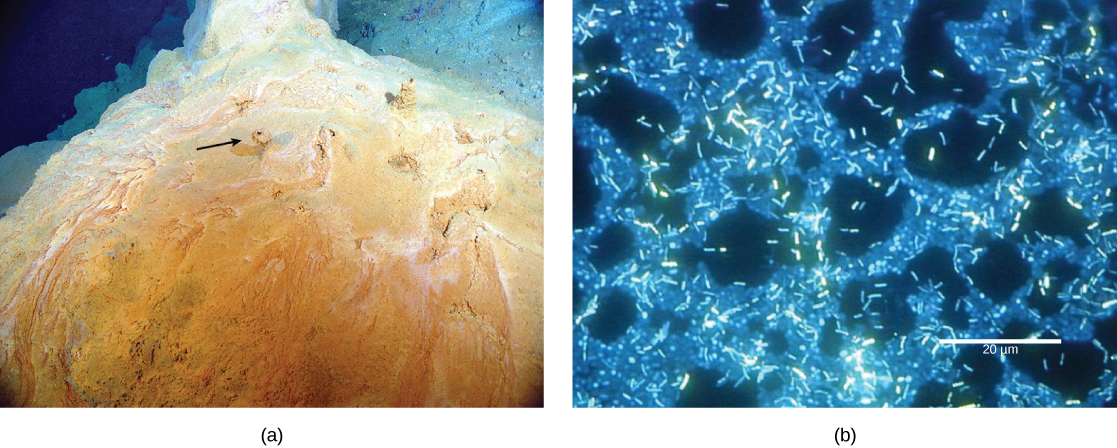
Microbial mats or large biofilms may represent the earliest forms of prokaryotic life on Earth; there is fossil evidence of their presence starting about 3.5 billion years ago. It is remarkable that cellular life appeared on Earth only a billion years after the Earth itself formed, suggesting that pre-cellular “life” that could replicate itself had evolved much earlier. A microbial mat is a multi-layered sheet of prokaryotes (Figure 22.2) that includes mostly bacteria, but also archaeans. Microbial mats are only a few centimeters thick, and they typically grow where different types of materials interface, mostly on moist surfaces. The various types of prokaryotes that comprise them carry out different metabolic pathways, and that is the reason for their various colors. Prokaryotes in a microbial mat are held together by a glue-like sticky substance that they secrete called extracellular matrix.
英語のヒント
微生物マット、すなわち大きなバイオフィルムは、地球上の原核生物の最も初期の形を表しているのかもしれない。その存在を示す化石証拠は、約35億年前にさかのぼる。地球そのものが形成されてから、わずか10億年で細胞生命が現れたことは注目に値する。このことは、自己複製できる細胞以前の「生命」が、それよりずっと早く進化していたことを示唆する。微生物マットは、原核生物からなる何層にも重なったシート状の構造で(図22.2)、主に細菌からなるが、古細菌も含む。厚さは数センチメートルにすぎず、通常は異なる種類の物質が接する場所、主に湿った表面に生育する。マットを構成するさまざまな原核生物は、それぞれ異なる代謝経路を使い、それが多様な色の理由となる。マット内の原核生物は、自ら分泌する細胞外マトリックスと呼ばれる、接着剤のような粘着性物質で結びついている。
The first microbial mats likely obtained their energy from chemicals found near hydrothermal vents. A hydrothermal vent is a breakage or fissure in the Earth’s surface that releases geothermally heated water. With the evolution of photosynthesis about three billion years ago, some prokaryotes in microbial mats came to use a more widely available energy source—sunlight—whereas others were still dependent on chemicals from hydrothermal vents for energy and food.
英語のヒント
最初の微生物マットは、おそらく熱水噴出孔の近くにある化学物質からエネルギーを得ていた。熱水噴出孔とは、地熱で温められた水を放出する、地球表面の割れ目や裂け目である。約30億年前に光合成が進化すると、微生物マットの一部の原核生物は、より広く利用できるエネルギー源、太陽光を使うようになった。一方、ほかの原核生物は、エネルギーと食物を得るため、依然として熱水噴出孔の化学物質に依存していた。
OpenStax, Rice University; Biology 2e. (credit a: modification of work by Dr. Bob Embley, NOAA PMEL, Chief Scientist; credit b: modification of work by Ricardo Murga, Rodney Donlan, CDC; scale-bar data from Matt Russell) · CC BY 4.0 · Source出典

Figure 22.2図 22.2
A microbial mat. (a) This microbial mat, about one meter in diameter, is growing over a hydrothermal vent in the Pacific Ocean in a region known as the “Pacific Ring of Fire.” The mat’s colony of bacteria helps retain microbial nutrients. Chimneys such as the one indicated by the arrow allow gases to escape. (b) In this micrograph, bacteria are visualized using fluorescence microscopy. (credit a: modification of work by Dr. Bob Embley, NOAA PMEL, Chief Scientist; credit b: modification of work by Ricardo Murga, Rodney Donlan, CDC; scale-bar data from Matt Russell)
英語のヒント
微生物マット。(a)直径約1メートルのこの微生物マットは、太平洋の「環太平洋火山帯」として知られる地域の、熱水噴出孔の上に生育している。マットの細菌集落は、微生物の栄養分を保持するのに役立つ。矢印で示すような煙突状構造から、ガスが抜ける。(b)この顕微鏡写真では、蛍光顕微鏡を使って細菌を可視化している。(クレジットa:主任研究員Dr. Bob Embley、NOAA PMELの作品を改変。クレジットb:Ricardo Murga、Rodney Donlan、CDCの作品を改変。スケールバーのデータ:Matt Russell)
Stromatolitesストロマトライト
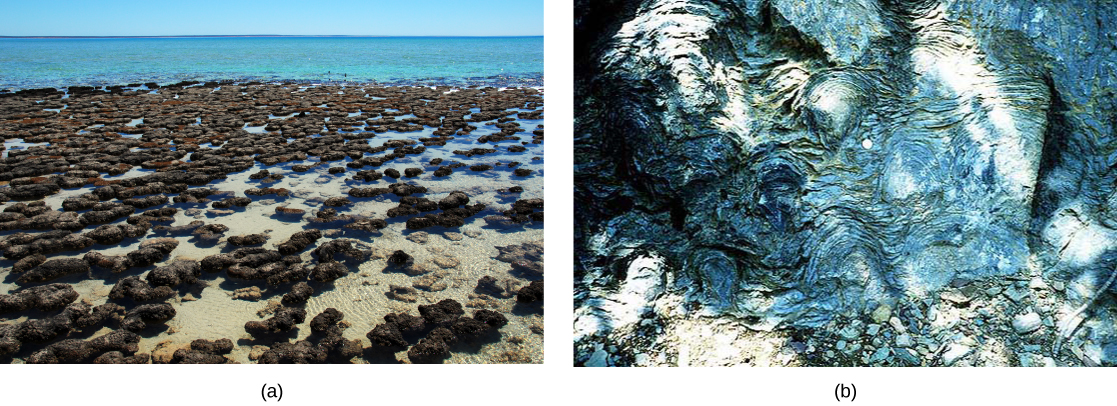
Fossilized microbial mats represent the earliest record of life on Earth. A stromatolite is a sedimentary structure formed when minerals are precipitated out of water by prokaryotes in a microbial mat (Figure 22.3). Stromatolites form layered rocks made of carbonate or silicate. Although most stromatolites are artifacts from the past, there are places on Earth where stromatolites are still forming. For example, growing stromatolites have been found in the Anza-Borrego Desert State Park in San Diego County, California.
英語のヒント
化石化した微生物マットは、地球上の生命の最古の記録を示す。ストロマトライトは、微生物マット内の原核生物によって水中の鉱物が沈殿するときに形成される、堆積構造である(図22.3)。ストロマトライトは、炭酸塩やケイ酸塩からなる層状の岩石を作る。大半のストロマトライトは過去の遺物だが、地球上には、今も形成され続けている場所がある。たとえば、カリフォルニア州サンディエゴ郡のアンザ・ボレゴ砂漠州立公園では、成長中のストロマトライトが見つかっている。
OpenStax, Rice University; Biology 2e. (credit a: Robert Young; credit b: P. Carrara, NPS) · CC BY 4.0 · Source出典

Figure 22.3図 22.3
Stromatolites. (a) These living stromatolites are located in Shark Bay, Australia. (b) These fossilized stromatolites, found in Glacier National Park, Montana, are nearly 1.5 billion years old. (credit a: Robert Young; credit b: P. Carrara, NPS)
ストロマトライト。(a)これらの生きたストロマトライトは、オーストラリアのシャーク湾にある。(b)モンタナ州のグレーシャー国立公園で見つかった、これらの化石ストロマトライトは、約15億年前のものである。(クレジットa:Robert Young。クレジットb:P. Carrara、NPS)