第22章原核生物:細菌と古細菌
22.4 Bacterial Diseases in Humans22.4 ヒトの細菌性疾患
Learning Objectives学習目標
By the end of this section, you will be able to do the following:
この節を終えると、次のことができるようになる。
- Identify bacterial diseases that caused historically important plagues and epidemics歴史上重要な疫病や流行を起こした、細菌性疾患を挙げる。
- Describe the link between biofilms and foodborne diseasesバイオフィルムと食品媒介疾患のつながりを説明する。
- Explain how overuse of antibiotics may be creating “super bugs”抗生物質の使いすぎが、どのように「スーパーバグ」を生みうるか説明する。
- Explain the importance of MRSA with respect to the problems of antibiotic resistance抗生物質耐性の問題に関して、MRSAの重要性を説明する。
To a prokaryote, humans may be just another housing opportunity. Unfortunately, the tenancy of some species can have harmful effects and cause disease. Bacteria or other infectious agents that cause harm to their human hosts are called pathogens. Devastating pathogen-borne diseases and plagues, both viral and bacterial in nature, have affected humans and their ancestors for millions of years. The true cause of these diseases was not understood until modern scientific thought developed, and many people thought that diseases were a “spiritual punishment.” Only within the past several centuries have people understood that staying away from afflicted persons, disposing of the corpses and personal belongings of victims of illness, and sanitation practices reduced their own chances of getting sick.
英語のヒント
原核生物から見れば、ヒトは単なる新たな住まいの候補かもしれない。残念ながら、一部の種の入居は有害な影響を与え、病気を起こす。宿主であるヒトに害を与える細菌や、ほかの感染性因子は、病原体と呼ばれる。ウイルス性、細菌性のいずれも含む、病原体による壊滅的な疾患や疫病は、何百万年もの間、ヒトとその祖先に影響してきた。近代的な科学思想が発達するまで真の原因は理解されず、多くの人は病気を「霊的な罰」と考えていた。病気にかかった人から離れること、病死した人の遺体や所持品を処分すること、衛生的な処置によって、自分が病気になる確率を下げられると理解されるようになったのは、ここ数世紀のことである。
Epidemiologists study how diseases are transmitted and how they affect a population. Often, they must following the course of an epidemic—a disease that occurs in an unusually high number of individuals in a population at the same time. In contrast, a pandemic is a widespread, and usually worldwide, epidemic. An endemic disease is a disease that is always present, usually at low incidence, in a population.
英語のヒント
疫学者は、病気がどのように伝わり、集団へどのように影響するかを研究する。しばしば、エピデミック、すなわち集団内で同時に異常に多くの人に起こる病気の流行を追跡する必要がある。これに対し、パンデミックは、広い地域に、通常は世界的に広がる流行である。エンデミック、すなわち常在性の疾患は、通常は低い発生率で、ある集団に常に存在する病気である。
Long History of Bacterial Disease細菌性疾患の長い歴史
There are records about infectious diseases as far back as 3000 B.C. A number of significant pandemics caused by bacteria have been documented over several hundred years. Some of the most memorable pandemics led to the decline of cities and entire nations.
英語のヒント
感染症の記録は、紀元前3000年にまでさかのぼる。ここ数百年間には、細菌が起こした重大なパンデミックが数多く記録されている。特に記憶に残るものの中には、都市や国家全体の衰退を招いたものもある。
In the 21st century, infectious diseases remain among the leading causes of death worldwide, despite advances made in medical research and treatments in recent decades. A disease spreads when the pathogen that causes it is passed from one person to another. For a pathogen to cause disease, it must be able to reproduce in the host’s body and damage the host in some way.
英語のヒント
21世紀になっても、ここ数十年の医学研究や治療の進歩にもかかわらず、感染症は世界の主要な死因の一つであり続けている。病気は、原因となる病原体が一人から別の人へ伝わると広がる。病原体が病気を起こすには、宿主の体内で増殖し、何らかの形で宿主を傷つけられなければならない。
The Plague of Athensアテナイの疫病
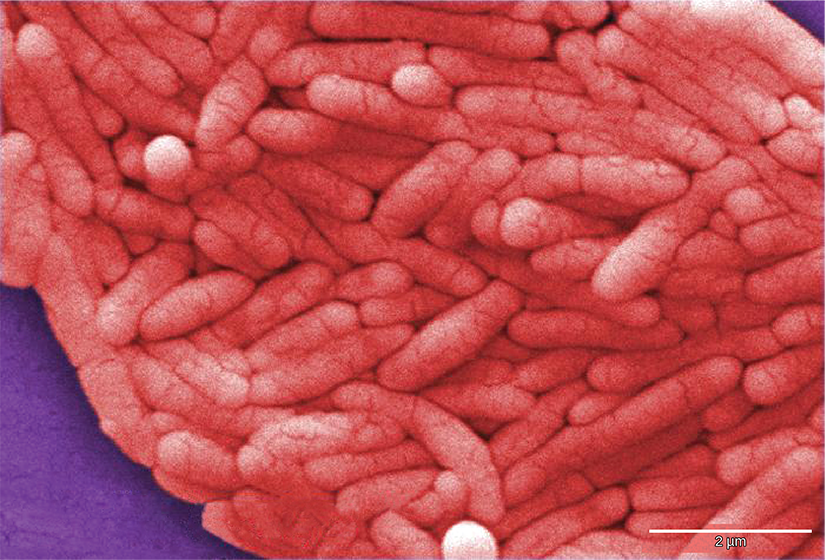
In 430 B.C., the Plague of Athens killed one-quarter of the Athenian troops who were fighting in the great Peloponnesian War and weakened Athens’s dominance and power. The plague impacted people living in overcrowded Athens as well as troops aboard ships that had to return to Athens. The source of the plague may have been identified recently when researchers from the University of Athens were able to use DNA from teeth recovered from a mass grave. The scientists identified nucleotide sequences from a pathogenic bacterium, Salmonella enterica serovar Typhi (Figure 22.20), which causes typhoid fever. Papagrigorakis MJ, Synodinos PN, and Yapijakis C. Ancient typhoid epidemic reveals possible ancestral strain of Salmonella enterica serovar Typhi. Infect Genet Evol 7 (2007): 126–7, Epub 2006 Jun. This disease is commonly seen in overcrowded areas and has caused epidemics throughout recorded history.
英語のヒント
紀元前430年、アテナイの疫病は、大規模なペロポネソス戦争で戦っていたアテナイ兵の4分の1を死に至らせ、アテナイの支配力と勢力を弱めた。過密なアテナイの住民だけでなく、アテナイへ帰還しなければならなかった船上の兵士にも影響した。最近、アテネ大学の研究者が、集団墓地から回収した歯のDNAを利用できたことで、この疫病の原因が特定された可能性がある。研究者は、腸チフスを起こす病原細菌Salmonella enterica血清型Typhi(図22.20)のヌクレオチド配列を確認した。Papagrigorakis MJ、Synodinos PN、Yapijakis C。「古代の腸チフス流行が示す、Salmonella enterica血清型Typhiの祖先株の可能性」。Infect Genet Evol 7(2007):126–7、2006年6月電子公開。この病気は過密な地域でよく見られ、記録された歴史の全体を通して流行を起こしてきた。
OpenStax, Rice University; Biology 2e. (credit: modification of work by NCI, CDC) · CC BY 4.0 · Source出典

Figure 22.20図 22.20
Salmonella enterica. Salmonella enterica serovar Typhi, the causative agent of Typhoid fever, is a Gram-negative, rod-shaped gamma proteobacterium. Typhoid fever, which is spread through feces, causes intestinal hemorrhage, high fever, delirium, and dehydration. Today, between 16 and 33 million cases of this re-emerging disease occur annually, resulting in over 200,000 deaths. Carriers of the disease can be asymptomatic. In a famous case in the early 1900s, a cook named Mary Mallon (“Typhoid Mary”) unknowingly spread the disease to over fifty people, three of whom died. Other serotypes of Salmonella cause food poisoning. (credit: modification of work by NCI, CDC)
英語のヒント
Salmonella enterica。腸チフスの病原体Salmonella enterica血清型Typhiは、グラム陰性の棒状のガンマプロテオバクテリアである。糞便を通じて広がる腸チフスは、腸出血、高熱、せん妄、脱水を起こす。現在、この再興疾患は年間1600万〜3300万件発生し、20万人以上が死亡する。保菌者には症状がないこともある。1900年代初めの有名な例では、メアリー・マローンという料理人、通称「腸チフスのメアリー」が、知らないうちに50人以上へ病気を広め、そのうち3人が死亡した。サルモネラのほかの血清型は、食中毒を起こす。(クレジット:NCI、CDCの作品を改変)
Bubonic Plagues腺ペストの流行
From 541 to 750, the Plague of Justinian, an outbreak of what was likely bubonic plague, eliminated one-quarter to one-half of the human population in the eastern Mediterranean region. The population in Europe dropped by 50 percent during this outbreak. Astoundingly, bubonic plague would strike Europe more than once!
英語のヒント
541〜750年、腺ペストだったと考えられるユスティニアヌスのペストが流行し、東地中海地域の人口の4分の1から半分が失われた。この流行の間、ヨーロッパの人口は50%減少した。驚くべきことに、腺ペストがヨーロッパを襲うのは一度きりではなかった。
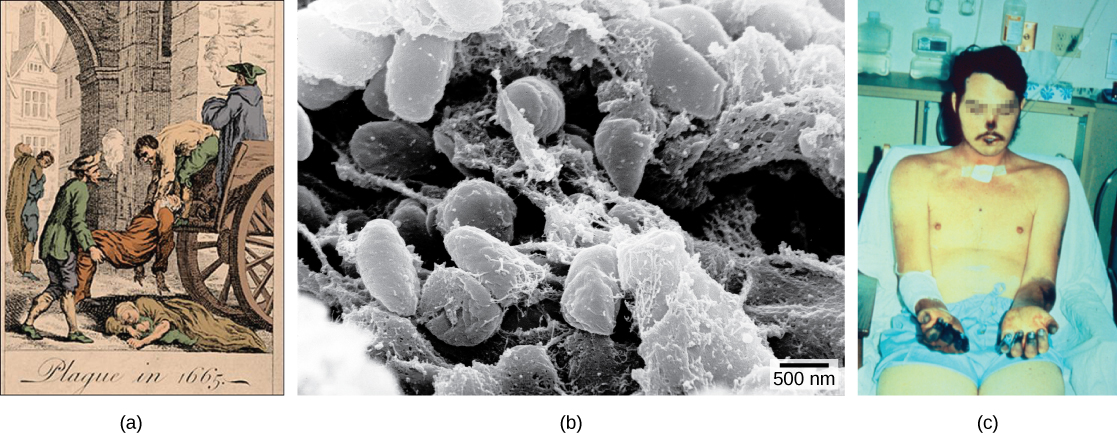
Bubonic plague is caused by the bacterium Yersinia pestis. One of the most devastating pandemics attributed to bubonic plague was the Black Death (1346 to 1361). It is thought to have originated in China and spread along the Silk Road, a network of land and sea trade routes, to the Mediterranean region and Europe, carried by fleas living on black rats that were always present on ships. The Black Death was probably named for the tissue necrosis (Figure 22.21c) that can be one of the symptoms. The "buboes" of bubonic plague were painfully swollen areas of lymphatic tissue. A pneumonic form of the plague, spread by the coughing and sneezing of infected individuals, spreads directly from human to human and can cause death within a week. The pneumonic form was responsible for the rapid spread of the Black Death in Europe. The Black Death reduced the world’s population from an estimated 450 million to about 350 to 375 million. Bubonic plague struck London yet again in the mid-1600s (Figure 22.21). In modern times, approximately 1,000 to 3,000 cases of plague arise globally each year, and a “sylvatic” form of plague, carried by fleas living on rodents such as prairie dogs and black footed ferrets, infects 10 to 20 people annually in the American Southwest. Although contracting bubonic plague before antibiotics meant almost certain death, the bacterium responds to several types of modern antibiotics, and mortality rates from plague are now very low.
英語のヒント
腺ペストは、細菌Yersinia pestisによって起こる。腺ペストによるとされる、最も壊滅的なパンデミックの一つが、1346〜1361年の黒死病である。中国で始まり、陸海の交易路網であるシルクロードに沿って、地中海地域とヨーロッパへ広がったと考えられている。船には常にいたクマネズミに寄生するノミが媒介した。黒死病という名前は、おそらく症状の一つとなりうる組織壊死に由来する(図22.21c)。腺ペストの「横痃」は、痛みを伴って腫れたリンパ組織である。感染者のせきやくしゃみで広がる肺ペストは、人から人へ直接伝わり、1週間以内に死に至ることがある。この肺型が、ヨーロッパで黒死病が急速に広まった原因となった。黒死病は、推定4億5000万人だった世界人口を、約3億5000万〜3億7500万人へ減らした。1600年代半ば、腺ペストは再びロンドンを襲った(図22.21)。現代でも、世界で毎年約1000〜3000例のペストが発生する。また、プレーリードッグやクロアシイタチなどのげっ歯類に住むノミが媒介する「野生動物型」のペストが、米国南西部で毎年10〜20人に感染する。抗生物質以前には、腺ペストへの感染はほぼ確実な死を意味したが、現在の数種類の抗生物質にこの細菌は反応するため、今のペストの死亡率は非常に低い。
OpenStax, Rice University; Biology 2e. (credit b: Rocky Mountain Laboratories, NIAID, NIH; scale-bar data from Matt Russell; credit c: Textbook of Military Medicine, Washington, D.C., U.S. Dept. of the Army, Office of the Surgeon General, Borden Institute) · CC BY 4.0 · Source出典

Figure 22.21図 22.21
The Black Death. The (a) Great Plague of London killed an estimated 200,000 people, or about 20 percent of the city’s population. The causative agent, the (b) bacterium Yersinia pestis, is a Gram-negative, rod-shaped bacterium from the class Gammaproteobacteria. The disease is transmitted through the bite of an infected flea, which is carried on a rodent. Symptoms include swollen lymph nodes, fever, seizure, vomiting of blood, and (c) gangrene. (credit b: Rocky Mountain Laboratories, NIAID, NIH; scale-bar data from Matt Russell; credit c: Textbook of Military Medicine, Washington, D.C., U.S. Dept. of the Army, Office of the Surgeon General, Borden Institute)
英語のヒント
黒死病。(a)ロンドンの大疫病では、推定20万人、すなわち都市人口の約20%が死亡した。原因となる(b)細菌Yersinia pestisは、ガンマプロテオバクテリア綱のグラム陰性桿菌である。この病気は、げっ歯類に運ばれる感染ノミにかまれることで伝わる。症状には、リンパ節の腫れ、発熱、けいれん、吐血、(c)壊疽がある。(クレジットb:Rocky Mountain Laboratories、NIAID、NIH。スケールバーのデータ:Matt Russell。クレジットc:Textbook of Military Medicine、Washington, D.C.、U.S. Dept. of the Army、Office of the Surgeon General、Borden Institute)