第22章原核生物:細菌と古細菌
Reproduction増殖
Reproduction in prokaryotes is asexual and usually takes place by binary fission. (Recall that the DNA of a prokaryote is a single, circular chromosome.) Prokaryotes do not undergo mitosis; instead, the chromosome is replicated and the two resulting copies separate from one another, due to the growth of the cell. The prokaryote, now enlarged, is pinched inward at its equator and the two resulting cells, which are clones, separate. Binary fission does not provide an opportunity for genetic recombination or genetic diversity, but prokaryotes can share genes by three other mechanisms.
英語のヒント
原核生物の増殖は無性生殖で、通常は二分裂によって起こる。原核生物のDNAは一つの環状染色体であることを思い出してほしい。原核生物は有糸分裂を行わない。代わりに染色体が複製され、細胞の成長によって、できた二つのコピーが互いに離れる。大きくなった原核細胞は赤道部で内側へくびれ、クローンである二つの細胞が分離する。二分裂には遺伝的組換えや遺伝的多様性を生む機会がないが、原核生物はほかの三つの仕組みによって、遺伝子を共有できる。
In transformation, the prokaryote takes in DNA shed by other prokaryotes into its environment. If a nonpathogenic bacterium takes up DNA for a toxin gene from a pathogen and incorporates the new DNA into its own chromosome, it too may become pathogenic. In transduction, bacteriophages, the viruses that infect bacteria, may move short pieces of chromosomal DNA from one bacterium to another. Transduction results in a recombinant organism. Archaea also have viruses that may translocate genetic material from one individual to another. In conjugation, DNA is transferred from one prokaryote to another by means of a pilus, which brings the organisms into contact with one another, and provides a channel for transfer of DNA. The DNA transferred can be in the form of a plasmid or as a composite molecule, containing both plasmid and chromosomal DNA. These three processes of DNA exchange are shown in Figure 22.17.
英語のヒント
形質転換では、原核生物は、ほかの原核生物が環境中へ放出したDNAを取り込む。非病原性細菌が、病原体から毒素遺伝子のDNAを取り込み、新しいDNAを自分の染色体へ組み込むと、その細菌も病原性をもつようになることがある。形質導入では、細菌に感染するウイルスであるバクテリオファージが、染色体DNAの短い断片を、ある細菌から別の細菌へ運ぶことがある。形質導入の結果、組換え生物が生じる。古細菌にも、ある個体から別の個体へ遺伝物質を移せるウイルスがある。接合では、線毛を介し、一つの原核生物から別の原核生物へDNAが伝わる。線毛は両者を接触させ、DNAを移す通路となる。伝わるDNAは、プラスミドの場合もあれば、プラスミドと染色体DNAの両方を含む複合分子の場合もある。これら三つのDNA交換過程を図22.17に示す。
Reproduction can be very rapid: a few minutes for some species. This short generation time coupled with mechanisms of genetic recombination and high rates of mutation result in the rapid evolution of prokaryotes, allowing them to respond to environmental changes (such as the introduction of an antibiotic) very quickly.
英語のヒント
増殖は非常に速いことがあり、種によっては数分で起こる。この短い世代時間に、遺伝的組換えの仕組みと高い変異率が組み合わさり、原核生物の急速な進化が生じる。そのため、抗生物質の導入などの環境変化へ、非常に素早く応答できる。
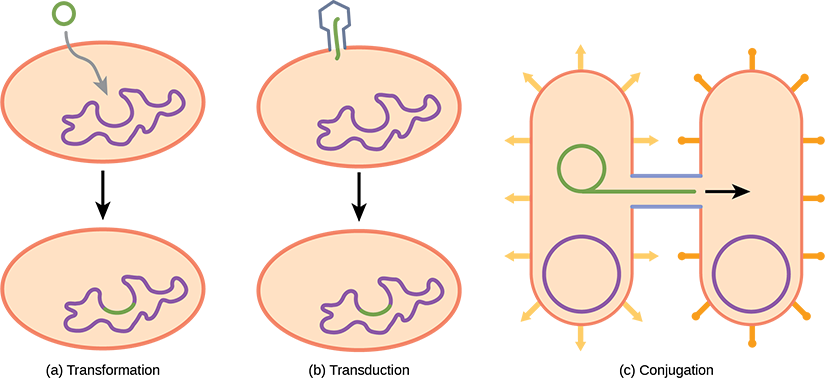

Figure 22.17図 22.17
Gene transfer mechanisms in prokaryotes. There are three mechanisms by which prokaryotes can exchange DNA. In (a) transformation, the cell takes up prokaryotic DNA directly from the environment. The DNA may remain separate as plasmid DNA or be incorporated into the host genome. In (b) transduction, a bacteriophage injects DNA into the cell that contains a small fragment of DNA from a different prokaryote. In (c) conjugation, DNA is transferred from one cell to another via a mating bridge, or pilus, that connects the two cells after the sex pilus draws the two bacteria close enough to form the bridge.
原核生物の遺伝子伝達機構。原核生物がDNAを交換する仕組みは三つある。(a)形質転換では、細胞が環境から原核生物のDNAを直接取り込む。DNAはプラスミドDNAとして別個に存在し続けることも、宿主ゲノムへ組み込まれることもある。(b)形質導入では、バクテリオファージが、別の原核生物由来の小さなDNA断片を含むDNAを細胞へ注入する。(c)接合では、性線毛が二つの細菌を、橋を作れるほど近くへ引き寄せる。その後、両細胞を結ぶ接合橋、すなわち線毛を通って、一方から他方へDNAが伝わる。